The setup
The Mets drag an 11-game losing streak into Citi Field for a three-game set against a Twins club hovering around .500. This series is less about vibes and more about whether the Mets can start behaving like a functional offense again.
Why this series matters
New York is 7-15 and already digging out of an early hole. Minnesota is not exactly a juggernaut, but it does enough things competently to punish empty at-bats, sloppy bullpen work, and pitchers who fall behind.
The biggest edge
The Mets’ path is simple. They need Nolan McLean and the rest of the staff to keep the game in a low-scoring script, because the lineup has not earned the benefit of a shootout.
Advanced analytics snapshot
- Mets team barrel rate: 9.1%
- Mets team hard-hit rate: 33.8%
- Twins team barrel rate: 17.8%
- Twins team hard-hit rate: 37.6%
- ESPN matchup predictor for Game 1: Mets 65.8%, Twins 34.2%
That is the tension in this series. The public model likes the Mets at home in Game 1, but the underlying contact profile has been a lot healthier for Minnesota.
What the Mets need to do
- Win the zone
- Stop chasing
- Get length from McLean
- Get real production from Lindor, Bichette, Alvarez, and Melendez
- Turn Citi Field into an actual edge instead of a sad backdrop
Player angles
Francisco Lindor
This series starts with Lindor. The season line has been ugly, but if the Mets are going to look alive, it usually starts with him controlling counts and getting on base.
Francisco Alvarez
He remains one of the few Mets hitters who can still change the game with one swing. The Twins cannot let him hit in leverage spots with traffic.
Nolan McLean
Game 1 feels like a tone-setter. If he gets ahead, lands the breaking ball, and misses enough bats, the Mets can finally stop bleeding for a night.
Twins side
Minnesota does not need to be spectacular. It just needs to keep hitting the ball hard and force the Mets to prove they can finish innings and cash in runners.
Prediction

This is the kind of series the Mets absolutely should win and the kind they can still lose if the offense stays buried. The cleanest read is Mets in 2 of 3, but only if the rotation keeps the games tight and the core bats finally stop sleepwalking.
The Mets are back home, which is nice. They are also 7-15, dragging an 11-game losing streak into Citi Field, which is less nice.
Now comes a three-game set against the Twins, a club sitting right around .500 but carrying a much healthier offensive profile than New York. This is the kind of series the Mets should be able to take. It is also exactly the kind of series they can still butcher if the lineup keeps producing soft contact, empty swings, and stranded runners like it is getting paid by the corpse.
Minnesota is not a monster. The Twins are just more functional right now.
They have scored 112 runs to the Mets’ 72. Their team OBP sits at .332 while the Mets are at .288. Their slugging is .381 compared with the Mets at .336. The ERA is dead even at 4.06 for both clubs, which tells you this series is not screaming for brilliance. It is screaming for competence. The Mets do not need to become the 1927 Yankees for three nights. They just need to stop playing offense like they are trying to assemble Ikea furniture with no instructions and one missing screw.
Why this series matters
Because April counts. That sounds stupidly obvious, but every year people act like the standings before Memorial Day are decorative. They are not. The Mets are already underwater in the division, already bleeding games, and already asking the schedule to be more forgiving than it usually is.
This homestand is a pressure valve. If they do not start pushing back here, the early hole becomes less “annoying” and more “structural damage.”
The real series battleground
The middle innings.
That is where this thing swings.
The Mets can absolutely win the first five innings of a game and still lose the damn thing if the offense leaves traffic everywhere and the bullpen has to pitch on a razor blade. Minnesota is not overpowering, but it does enough to punish mistakes. The Twins’ offense has simply been more capable of creating run-producing innings, while the Mets have needed a crowbar just to get a crooked number on the board.
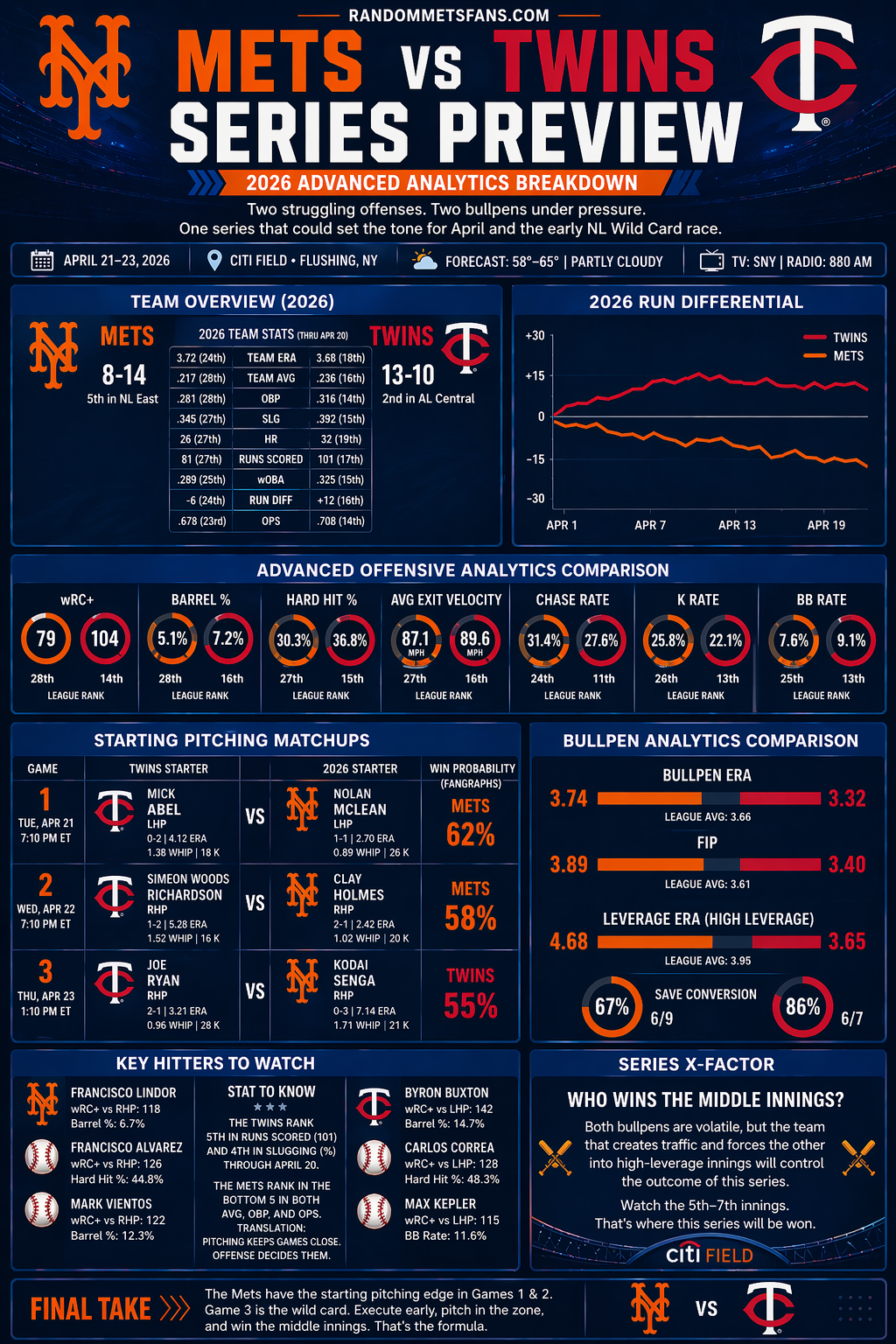
Game 1: Mick Abel vs. Nolan McLean
This is the cleanest matchup for New York to set the tone.
McLean enters with a 2.28 ERA, 0.76 WHIP, and 28 strikeouts in 23.2 innings, while Abel carries a 3.98 ERA and 1.57 WHIP into Citi Field. MLB’s preview notes McLean has allowed two earned runs or fewer in all but one of his 12 MLB starts, which is exactly the kind of stability the Mets need right now. ESPN’s matchup predictor gives the Mets a 65.8% edge in this opener.
That means there is no mystery here. McLean’s job is to keep this game in a low-scoring script. The lineup’s job is to act like a major league lineup for once.
Game 2: Simeon Woods Richardson vs. Clay Holmes
Game 2 leans New York on paper too.
Holmes comes in with a 1.96 ERA over 23.0 innings, while Woods Richardson has a 6.10 ERA and has already given up 26 hits and 4 home runs in 20.2 innings. ESPN still gives the Mets the edge here at 59.4%, even with how ugly the offense has looked. That tells you the model still sees the pitching matchup as favorable enough to overcome the bats, which is both encouraging and kind of insulting.
Game 3: Joe Ryan vs. Kodai Senga
This one is the problem child.
Ryan has been sharp, bringing a 3.29 ERA, 0.88 WHIP, and 28 strikeouts in 27.1 innings. Senga, meanwhile, has had a brutal opening stretch at 0-3 with an 8.83 ERA and 1.90 WHIP. If the Mets do not take care of business early in the series, Game 3 starts looking like the one where the pressure gets loud, weird, and very Citi Field.
The Mets bats that matter most
Francisco Alvarez is still the clearest in-house power threat. ESPN lists him as the Mets’ home run leader with 4, and when he squares something up, it actually sounds different.
Francisco Lindor has to be better. Full stop. You do not need a doctorate in predictive modeling to know the Mets’ offense looks smaller when Lindor is not controlling counts and driving the ball.
Bo Bichette, Luis Robert Jr., MJ Melendez, and whatever version of Mark Vientos shows up this week all matter too, but Lindor and Alvarez are still the emotional and structural center of this thing. If those two are alive, the series changes texture fast.
What Minnesota does better right now
The Twins are not dazzling. They are just cleaner.
They have the better team on-base profile. They have scored more. They have hit more home runs. Josh Bell is leading them in average, RBI, and is tied atop their home run board, which is not exactly Murderers’ Row stuff, but it is enough when the other team is busy setting fire to every run-scoring opportunity.
The series prediction
This should be Mets in 2 of 3.
That is the rational read.
McLean gives them the best starter in Game 1. Holmes gives them a strong edge in Game 2. Game 3 is the danger zone. If the Mets are going to start crawling out of this mess, this is the series where it has to begin. Not because the Twins are weak, but because the matchups actually give New York a runway.
The numbers say this is winnable.
Now the offense has to stop acting like that is somebody else’s problem.
Mets vs. Twins Series Preview: The Metrics Say This Is Winnable, the Offense Says Otherwise
The Mets limp home at 7-15 for a three-game set against the 11-11 Twins. The pitching matchups give New York a real shot, but the offense has spent two weeks looking like it forgot where first base is.

Quick Hitters
- Mets enter the series at 7-15. Twins come in at 11-11.
- Game 1: Mick Abel vs. Nolan McLean.
- Game 2: Simeon Woods Richardson vs. Clay Holmes.
- Game 3: Joe Ryan vs. Kodai Senga.
- Minnesota owns the better team run production, OBP, slugging, and home run total.
- The Mets still have the better early edge in Games 1 and 2 on paper.
Series Snapshot
| Team | Record | Runs | AVG | OBP | SLG | HR | ERA |
|---|---|---|---|---|---|---|---|
| Twins | 11-11 | 112 | .230 | .332 | .381 | 26 | 4.06 |
| Mets | 7-15 | 72 | .226 | .288 | .336 | 16 | 4.06 |
Pitching Matchups
Mick Abel vs. Nolan McLean
Abel: 1-2, 3.98 ERA, 1.57 WHIP, 23 K in 20.1 IP
McLean: 1-1, 2.28 ERA, 0.76 WHIP, 28 K in 23.2 IP
This is the Mets’ cleanest edge. McLean has been the steadiest arm in the series opener slot.
Simeon Woods Richardson vs. Clay Holmes
Woods Richardson: 0-3, 6.10 ERA, 1.60 WHIP, 11 K in 20.2 IP
Holmes: 2-2, 1.96 ERA, 1.09 WHIP, 16 K in 23.0 IP
On paper, this should tilt hard toward New York. Which is exactly why the offense better not disappear again.
Joe Ryan vs. Kodai Senga
Ryan: 2-2, 3.29 ERA, 0.88 WHIP, 28 K in 27.1 IP
Senga: 0-3, 8.83 ERA, 1.90 WHIP, 22 K in 17.1 IP
This is the danger game. If the Mets do not win one of the first two, Thursday gets ugly fast.
Key Analytics to Know
The Twins have outscored the Mets by 40 runs already.
Minnesota is simply putting more traffic on base.
The Twins have had more damage in fewer perfect conditions.
ESPN’s matchup predictor leans Mets in the opener.
Series X-Factors
Francisco Alvarez
Still the clearest power threat in the Mets lineup. If New York gets a swing that changes a game, he is usually in the middle of it.
Francisco Lindor
The offense takes on his personality. If he is controlling counts and driving the ball, the whole lineup looks less dead.
Middle Innings
That is where the series probably gets decided. Whoever creates leverage in innings 5 through 7 should own this thing.
RMF Prediction
Mets in 2 of 3. The numbers give New York a real edge in the first two games. If they waste those, then they are begging for trouble by the time Joe Ryan and Kodai Senga take the mound in the finale.
Why This Matters for Mets Fans
The Mets do not need a miracle this series. They need competent offense, clean middle innings, and at least two games where the starting pitching edge actually matters.