There are pitching prospects you hype because the radar gun looks sexy on a spreadsheet. Then there are pitching prospects you hype because the profile is actually starting to tighten up in the places that matter. Jonathan Santucci is the second kind. He opened 2026 back at Double-A Binghamton, where the Mets and the Rumble Ponies are treating him like a real part of the next wave, not some lottery ticket buried in the back of a media guide. MLB Pipeline had him as the Mets’ No. 9 prospect on Binghamton’s Opening Day roster, while FanGraphs ranked him No. 8 in the system.
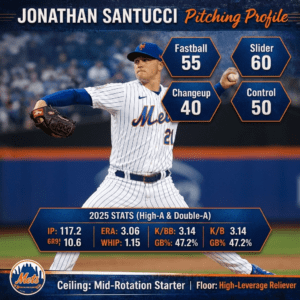
That matters, because Santucci is not just another lefty with a nice story and a clean cap. He is a 23-year-old, 6-foot-2 southpaw whose profile already has the bones teams look for in a real starter: a fastball that plays, a slider that misses bats, enough athleticism to make delivery changes, and now, finally, signs that the strike-throwing is moving in the right direction. MLB’s scouting report pegs him with a 55 fastball, 60 slider, 40 changeup, 50 control and 45 overall grade. That is not ace language. That is, however, very real big league language.
The raw stuff is why people noticed him at Duke in the first place. Santucci’s four-seamer sits 92 to 95 and has touched 97, coming from a high release angle with carry that helps it play at the top of the zone. His slider, generally 86 to 88, is the money pitch, a two-plane breaker that tunnels off the heater and gives hitters the kind of evening that ends with them walking back to the dugout pretending they knew what happened. MLB Pipeline also noted that the curveball and changeup were used far less often in the amateur look, which gets right to the central question of his future.
That question is simple. Can he hold a starter’s shape against real lineups three times through, or is this eventually a two-pitch weapon who wrecks people in shorter bursts? FanGraphs is encouraged enough to keep him in the starter bucket, and for good reason. The Mets adjusted his setup and delivery after the draft, shifting him on the rubber toward first base, upping the tempo, cleaning up the finish, and shortening the arm swing. The result was not cosmetic. FanGraphs noted that his walk rate dropped from 14 percent at Duke to 8.5 percent across his first two pro stops. That is a real development marker, not brochure fluff.
The statistical arc backs it up. In his final college season at Duke, Santucci struck out 90 in 58 innings, but the walk rate was still loud enough to scare evaluators and a rib injury cost him late-season time. In 2025, his first full pro season, he threw 117 2/3 innings across High-A and Double-A with a 3.06 ERA, 10.56 strikeouts per nine, 3.14 walks per nine, 0.69 home runs per nine, a 47.2 percent ground-ball rate, a 3.12 FIP and a 2.98 xFIP. Then the really fun part showed up in Binghamton: 10 starts, 50 innings, a 2.52 ERA, 11.34 K/9, 3.24 BB/9, a 51.3 percent ground-ball rate, a 2.43 FIP, .189 batting average against, 1.02 WHIP, and 63 strikeouts. That is not fake good. That is “this kid is forcing a harder conversation” good.
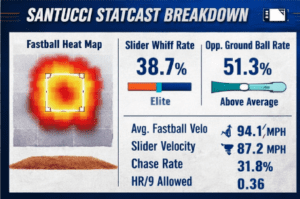
There is another reason I like the profile. He is not succeeding with smoke and mirrors. The Double-A line says the bat-missing held, and the shape of the contact improved. In High-A, he ran a 44.6 percent ground-ball rate and 0.93 HR/9. In Double-A, that jumped to a 51.3 percent ground-ball rate and dropped to 0.36 HR/9. That is exactly the sort of trend you want from a starter trying to prove he can survive better hitters, because the whole point is not just getting chase. It is avoiding the kind of damage that turns a nice fifth inning into a two-batter funeral.
The changeup is still the hinge. Everybody sees it. MLB’s spring prospect report said Santucci continues to hone the changeup to round out an arsenal built mostly on the fastball and slider. FanGraphs said much the same thing more bluntly: the changeup is underbaked, and its development is important if he is going to turn over big league lineups instead of becoming a two-pitch bullpen problem. That does not mean the starter dream is dead. It means the next step is obvious. He does not need six pitches and a TED Talk. He needs one usable third pitch that keeps right-handed hitters from camping on the main event.
So what do the projection models say? They are doing what projection systems always do to young pitchers without big league track records. They are cautious to the point of being annoying. FanGraphs’ 2026 ZiPS projection gives him 24 games, 22 starts, 105.3 innings, 7.78 K/9, 3.33 BB/9, a 4.70 ERA, 4.46 FIP, and 0.9 WAR. Steamer and OOPSY are even more conservative on workload. That is not a takedown. That is math basically saying, “Cool story, kid. Show me the third pitch and prove the command gains are real for six months.”
My read is more aggressive than the computer, but not stupid-aggressive. Santucci’s most likely outcome still looks like a mid-rotation starter if the changeup gets to average, with enough strikeout juice to pitch as a No. 4 who flashes No. 3 stretches. The floor is also pretty clean. If the changeup never really arrives, the fastball-slider combo still gives him a very real late-inning or multi-inning relief path. In other words, this is not a profile that disappears. The role may shift, but the arm still plays. That inference tracks with his official scouting mix, his pro strike-throwing improvement, and the Mets’ continued usage of him as a starter.

As for comparisons, here is the honest version. The stylistic comp that keeps jumping out is an Andrew Heaney-type lane, a lefty built around a riding fastball and a bat-missing breaking ball, with the final value tied to whether the third pitch and command hold enough for a rotation role. The more optimistic version is a MacKenzie Gore-lite shape, not in pure ceiling, calm down, but in the sense that the profile works because the left-handed fastball/slider combination creates real discomfort and real swing-and-miss when the strike throwing is under control. The fallback version is simpler: if the starter package stalls, the Mets could still wind up with a nasty, high-leverage lefty. Those are style comps, not one-to-one player predictions, but the lane is clear.
There is already evidence the Mets think he is closer to mattering than the casual fan realizes. He finished 2025 in Double-A, returned there to open 2026, and struck out five in 3 2/3 innings in Spring Breakout. MLB’s spring prospect coverage grouped him among the next tier of Mets starters who could be “lying in wait” beneath the big league level this summer. That does not guarantee Queens in 2026. It does tell you the conversation has started.
My bottom line is this. Jonathan Santucci is not some vague “keep an eye on him” prospect. He is one of the more important arms in the Mets’ system because his development path is easy to understand and easy to track. Fastball shape. Slider quality. Strike percentage. Changeup usage. That is the checklist. The first two are already good. The third got better. The fourth is the swing factor. If that pitch becomes even playable, the Mets may have another legitimate left-handed rotation piece moving toward Queens. If it does not, they still may have a weapon. Either way, this is a pitcher worth paying attention to now, not six months after everybody else starts pretending they saw it coming.
Resources: MLB Pipeline/MiLB prospect profile and Spring Breakout coverage; FanGraphs prospect ranking and statistical dashboard; Binghamton Rumble Ponies Opening Day roster announcement.