
Why it matters: Mets fans are going to treat Luis Robert Jr. like a volatile stock – two great games and he’s an MVP, two strikeouts and he’s a bust. Rather than riding that emotional rollercoaster, it’s important to understand why the Mets traded for Robert in the first place. The front office’s bet wasn’t based on recent stat lines or vibes; it was rooted in elite tools, measurable skills in power, defense, and speed that are among the best in baseball. In short, David Stearns didn’t just buy Robert’s 2025 production – he bought Robert’s ceiling and his defense at a premium position.
New York acquired Robert Jr. from the White Sox this offseason, giving up two top prospects (Luisangel Acuña and Truman Pauley) in return. It’s a bold move considering Robert’s inconsistency the past two years – he slashed just .213/.293/.367 with a .660 OPS and 28 total home runs over 2024-25, production you might expect from a fourth outfielder. But just two seasons ago, in 2023, Robert was an All-Star who hit 38 homers with a .542 slugging percentage and finished 12th in AL MVP voting. That 2023 campaign (4.9 WAR, 129 wRC+ by advanced metrics) showed his ceiling as a dynamic five-tool superstar. The Mets are wagering that with the right context and health, Robert can get back to something close to that elite form. As one Mets analyst put it, this trade is “a ceiling move” the kind a forward-thinking, confident organization makes, betting on talent rediscovered rather than past performance.
So why would the Mets think Robert can be that player again, given his recent struggles? It’s simple: to understand the trade, just look at three numbers:
- 75.6 mph – Robert’s average bat speed in 2025
- +7 – Robert’s Statcast Outs Above Average (OAA) on defense in 2025
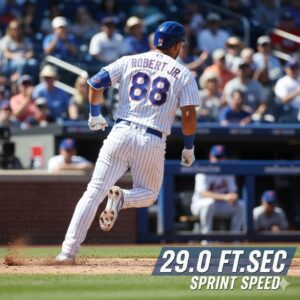
- 29.0 ft/sec – Robert’s average sprint speed in 2025
Those three numbers (all from his most recent season) tell you almost everything you need to know about why Robert Jr. was worth trading for. In each case, they represent an elite ranking among MLB players. In fact, Robert ranked in roughly the top 10% of the league last year in a key hitting metric (bat speed), a key fielding metric (OAA), and a key running metric (sprint speed). In other words, he possesses three standout tools in three critical areas of the game. Below, we break down each of these numbers – and translate what they mean in real life: “loud” contact, elite range, and violent acceleration.
INFO : Statcast percentile rankings for Luis Robert Jr.’s 2025 season. His average bat speed (75.6 mph) was in the top 10% of MLB, his Outs Above Average (+7) ranked among the top defensive outfielders, and his sprint speed (29.0 ft/s) was near the 90th percentile. These three measures encapsulate the rare power, range, and speed that made the Mets covet him.
1. Elite Bat Speed = “Loud” Contact and Raw Power

The first number, 75.6 mph, represents Robert’s average bat speed last season – one of the highest in the Majors. Statcast considers any average swing above 75 mph to be exceptionally fast. In 2025, Robert easily cleared that benchmark; in fact, he was one of only 29 qualified hitters in all of MLB to average a 75+ mph swing speed. To put that in perspective, the names in that exclusive club are mostly elite sluggers – think Aaron Judge, Kyle Schwarber, Vladimir Guerrero Jr., Julio Rodríguez, Shohei Ohtani, and so on. It’s good company to be in. A fast bat means the potential to drive the ball with authority: as the saying goes, the faster you can swing, the harder you can hit the ball – and the more damage you can do.
For Robert, bat speed has always been the foundation of his offensive upside. Even during his down year in 2025, when he hit only 14 home runs and slugged .364, his swing speed remained elite – virtually the same as it was in 2023 when he blasted 38 homers and slugged .542. In other words, the underlying power is still there (“the big home run bat is still in there,” as one analysis noted). The Mets’ task is to unlock that power again by helping Robert make more consistent contact.
Robert’s struggles at the plate haven’t been due to slow bat speed or lack of strength – they stem from plate discipline and contact issues. He is an aggressive free-swinger who rarely met a pitch he didn’t like. Last season, Robert chased pitches out of the zone more often than about 80% of hitters, and he whiffed (missed) more than 91% of hitters. In Statcast terms, his chase rate and whiff rate both ranked near the bottom of the league. This approach has led to elevated strikeout rates and streaky production. However, this is not a new problem, his swing-and-miss tendencies have been there his whole career, even in his successful seasons. Importantly, when Robert does connect, his elite bat speed does the rest: the ball jumps off his bat with tremendous exit velocity. That’s why the Mets aren’t as deterred by his poor batting average or strikeout totals; they believe if they can get him to connect on enough of his swings, his raw power will shine through again. In 2023, despite a below-average walk rate and high Ks, Robert made enough contact to unleash his talent and hit 30+ homers. The bet is that he can do it again in 2026 with some adjustments or simply better luck/health.
It’s worth noting that Robert is still just 28 years old, entering what should be his prime years. His bat speed is in the 90th percentile of MLB, which is the kind of raw tool you typically see in MVP-caliber hitters. Very few players possess the combination of bat speed and sheer strength that Robert has. The upside scenario here is a player who could flirt with 40 home runs in a season if everything clicks – a fearsome middle-of-the-order force. As one evaluator quipped, if you built an outfielder in a lab, he’d have a profile a lot like Robert’s, elite power, speed, and defense all in one. The bat speed number is the clearest indicator that Robert’s power potential remains off the charts. The loud contact, those booming line drives and deep flies, will come if he can just refine his approach to make more contact. The Mets traded for that loud-contact potential, not the middling .715 OPS he put up over the last two seasons.
2. Statcast Outs Above Average: Elite Range in Center Field
The second number, +7, is Robert’s Outs Above Average (OAA) from 2025 – a Statcast metric that measures how many outs a fielder saved relative to an average defender. A +7 OAA means Robert was 7 plays better than the average outfielder last season, which is excellent. In fact, +7 put him among the top defensive outfielders in baseball (a top-20 outfielder by OAA). Statcast rated Robert in the 93rd percentile for outfield defense last year, reflecting his outstanding range and playmaking ability in center field.

For the Mets, this defensive prowess was a huge part of Robert’s appeal. He plays a premium position, center field, and plays it very well, often in spectacular fashion. Robert has already proven his defensive chops at the highest level; he won a Gold Glove Award as a rookie in 2020 for his work in center. Since his debut, he’s been consistently above-average out there. In fact, since 2020, Robert has +33 Outs Above Average cumulatively, which ranks 15th among all MLB outfielders in that span. Even when injuries and slumps affected other parts of his game, his glove has remained a strong, steady asset.
What does +7 OAA look like in real life? It means Robert covers serious ground in the outfield, he gets to balls that many center fielders simply can’t reach. Statcast data shows he is particularly adept at tracking down balls in the gaps to his left and right. Those are the toughest plays for a center fielder, often resulting in doubles or triples if not caught. In 2025, Robert made seven catches on balls that had a ≤50% catch probability (essentially “unlikely” or challenging plays). Only 15 outfielders in MLB made that many tough catches, underscoring his ability to make highlight-reel plays to save runs. Mets president David Stearns explicitly targeted better up-the-middle defense this offseason, and Robert is now the centerpiece of that plan. When you find a very good defensive center fielder who also has 30-homer upside, you take it.
Robert’s range and instincts will be especially valuable given the Mets’ new roster construction. With superstar Juan Soto (a below-average defender) slated for right field and possibly an inexperienced rookie in left, New York needs a ballhawk in center who can “anchor their whole outfield”. Robert is expected to be exactly that, a captain of the outfield who can cover for his teammates’ limitations. His presence in center should markedly improve the Mets’ overall run prevention. In recent years, the Mets struggled to find a reliable everyday center fielder, cycling through options like Brandon Nimmo (now departed), Harrison Bader, Jose Siri, and others. By acquiring Robert, they’ve solved their center field puzzle with a player who brings Gold Glove-caliber defense plus middle-of-the-order pop. As one local reporter noted, Robert arrives as “a true two-way center fielder, one of the few who can change games with both range and raw power.”
In terms of tools, Robert’s defensive tool (his glove + range) is as elite as his bat speed. We often say a great center fielder “goes and gets it,” Robert does. He can turn would-be doubles into outs, dramatically affecting games. For a Mets club emphasizing run prevention and pitching, that defensive impact is incredibly valuable. Even if Robert’s bat is only league-average at times, his glove alone gives him a high floor as a player. That’s part of the rationale for the trade: at worst, Robert stabilizes center field defensively and buys time for the next wave of prospects; at best, his bat comes around and he’s a superstar.
3. 29.0 ft/sec Sprint Speed: “Violent” Acceleration and Basepath Threat
The third number, 29.0 feet per second, was Robert’s average sprint speed in 2025. This measures how fast a player runs in peak moments (like stealing a base or running down a fly ball), and it’s another Statcast gem. The league average sprint speed is about 27 ft/sec, and 30+ ft/sec is considered “elite” burner speed. Robert’s 29.0 ft/sec is very high, roughly 90th percentile in MLB. He’s a lot closer to that elite 30+ ft/sec tier than to the middle of the pack. In practical terms, Robert can absolutely fly on the basepaths and in the field. Statcast even tracks “Bolts,” which are runs where a player hits 30 ft/sec or more. Robert recorded 24 bolts last season, one of only 35 players in baseball to log 20+ such elite-speed runs. In other words, his peak acceleration is regularly in that explosive, top-tier range.
Speed never takes a slump, as the old adage goes, and Robert’s speed is a weapon in multiple ways. First, it amplifies his defensive range (discussed above) his violent acceleration and top-end speed allow him to close gaps in the outfield that other players simply can’t. Second, it makes him a terror on the bases. In 2025, Robert stole a career-high 33 bases, taking advantage of the new MLB rules and his regained health. In fact, 2025 was the first time since his rookie year (2020) that he averaged 29 ft/sec for a full season, a sign that he was as fast as ever and feeling free to run. The result was a 30-30 type of threat (he finished with 14 HR and 33 SB in an injury-shortened year). With the Mets, there’s no reason he shouldn’t threaten 30+ steals again in 2026 if he stays healthy. He’s now among the fastest players on the team (and the league), which adds a new dimension to the Mets’ offense: they haven’t had a true power-speed combo like this in some time.
Beyond the stolen bases, Robert’s speed puts pressure on defenses. He can score from first on a deep gap double, go first-to-third on singles, and leg out extra-base hits for himself. In a lineup with more firepower around him, he might not need to be the primary slugger – he can contribute by getting on base and wreaking havoc as well. The Mets envision **Robert as a power-speed double threat who, if his hitting clicks again, becomes a rare triple threat (power, speed and defense) – the kind of player every roster covets. Such players (think peak Ronald Acuña Jr. or Julio Rodríguez) are incredibly valuable. “If all three phases come together with the Mets, they’ll have a power-speed-defense triple threat. Those players are very valuable… The chance that Robert will be one again explains why the Mets pulled off a trade for him,” as MLB.com summed up.
How Citi Field Could Unlock Robert’s Full Potential
An often-overlooked aspect of this trade is environment both the ballpark and the team context – and how it might help unlock Robert’s tools. Citi Field, the Mets’ home park, could actually be the perfect stage for a player like Luis Robert Jr.
Defensively, Citi Field is spacious, especially in the power alleys and center field. Its outfield area has historically been larger than the league average (at one point about 4–5% bigger than a typical park). Even after some dimension changes in recent years, Citi Field still has some of the deepest gaps in baseball (e.g. up to 408 feet to center). What that means is there’s plenty of real estate for Robert to patrol, and having an elite-range center fielder is a huge advantage. Balls that might drop in for extra bases elsewhere can be run down by Robert in Queens. He’s particularly good at covering ground into those gaps, which is exactly the skill set you need in a big outfield. Mets fans have seen the value of great center-field defense before (e.g. Carlos Beltrán in the past, or Juan Lagares flagging down flies in the cavernous early Citi Field days). Robert has a chance to provide that kind of highlight-reel defense on a nightly basis, turning Citi Field’s spaciousness into an asset for the home team. In a park where fewer balls leave the yard, outs in the outfield become even more important – and Robert will grab many that lesser defenders simply wouldn’t reach.
Offensively, Citi Field’s dimensions could play to Robert’s strengths in a couple ways. It’s true that Citi Field is not a bandbox for home runs, it suppresses homers a bit, especially for certain hitters. But Robert’s raw power is huge; he can clear the fence anywhere when he truly squares a ball up. Meanwhile, the large gaps can actually boost a player like Robert. His combination of power and speed means he can shoot balls into the alleys and turn them into triples or inside-the-park chances. (Historically, speedy right-handed hitters have enjoyed legging out triples at Citi Field’s roomy left-center gap.) Robert’s 33 doubles in 2023 show he can drive the ball to the wall, and at Citi Field those might occasionally stay in play allowing him to stretch a double into a triple with his elite wheels. In essence, the park rewards his athleticism. Additionally, the Mets’ lineup around him is stronger now (with stars like Juan Soto, Francisco Lindor, Pete Alonso, and newly acquired Bo Bichette in the mix), so Robert should “benefit from not being the focal point of the lineup” he can be comfortable, pick his spots, and just let his tools play. The team won’t be asking him to carry the offense alone, which could take pressure off him compared to his role in Chicago. Sometimes a change of scenery and batting order protection can do wonders; as Stearns noted, “sometimes, just a change of venue helps a little bit, and I think it might here.”
Finally, the club’s philosophy and coaching might help unlock Robert. Under GM David Stearns, the Mets have put a premium on age, athleticism, and upside, and Robert checks all those boxes. The organization believes in using analytics and sports science to get the most out of players’ natural talents. For someone with Robert’s measurable gifts, that’s enticing. “All of the underlying skills and tools are there – the same skills and tools that were there when he had his monster season (in 2023),” Stearns emphasized. The Mets are essentially saying: if we can keep this guy healthy and in the right headspace, those tools will do the rest. Health is indeed a big factor, Robert has dealt with injuries (like the hamstring strains that cut short his 2025). But the team is optimistic about managing his workload and keeping him on the field. If they succeed, Robert’s natural ability could flourish in a more supportive environment.
Betting on Ceiling at a Premium Position

At the end of the day, the Mets’ acquisition of Luis Robert Jr. is all about upside, specifically, the upside of a player who can impact the game with his bat, his glove, and his legs. Few players possess that triad of elite tools, especially in center field. “If you’re looking for a Gold Glove defender who can hit 40 homers at the hardest outfield spot and swipe 30 bags, he’s one of maybe three players in the entire majors who fits the bill,” one analysis noted of Robert. That is the kind of ceiling we’re talking about, essentially an MVP-caliber profile. The Mets paid a hefty price in prospects and are willing to pay Robert’s hefty salary, not because they expect him to instantly replicate his 2023 All-Star numbers, but because they believe his ceiling is worth chasing and his defense provides a solid floor in the meantime. As a Mets beat writer observed, “The floor is useful, his ceiling is transformative”. In the worst case, even if Robert’s bat only rebounds partway, the Mets will still have a high-quality defensive center fielder (a position where they had a void) who contributes on the bases and hits the occasional thunderous homer. In the best case, they have a superstar. That range of outcomes and the tantalizing possibility of the latter, made this a risk worth taking.
It’s also a statement move for New York’s front office. It signals that under Steve Cohen’s ownership and Stearns’ leadership, the Mets are willing to bet on talent and tools. “This is the type of gamble that fits the Mets’ moment… with ownership willing to absorb risk, the Mets could afford to dream a little louder than most,” one report noted. By bringing in Robert, the Mets addressed a roster need (center field defense) while also swinging for the fences on upside. They’re effectively saying they’d rather have a player with star potential (even if he’s a bit of a reclamation project) than a safer, lower-ceiling option. It’s a calculated gamble: Stearns and company bought Luis Robert Jr.’s ceiling and his elite tools, not just his recent stats. And if Robert does put it all together in Queens – if the loud contact, elite range, and explosive speed all come to fruition simultaneously – Citi Field might just be witnessing the rise of the next great 5-tool player in baseball. That is the home run scenario the Mets are chasing, and those three numbers are the reason they’re optimistic about getting it.
Sources:
- MLB.com – “What are the Mets getting in Robert? Three numbers explain it” (David Adler, Feb 6, 2026)
- MLB.com – Mets acquire Luis Robert Jr. from White Sox (Scott Merkin & Anthony DiComo, Jan 21, 2026)
- FanGraphs – “Mets Snag Luis Robert Jr. From White Sox” (Ben Clemens, Jan 21, 2026)
- ONNJ (New Jersey) – “Mets shore up outfield with trade for Luis Robert Jr.” (Gabrielle Raucci, Jan 21, 2026)
- Statcast data via BaseballSavant – Robert Jr.’s 2025 Bat Speed, Outs Above Average, and Sprint Speed percentiles.
Join the conversation at RandomMetsFans.com
Subscribe to the newsletter
Let’s build the smartest Mets community on the internet