Mets fans do not evaluate bullpens, Mets fans relive bullpens. Every blown save comes with a flashback, a smell, a specific chair in the living room where something went wrong in the eighth inning, again. Skepticism is earned. Trauma is the receipt.
Still, the early shape of this 2026 bullpen looks smarter than last year’s version in the ways that actually matter in October. Fewer “one guy has to be perfect” nights. More “pick your poison” leverage lanes. More redundancy. More boring seventh innings, which is the highest compliment a bullpen can get.
This is not a “pray for seven innings” plan. This is a “shorten the game” plan.
My clean thesis
The 2026 bullpen is built with role clarity and overlap, not vibes. That overlap is the point. Overlap turns bullpen volatility into bullpen flexibility, which is how contenders survive the six month grind, then win four games in a week when the schedule turns into a knife fight.
Last year’s pen asked for too many perfect sequences. One bad matchup, one tired arm, one command blip, then everything cascaded.
This group projects as a deeper set of “good outcomes” nights.
The projected leverage core looks like a real “end games” unit
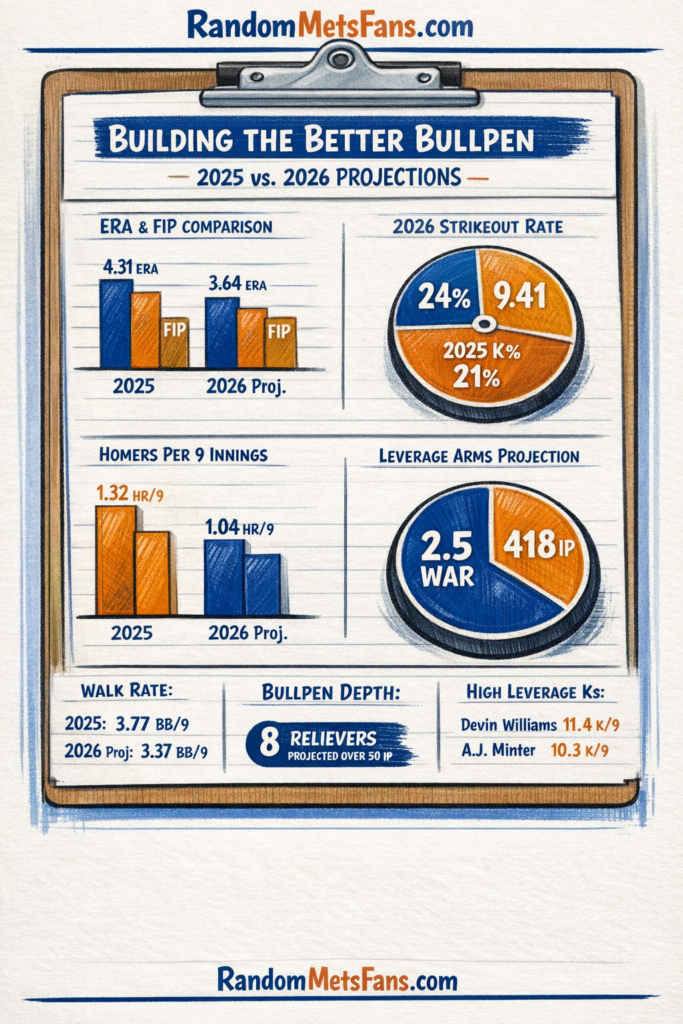
Using Steamer’s 2026 projections as a clean baseline for the likely leverage group, the “core seven” below projects to:
- 418 IP
- 3.64 ERA
- 3.80 FIP
- 9.41 K/9
- 3.37 BB/9
- 1.04 HR/9
- 2.5 WAR
That is not one closer carrying the entire brand. That is a bullpen that can absorb a slump, an injury, a fatigue pocket, then keep moving.
The roles, not the names

9th inning: Devin Williams
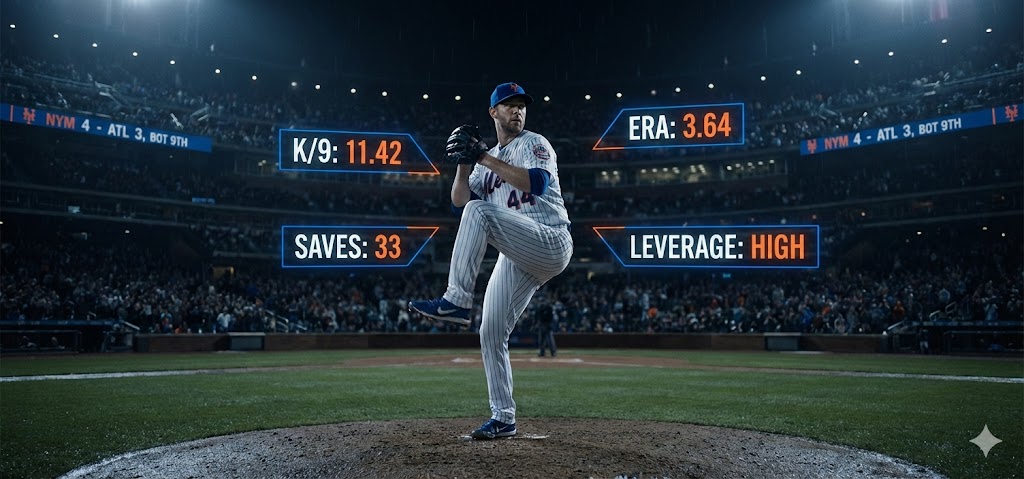
- 64 IP, 3.12 ERA / 3.24 FIP, 11.42 K/9, 0.83 HR/9, 33 saves projected
The most important part here is the shape of the profile: strikeouts that travel, homers that do not. A closer with this kind of miss rate changes how managers deploy the seventh and eighth. Fewer “save the guy for the save” decisions. More “use the best arm when the game is on fire” decisions.
7th–8th leverage: A.J. Minter, Luke Weaver
- Minter: 60 IP, 3.31 ERA / 3.50 FIP, 10.26 K/9
- Weaver: 67 IP, 3.70 ERA / 3.86 FIP, 2.84 BB/9
Minter gives the pen a legitimate second swing-and-miss look. Weaver gives it a steadier command profile with innings volume. Volume matters. October bullpens look dominant on TV, then someone checks the innings log and realizes the “setup guy” threw 74 games.
Matchup lefty and bridge depth: Brooks Raley, Luis García
- Raley: 62 IP, 3.84 ERA / 4.07 FIP
- García: 59 IP, 3.73 ERA / 3.85 FIP
This is where “structured better” shows up. One lefty. One righty. Both capable of working in the middle innings, not just the cleanest pocket. These are the arms that stop the bullpen from turning into a four-man act.
The undercard that makes the card: Brazobán, Alzolay
- Brazobán: 56 IP, 3.92 ERA / 4.14 FIP
- Alzolay: 50 IP, 3.92 ERA / 4.05 FIP
These are not the names fans argue about in December, then these are the names fans love in June. A bullpen becomes reliable when the “sixth guy” does not feel like a stunt.
Why this projects better than last year, in the parts fans usually ignore

1) More leverage innings are covered by arms with closer-tier strikeout ability
A bullpen can survive a mediocre ERA if it owns the strike zone in leverage. Strikeouts erase bloops, defensive variance, and the annoying “single, stolen base, ground ball, run” sequence that ruins good teams.
This 2026 setup projects multiple arms at or near double-digit K/9 in meaningful innings. That widens the margin for error. It also makes matchups less fragile. A manager can choose based on hitter shape instead of praying the platoon math holds.
2) The structure has fewer single points of failure
Bullpens break when a team needs one specific guy for one specific inning every night. That guy becomes a calendar, not a pitcher.
This group projects as a bullpen with interchangeable pieces in the 7th and 8th, plus a defined finisher. Interchangeability is the antidote to bullpen drama. Interchangeability also keeps everyone fresher, which is the quiet difference between September bullpen fatigue and September bullpen dominance.
3) The home run profile is not screaming “one bad pitch and we are cooked”
The quickest way to turn a bullpen into a hostage situation is a leverage group that gives up loud contact when tired.
The projected leverage core sits around 1.04 HR/9 as a group. That is not elite across the board, still it is steady. Steady plays. Steady closes games.
4) “Roster elasticity” finally matches the win-now posture
Bullpen math is not just “best seven arms.” Bullpen math is options, shuttle depth, and the ability to avoid burning leverage arms on nights the starter cannot find the zone.
This roster shape hints at a real plan: leverage specialists up top, bridge volume in the middle, callable depth behind it. That matters across 162. That matters even more when the rotation hits a rough patch, which every rotation does.
The skepticism is still rational
A bullpen can look perfect in January and still implode in July. Relief performance swings fast. Small samples lie for a living. One velocity dip changes everything. One command month turns a setup man into a mop-up arm.
Trust is earned in-season.
Still, the design of this bullpen is better. Better design does not guarantee dominance, it does raise the probability of competence, then keeps competence from collapsing into chaos.
That is the whole point.
The punchline Mets fans will hate, then love
This bullpen is trying to make the seventh inning boring again.
Boring is good. Boring is playoff baseball. Boring is how a very good roster turns into a real postseason problem.
Resources
FanGraphs, 2026 Steamer Projections, New York Mets team filter (pitching table including projected lines for Devin Williams, Luke Weaver, A.J. Minter, Brooks Raley, Luis García, Huascar Brazobán, Adbert Alzolay).
FanGraphs, projections menu showing additional 2026 systems available on the same Mets team filter page (ATC, THE BAT, THE BAT X, OOPSY, ZiPS, ZiPS DC) for cross-system comparison.
FanGraphs Library, “How To Use FanGraphs: Depth Charts” (methodology note on Depth Charts being a mix of ZiPS and Steamer with staff playing-time allocation).
Join the conversation at RandomMetsFans.com
Subscribe to the newsletter
Let’s build the smartest Mets community on the internet