

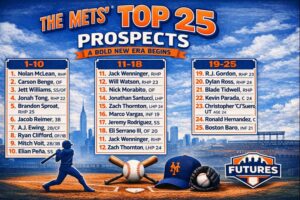
Mets fans, brace yourselves: the farm system you thought you knew has been turned on its head. After a transformative 2025 season, the Mets have recalibrated their Top 25 prospects list, and it’s loaded with new names, breakout stars, and a few big surprises. This isn’t a timid update or generic puff piece. It’s an unapologetic re-ranking that shows how far the Mets’ player development has come (and who’s been left in the dust). I’m here for it, and I have opinions. Let’s dive into the new Top 10 in detail, then hit quick notes on prospects 11–25. No sugarcoating, no clichés, just a confident, first-hand take on the Mets’ future.
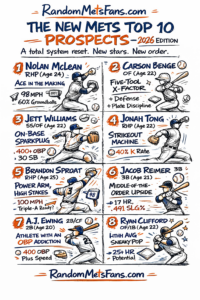
Top 10 Mets Prospects for 2026 (Detailed Breakdown)
1. Nolan McLean, RHP (Age 24), Ace in the Making.
If you had told me a year ago that an 8th-round pick from 2023 would become the Mets’ No. 1 prospect and a potential rotation ace, I’d have smirked. Nolan McLean just wiped that smirk off everyone’s face. The 6’2” right-hander blasted through Double-A and Triple-A with a 2.45 ERA, then made a late-2025 MLB debut that was nothing short of dominant. In eight big-league starts, McLean posted a 2.06 ERA with 57 strikeouts in 48 innings, immediately the Mets’ best pitcher down the stretch. His mix? How about six different pitches, including a vicious sweeper and hammer curve that each generated whiff rates around 50%. Oh, and he pairs a 30% strikeout rate with a 60% groundball rate, no MLB pitcher has ever done that over a full season in the pitch-tracking era. In plain English: McLean’s stuff is filthy and he gets weak contact. That’s ace material. The Mets know it too, he’s essentially untouchable in trade talks, and President David Stearns has all but penciled him into the 2026 rotation. McLean’s meteoric rise earned him MLB Pipeline’s “Breakout Prospect of the Year” and a Top-15 spot in Baseball America’s Top 100. The only things between McLean and frontline status are health and consistency. If he clears those hurdles, we’re looking at the franchise’s next great homegrown starter. Point of view: I’m all-in on McLean. He’s got the mentality of a workhorse (twice going 7+ innings in MLB starts) and the arsenal of a strikeout artist. Mets fans should be salivating, this is the kind of arm you build a rotation around.
2. Carson Benge, OF (Age 22), Five-Tool X-Factor.
Carson Benge is officially the Mets’ top position-player prospect, and he’s here faster than anyone expected. A year ago, Benge was a freshly drafted two-way player out of Oklahoma State; now he’s rocketed to Triple-A and forced his way into the club’s plans. How fast? He tore through High-A and Double-A in 2025, hitting a combined .281 with 15 homers and 22 steals in 116 games. His plate discipline is beyond his years, Benge walked as much as he struck out, leading to a stellar .389 OBP. By season’s end, he’d jumped to No. 21 overall on MLB’s Top 100 prospects list. The Mets were so confident in Benge that they traded incumbent center fielder Brandon Nimmo this winter to clear a path for him. Talk about an endorsement. Team president Stearns didn’t mince words: “We have to find space for [our top prospects] to play… Carson is among them.” Benge might be the Opening Day left fielder if he has a big spring, and he’s athletic enough to handle center in the long run. At 6’1”, he’s added muscle and streamlined his swing mechanics, and the team believes he could be a legitimate five-tool contributor in Queens. One MLB development exec called Benge the potential “X-factor” of the Mets’ season. My take: Benge’s rapid rise and well-rounded game give me shades of a young Brandon Nimmo with more pop. He’ll have to adjust to MLB pitching (his brief AAA stint humbled him with a .583 OPS slump), but the Mets actually wanted him to taste failure to fuel his offseason hunger. I love that mindset. Benge knows what he needs to do, now it’s time to do it. If he clicks, Mets fans are going to forget about that Nimmo guy real quick.
3. Jett Williams, SS/OF (Age 22), On-Base Sparkplug, Now Positionless.
Jett Williams has been a hyped name since he was drafted in 2022, and he’s lived up to it at every level. He’s also the smallest guy on this list (5’7”) with one of the biggest impacts. How? By getting on base seemingly at will. Williams posted a ludicrous .425 OBP in 2023, drawing 104 walks and swiping 45 bags as a teenaged leadoff hitter. In 2025, he continued to be an OBP machine through High-A and Double-A, and he’s now considered a Top-30 overall prospect in MLB. The Mets have fast-tracked Jett despite his size because his plate discipline, contact skills, and speed are that special. He’s a plus defender at shortstop and center field, yes, the Mets started playing him in center, anticipating a crowded infield. That became even more important after the Mets traded for All-Star 2B Marcus Semien this offseason. With Francisco Lindor entrenched at short and Semien at second, Williams might permanently shift to center or a super-utility role, and you know what? I think he’ll thrive wherever you put him. This kid has a chip on his shoulder, a la Mookie Betts or Jose Altuve, proving size doesn’t matter when you can flat-out play. He slashes line drives gap to gap, can drop a bunt, and will steal 30+ bases in the bigs without breaking a sweat. One scout told me Jett “controls the zone like a 10-year veteran”, he almost never chases junk. With the bat control and blazing speed, he’s a weapon at the top of any lineup. My only question: where does he play every day for the Mets? If I’m the Mets, I get creative, move him around like a young Ben Zobrist or shift him to center field full-time (where his range and fearless approach will play). Either way, Jett is a big part of the future. He’s the type of homegrown sparkplug championship teams love. Mets fans have heard the comp before, but I’ll say it: there’s a Lenny Dykstra vibe here (minus the off-field antics). High praise? Sure. But Williams’ combination of on-base prowess and swagger earns it.
4. Jonah Tong, RHP (Age 22), Strikeout Savant.
Jonah Tong’s 2025 season wasn’t just good, it was historic. The 22-year-old righty (a 7th-round pick out of Canada in 2022) led all of Minor League Baseball with a 1.43 ERA and 179 strikeouts in 113⅔ innings. Go ahead, read that again. No full-season minor league pitcher has topped both the ERA and strikeout leaderboards in the same year in over 60 years. Tong dominated Double-A and Triple-A hitters with a fastball that touches 98 mph and a wipeout slider, racking up an absurd 40.5% K-rate. Hitters managed a pitiful .148 average against him. It’s no wonder he was named MiLB’s Pitching Prospect of the Year for 2025. By season’s end, Tong had vaulted into the overall Top 50 prospects. He did get a cup of coffee in Queens in September and surprise, he looked human (a few rough outings bumped his MLB ERA north of 6). I’m not deterred by that though. Tong has the raw stuff to be a mid-rotation strikeout machine once he polishes his command and sequencing. He’s got a bit of that effectively wild streak; even in the minors his walk rate was around 10%. The Mets are working to streamline his delivery, and I expect he’ll start 2026 in Triple-A fine-tuning a third pitch (a changeup) and learning when to nibble vs. attack. Big picture: Tong’s emergence is a testament to the Mets’ much-improved pitching development. Along with McLean and others, he’s made the Mets’ pipeline of arms one of the league’s most formidable (Mets minor leaguers led all systems in strikeout rate in 2025). I’m bullish on Tong, he’s got a bulldog mentality on the mound and the kind of strikeout prowess that will miss bats even against big-league hitters. Don’t be shocked if he’s starting games for the Mets by mid-2026. The whiffs are coming to Citi Field soon.
5. Brandon Sproat, RHP (Age 25), Power Arm, High Stakes.
If any name on this list feels like “old news,” it’s Brandon Sproat, but don’t sleep on him. Sproat was actually the Mets’ No. 1 prospect entering 2025, and while he didn’t implode by any means, others simply blew past him. A second-round pick out of Florida in 2023, Sproat is a 6’3” righty who can dial upper-90s heat and snap off a hard slider. In 2025 he held his own, climbing to Triple-A and even debuting in the Mets’ bullpen late in the year. But compared to McLean and Tong’s gaudy numbers, Sproat’s stats were merely solid (he posted a mid-3s ERA and roughly a strikeout per inning). The good news: he stayed healthy and refined his control, which was his bugaboo in college. The bad news: as a 25-year-old, the expectation is that Sproat should be ready now, and indeed he might be on the Opening Day roster as a reliever or swingman. The Mets still view him as a starter long-term, but there’s a bit of a roster squeeze. With McLean, Kodai Senga, José Quintana, and possibly free-agent additions locking down rotation spots, Sproat may break in as a multi-inning bullpen weapon. I’m eager to see how his stuff plays in short bursts; his fastball touched 100 mph in relief in Syracuse. Sproat is also notable as a test case of the Mets’ development overhaul: he struggled with walks after being drafted, but under the new regime he improved his BB/9 substantially in 2025. If that progress holds, his combination of experience and velocity will get him big-league outs. I see Sproat as a potential No. 4 starter or high-leverage reliever, the question is, can he miss enough bats against MLB hitters? He’ll get every chance to prove it. This ranking (down at No. 5) might light a fire under him, and competition from younger arms can be a great motivator. Don’t count him out, sometimes the post-hype prospects surprise you once the spotlight shifts. Sproat might be that guy in 2026.
6. Jacob Reimer, 3B (Age 21), Middle-of-the-Order Upside.
Here’s a name making huge waves: Jacob Reimer. A fourth-round pick in 2022, Reimer was on nobody’s Top 100 radar a year ago. Now, after a monster 2025 season, he’s the Mets’ top-ranked hitting prospect not named Jett or Benge. Reimer put up 17 homers, 54 extra-base hits, and a .491 slugging across High-A and Double-A in 2025. His 157 wRC+ was the highest of any Mets farmhand with 100+ games, meaning he was 57% better than league average at the plate. The difference, health and bat speed. Reimer battled hamstring injuries in 2024 that sapped his power; in 2025 he was fully healthy and more than doubled his previous HR total. Scouts noticed his swing was quicker and he was driving the ball to all fields. At 6’3” and 205 lbs, Reimer has the physicality to be a run-producing corner infielder, think peak J.D. Davis or even Daniel Murphy with more pop. Defensively, he’s a solid third baseman with a strong arm, though some think he might end up at first base down the line. Either way, that bat will play. The Mets love his work ethic; player development folks have cited Reimer as a leader on those championship-winning minor league clubs (Double-A Binghamton, where he finished the year, won the Eastern League title). I’m placing a bet: Reimer will be a consensus Top-100 guy by mid-2026 and could be knocking on the Citi Field door by 2027 at the latest. The Mets haven’t developed a homegrown third baseman with legit power since David Wright, Reimer could be the next. Mets fans, keep an eye on him, because his surge is a big reason our prospect list is deep. (Oh, and in case you’re wondering, yes, he’s one of the reasons 2022 first-rounder Brett Baty was deemed expendable and traded last summer. The Mets are betting on Reimer’s bat in the long run.)
7. A.J. Ewing, 2B/CF (Age 20), Athlete with an OBP Addiction.

A.J. Ewing might be the least famous name in this Top 10, but he won’t be under the radar much longer. Ewing was a 4th-round pick in 2023 out of high school, and he absolutely exploded in 2025. He began the year as an unheralded prospect and ended it as the No. 7 prospect in the system (after climbing 21 spots from the previous year). What changed? Ewing found his identity as a hitter: he became an OBP machine and a havoc-wreaker on the bases. In High-A Brooklyn, he hit around .300 with a .400+ OBP, then got bumped to Double-A as a 20-year-old and held his own. He’s a plus-plus runner (think 30+ steals potential) and plays a stellar center field in addition to his natural second base. Essentially, Ewing is developing into a similar profile as Jett Williams, high on-base, high BABIP, plus speed, but with perhaps even better pure bat-to-ball skills. At 5’11” he’s not projected for big power (maybe 10 homers a year), but he doesn’t need huge pop to be valuable. Every scout report gushes about his baseball IQ and energy. One metric that stands out: Ewing led all Mets minor leaguers in runs scored in 2025. He was always on base setting the table. For Mets fans who follow the minors, A.J. Ewing’s rise is particularly exciting because it came out of nowhere. He wasn’t a top draft bonus baby or a hyped teen, he just performed his way into the conversation. Those are the kind of surprises that turn a farm system from average to elite. The front office now views Ewing as a key piece; he’s drawn comparisons to a young Ben Revere or even Andrés Giménez (pre-2020 version, when Giménez was slapping hits and flying). I wouldn’t be shocked if Ewing is included on Top 100 lists by next offseason if he keeps this up. For now, remember the name and don’t confuse him with Ronny Mauricio or Luisangel Acuña, Ewing is younger than those guys and may well end up having a bigger impact if everything breaks right.
8. Ryan Clifford, OF/1B (Age 22), Lefty Power with Patience.
Let’s talk about one of the big gets from the Mets’ 2023 deadline sell-off: Ryan Clifford. Acquired in the Justin Verlander trade from Houston, Clifford is a burly left-handed slugger who has already reached Triple-A at 22. He’s been hovering in that 6–10 range on Mets prospect lists since he arrived, and he stays in the Top 10 thanks to his offensive upside. In 2025, Clifford had an up-and-down year in Double-A Binghamton, he showed plus power (20+ homers) and a keen eye (double-digit walk rate), but his batting average and contact rates were middling. Essentially, he profiled as a Three True Outcomes hitter: walks, strikeouts, and homers. When he got to Triple-A Syracuse late in the year, he actually improved his approach, hitting for a better average over a small sample. At 6’2” and 215 lbs, Clifford is built to drive the ball out of any park, and the Mets have been working with him to use the whole field rather than selling out for pull-side bombs. Defensively, he’s played a competent left field and first base; he’s not a great athlete, but he’s not a liability either. In a lot of organizations, Clifford would rank even higher, but the Mets’ system got so deep that a guy who might be a middle-of-the-order MLB bat someday is sitting here at No. 8. For context, Baseball America dubbed Clifford the Mets’ “Best Power Hitter” in the system, his raw pop is at least 60-grade. The key will be making enough contact to tap into it. I’d like to see him cut down on the whiffs a bit; upper-level pitchers got him to chase breaking balls away quite a lot. Still, a patient lefty slugger with 25+ homer potential is a valuable asset. Mets fans might compare him to a young Lucas Duda or Michael Conforto, if things break right, that’s the kind of production you could see. Ranking him 8th shows how strong the top of this system is but make no mistake: Ryan Clifford has nothing “average” about his power.
9. Mitch Voit, 2B/3B (Age 21), Newest 1st-Round Phenom.
Every year, a few freshly drafted players shoot onto team prospect lists. Meet Mitch Voit, the Mets’ 2025 first-round pick (19th overall) and already a Top 10 prospect before he’s played a full pro inning. Voit is a unique prospect, a two-way star at University of Michigan who the Mets will develop as a hitter (with a fallback as a pitcher if hitting somehow fails). As a position player, Voit is a stocky 6’0” infielder who projects to play second or third base. What’s exciting is his bat: he’s got a quick right-handed swing that generates surprising power to all fields. In college he showed excellent plate discipline (more walks than strikeouts in his draft year) and gap pop that many scouts believe will turn into 20-homer potential with wood bats. He also has above-average speed and an aggressive style of play, fitting for a guy who was also a bulldog reliever on the mound. The Mets sent Voit to Low-A for a brief post-draft stint, and reports were glowing. One scout texted me that Voit has “the it factor, kid just barrels everything.” It’s early, and we’ll see how he adjusts once pitchers have a book on him, but the Mets internally graded Voit as a Top-25 prospect the moment he signed, and his Arizona Fall League performance (if you caught it) did nothing to dampen that enthusiasm. Some evaluators comped him to Jeff McNeil (if McNeil had more power) or perhaps a poor man’s DJ LeMahieu. That might be optimistic, but you get the idea: a well-rounded hitter who can spray the ball, run a bit, and play multiple spots. I’m eager to watch his first full pro season in 2026, he’ll likely start at High-A. If Voit rakes early, he could be in Double-A by late summer, on the fast track. Keep in mind, he’s also a funky pitcher with a mid-90s sinker, the Mets have said they’re open to him pitching occasionally, Ohtani-lite, but for now the focus is the bat. And that bat could move quickly. Don’t be surprised if Voit is a Top 5 Mets prospect by next year. Yes, I’m bullish, but I see a gamer with skills, exactly the kind of pick Stearns & Co. wanted to infuse into this system.
10. Elian Peña, SS (Age 18), Teenage Talent Factory Star.

Rounding out the Top 10 is the youngest of the bunch: Elian Peña, the crown jewel of the Mets’ 2025 international signing class. Peña signed out of the Dominican Republic for $1.4 million last January and immediately showed why the Mets were so high on him. He’s a switch-hitting shortstop with a beautiful swing from both sides and a surprisingly mature approach for a teenager. In his DSL (Dominican Summer League) debut, Peña hit well over .300 with patience and some sneaky pop. He’s already a plus runner and has the defensive chops to stick at shortstop, quick feet, strong arm, soft hands. At 6’0” 170 lbs, he’s projectable; you can easily imagine him adding 20 pounds of muscle and turning into a power-speed threat. The Mets internally have raved about his baseball IQ and work ethic. Now, let’s temper things: he’s just 18 and hasn’t played stateside yet. There’s enormous variance in outcomes here. But the reason he’s ranked so highly (even above many older, proven prospects) is his ceiling. Peña’s upside is an all-star caliber shortstop who hits in the middle of a lineup. That’s not hyperbole, his tools rate that well. He’s already drawn loose comparisons to a young Francisco Lindor (again, loose comparisons) in how he carries himself and impacts the game in all facets. If you’re the Mets, you dream on Peña being Lindor’s heir at shortstop by the early 2030s. Of course, that’s a long way off. For now, he’ll come to the U.S. and likely play in the Florida Complex League or Low-A in 2026. International prospects can be boom or bust, but seeing Peña at No. 10 signals that Mets brass and scouts around the league are very high on him. Mets fans should be too. We’ve learned in the past (looking at you, Amed Rosario) that not every hyped teenage shortstop becomes a star, but you can’t help but feel excited about Elian Peña’s potential. Circle his name, and be patient, good things come to those who wait.
Prospects 11–25: Quick Hits
Now that we’ve hit the headliners, here’s a rapid-fire look at the rest of the Mets’ Top 25 prospects (rankings 11 through 25). This group has a little of everything, more breakout arms, high-ceiling youngsters, and some former top dogs looking to re-establish themselves. If the Top 10 didn’t convince you how deep this system is, the next 15 will.
- Jack Wenninger, RHP (24), A 2023 sixth-rounder who blossomed in 2025, Wenninger is a 6’4” strike-thrower with a nasty splitter. He jumped from unranked to just outside the Top 10 after putting up a 2.81 ERA between AA and AAA. Likely a rotation depth option in 2026. Think of a Chris Bassitt-lite, perhaps, not flashy, but gets outs.
- Will Watson, RHP (23), Another big riser, Watson (7th-round 2024) led the entire system in strikeouts (142 in 121 IP) with a mid-90s heater and wicked changeup. He still walks too many, but the stuff is undeniable. Profiles as a No. 3/4 starter if he keeps sharpening his command. He could debut late 2026; until then he’s part of the “pitching juggernaut” down on the farm.
- Nick Morabito, OF (21), Don’t call it a comeback, Nick Morabito finally stayed healthy and reminded everyone why he got an overslot bonus in 2022. The athletic outfielder hit .290 with a .370 OBP across A-ball and lit up the Arizona Fall League (.340 AVG) He’s a plus runner (30 SB threat) and plays a gritty center field. There’s modest power (think 10 HR), but the hit tool and speed could carry him to a fourth-outfielder role or more. He’ll start 2026 in Double-A and could move quickly now that he’s regained momentum.
- Jonathan Santucci, LHP (23), A lefty with electric stuff and a growing track record. Santucci was a 2nd-round pick in 2024 from Duke, and after recovering from college elbow surgery, he showed out in 2025: 3.06 ERA, 138 K in 117 IP. He’s got a mid-90s fastball with nasty arm-side run and a slider that misses bats (60-grade). He’s actually got better control than many expected coming out of college. Why isn’t he higher? Durability and command consistency remain slight question marks, and other arms leaped ahead. Still, Santucci is a Top-15 talent who’d rank higher in many orgs. The Mets see him as a potential mid-rotation starter; I tend to agree. He’s likely ticketed for AAA in 2026 and could push for a call-up next year if all goes well.
- Zach Thornton, LHP (24), Maybe the most underrated arm here. Thornton (5th-round 2023) quietly put up a 1.98 ERA in Double-A with a jaw-dropping 0.81 WHIP in 2025. He doesn’t have Tong’s velocity or Santucci’s wipeout slider, but what he does have is pristine control (under 1.5 BB/9!) and a feel to pitch beyond his years. Thornton sits 92–93 with movement, locates a solid curve and changeup, and just doesn’t make mistakes. Some scouts see a future No. 4 starter; others see a crafty lefty longman. Either way, he’s close to MLB-ready and could be a sneaky-good contributor by late 2026. If you love the control artist types, keep an eye on Thornton.
- Marco Vargas, INF (19), Vargas was a key piece in the 2023 David Robertson trade (stolen from Miami) and has intrigued ever since. A switch-hitting middle infielder, Vargas has one of the sweetest swings in the system and an advanced approach (nearly as many walks as strikeouts in A-ball). He’s still growing into his frame, in 2025 he hit .270 with 5 HR and 20 SB in Low-A. Not eye-popping, but remember he’s still a teenager. The Mets gave him time at both SS and 2B; he’s probably a second baseman long-term due to average arm strength. The upside? A Luis Arraez-style hitter who sprays line drives, with maybe more speed. He’s a personal favorite of mine for breakout candidate in 2026 as he likely heads to High-A. If he adds a bit of muscle and starts driving the gaps more, Vargas will shoot up rankings.
- Jeremy Rodríguez, SS (20), Another trade pickup (from Arizona for Tommy Pham in 2023), Rodríguez had a rocky 2025, battling some injuries and slumps at High-A. He hit just .230, but did notch 30 steals and continued to flash his excellent glove at short. Scouts still love his fluid defense and contact skills, but the bat needs to catch up. He’s got very little power right now, which allowed pitchers to challenge him. Still, he’s only 20 and has plenty of time. He reminds some of former Met prospect Andrés Giménez at a similar stage, if things click, he could be a well-rounded middle infielder. For now, he stays in the Top 20 on potential and prior pedigree, but 2026 will be a pivotal year to see if the hit tool advances.
- Eli Serrano III, OF (20), A fourth-round pick in 2024, Serrano is a physical specimen at 6’3” 210 who tantalizes with power-speed potential. In Low-A in 2025, he slugged 13 homers and stole 20 bases, but hit just .235 and struck out a bunch. He’s young, so the Mets are preaching patience. Serrano is one of those high-upside lottery tickets, if his hit tool improves even a little, he could be a 20/20 threat and shoot up the list. If not, he might stall out in the high minors. We’ll find out more as he faces better pitching in High-A next year. For now, he’s a fun one to dream on, every system needs a few boom-or-bust guys like this in the 15–25 range.
- R.J. Gordon, RHP (23), Talk about player development wins: R.J. Gordon was a 13th-round pick in 2024 and by late 2025 he was in Double-A looking like a future MLB reliever. The Mets moved him to the bullpen full-time, and he responded by pumping 96–97 mph sinkers with nasty life. He also has a sharp slider that helped him strike out 14 batters per 9 innings in A-ball. With the success of other arms, Gordon doesn’t get much ink, but internally the Mets are high on him as a potential groundball machine out of the ‘pen. If you’re keeping track, eight of the ten prospects the Mets traded at the 2025 deadline were pitchers, Gordon was one they wisely kept. He’ll likely start 2026 in Triple-A and could be knocking on the big-league door by summer as bullpen needs arise.
- Dylan Ross, RHP (24), Ross is yet another pitcher who took a leap in 2025. A 13th-round pick in 2022 (originally by Atlanta, signed with Mets later), Ross recovered from Tommy John surgery and burst onto the scene with a 2.60 ERA and 28.5% K-rate in High-A/AA. He’s a sturdy 6’5” righty who relies on a heavy mid-90s fastball and improving slider. The Mets started using him as a multi-inning reliever to manage his innings, and that might be his ticket to the majors. Think of a taller Seth Lugo-type, someone who can give you 2-3 high-quality innings out of the pen. His command can waver, but man, when he’s on, hitters look uncomfortable. If the Mets need bullpen help (and when don’t they?), Ross could debut in 2026.
- Blade Tidwell, RHP (23), There was a time Blade Tidwell ranked in our Top 10 (he was a 2nd-round pick in 2022 with big expectations). Now he’s down here after an injury-riddled 2025. Tidwell’s stuff is still tantalizing, upper-90s fastball and a hellacious slider, but he barely pitched this past year due to shoulder fatigue. The Mets played it safe, shutting him down early. If healthy, he’d likely be in the Top 15, but durability is a skill and Tidwell hasn’t shown it yet. He might end up a bullpen weapon if starting proves too taxing. 2026 will be telling: he’ll try to rebuild his value, likely at Double-A to start. I wouldn’t be shocked if he comes back strong; the arm talent is first-round caliber. For now, he drops to 21 more due to others rising than his own failings.
- Kevin Parada, C (24), Yes, that Kevin Parada, the Mets’ 2022 first-round pick, is barely hanging onto a Top 25 spot. This is arguably the most disappointing development in the system. Parada was drafted for his polished bat, but in 2024 he struggled mightily (.214 average, 33.7% K-rate) and only modestly improved in 2025 (.254 average, .754 OPS). The power (11 HR in ‘25) is still there, but the expected hit tool hasn’t shown up as hoped, and his defense behind the plate remains below average. To be blunt, others leapt past him and Parada’s stock plummeted, he’s not even the top catching prospect in the system anymore. The Mets left him unprotected in the Rule 5 Draft and no one picked him, which says a lot. So why is he still on this list? Because the talent that made him a first-rounder hasn’t evaporated. He’s only 24 and catchers often develop late. There’s a non-zero chance the light bulb comes on and he starts raking again. If he does, he could regain top prospect status quickly (and the Mets could sure use that, with Francisco Alvarez graduated and catching depth thin). But for now, Parada has to re-earn the organization’s confidence. Consider this ranking a challenge to him, and an acknowledgment that prospect status is never guaranteed. It’s make-or-break time.
- Christoper “CJ” Suero, UT (24), Suero is a name casual fans won’t know, but Mets player development folks will gush about. An undrafted free agent signee in 2022, Suero has done nothing but hit everywhere he goes. In 2025 at Double-A, he hit .300 with a .380 OBP while playing six different positions (yes, six: 2B, 3B, SS, LF, CF, RF). He’s the proverbial Swiss Army knife who can fill in anywhere and grind out at-bats. No single tool jumps off the page, average speed, limited power (5 HR), decent glove, but the sum is greater than the parts. He’s the kind of player contenders love to have as a 26th man. Think Luis Guillorme but with a bit more bat. Suero likely tops out as a super-utility MLB player, but that has value. He could see Queens by 2026 if injuries open a bench spot. Keep working, kid.
- Ronald Hernandez, C (20), Acquired alongside Marco Vargas from Miami, Hernandez is a defense-first catcher who impressed at Low-A. He’s got a cannon arm (threw out +40% of base stealers) and earns praise for handling pitchers beyond his years. The bat is light right now, he hit .220 with a few homers, but he makes enough contact to have hope for improvement. He’s still very young for a backstop, so development is slow and steady. He’s on here because catcher prospects with genuine defensive chops are rare, and even if he becomes a backup catcher in MLB, that’s a win from a trade throw-in. File him under “potential successor to the Tomas Nido role” in a few years.
- Boston Baro, INF (21), Rounding out the Top 25 is Boston Baro, who you might recall was ranked much higher last year (#13). Baro had a tough 2025 at High-A Brooklyn, hitting just .224 with a .603 OPS. So why is he still here? Two reasons: speed and versatility. Baro stole 28 bases in 30 attempts and played solid defense at three infield spots. He’s one of the fastest players in the system and has a high baseball IQ. The hit tool regressed (in part due to a hand injury early in the year), but he’s shown better before, in 2024 he hit .288 and showed gap power. If Baro can get back to that form, he profiles as a utility infielder who can wreak havoc on the basepaths. He’s the type of guy who could steal a roster spot someday thanks to his wheels and glove. Consider him on notice: 2026 will be a prove-it year for Baro’s bat. For now, he clings to the final spot on upside and past performance.
Notable omissions: A few once-prominent names are nowhere to be found here. Former top pick Colin Houck fell off after a poor, injury-marred year, he’s got to re-establish himself from scratch. As mentioned, Brett Baty, Mark Vientos, Ronny Mauricio, and Luisangel Acuña are all off prospect lists due to MLB time (or in Acuña’s case, exhausting rookie eligibility in a lackluster debut). The Mets also shipped out some prospects in trades (goodbye, Drew Gilbert, we hardly knew ye!). What remains is a core of players that, frankly, I can’t remember ever being this strong for the Mets. When a recent first-rounder like Parada barely makes the list, that tells you something. It tells you the Mets’ system is no longer a joke, it’s a problem for the rest of the league.
Mets Fans, Your Move
I’ve given you my unfiltered take on the Mets’ Top 25 prospects, now I want your thoughts. Which of these kids gets you the most pumped? Who did I overrate or underrate? The beauty of prospects is that we can argue and debate endlessly because, until they show it in the bigs, anything can happen. So let’s hear it: Who’s the future star here? Which prospect would you trade right now if it brought a championship piece to Queens? And which one is absolutely untouchable in your eyes? Mets fans, this is the fun part, you get to weigh in. Drop a comment, share this breakdown with your fellow fans, and let’s get a real conversation going. The Mets’ future looks bright (finally, right?), and we’re all invested. If you enjoyed this deep dive, stick around, this kind of honest, passionate Mets talk is what we do. Now it’s your turn: Sound off and let’s talk Mets prospects!
References:
- Steve Sypa, “Top 25 Mets Prospects for 2026: Boston Baro (25),” Amazin’ Avenue, Jan 1, 2026 amazinavenue.comamazinavenue.com.
- Sam Dykstra, “New York Mets 2025 farm system highlights,” MLB.com, Mets Pipeline, Nov 17, 2025 mlb.commlb.com.
- Anthony DiComo, “Mets’ fast-rising prospect Benge could impact ’26 plans,” MLB.com, Mets News, Dec 22, 2025 mlb.commlb.com.
- MLB Pipeline Staff, “Mets farm system leads Minors in K’s in 2025,” MiLB.com/MLB Pipeline, Oct 2025 mlb.commlb.com.
- Just Mets (Drew Van Buskirk), “Who are the next young studs for the Mets?, Pt. 2 (Pitchers),” JustMets.net, Oct 14, 2025 justmets.netjustmets.net.
- Baseball America Staff, “2026 NL Top 10 Prospects, Mets Best Tools,” Baseball America Prospect Report, Nov 3, 2025 baseball-america-prospect-report.beehiiv.combaseball-america-prospect-report.beehiiv.com.
- Lukas Vlahos, “Mets Season Review: Nolan McLean, Key component of the next core,” Amazin’ Avenue, Dec 30, 2025 amazinavenue.comamazinavenue.com.
- Amazin’ Avenue Minor League Staff, “Top 25 Mets prospects for 2026: The Long List (Preview),” Amazin’ Avenue, Oct 13, 2025 amazinavenue.comamazinavenue.com.
Join the conversation at RandomMetsFans.com
Subscribe to the newsletter
Let’s build the smartest Mets community on the internet
Mets Fans Will Love These Too:
 Mets Top 25 Prospects for 2026, Post-Trade Reset (Yes, It’s a Different System Now)
 Mets Prospect Report : Jacob Reimer Is the Mets’ Next Corner-Bat Problem
 “Trade-First Rotation Plan” Means Someone You Like Is Getting Moved
 The Most Important Mets Players in 2026 Might Not Be Famous Yet
 Mets’ Strategy: Trading for Young Pitchers Like MacKenzie Gore