Bo Bichette to the Mets is the kind of move that tells the league Steve Cohen is still swinging, even when the Dodgers keep acting like baseball is a subscription service they already paid for. The only real question now is whether this signing becomes a clean offensive upgrade or the start of another position-shuffle soap opera that eats months of the season before the roster finally makes sense.
The opinion here is simple, even if the execution might get messy: the Mets made a smart bet on elite contact quality and prime-age production, then stapled a ticking clock to it with opt-outs, draft-pick penalties, and a defensive position change, which means the next move has to be about roster fit, not vibes. The outfield has to get solved with a real everyday bat, not a spring training experiment that gets everybody excited for three innings and depressed for six.
What the Mets Actually Bought
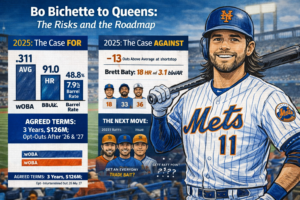
The contract is loud, 3 years, $126M, opt-outs after each of the first two seasons, so the Mets essentially paid for the right to rent a star bat without marrying the back end, and the player took a deal structure that screams “if I mash in New York, I am gone,” which is fine if the Mets treat 2026 like a real push and stop pretending roster problems solve themselves through positive thinking.
Bichette’s 2025 performance supports the aggression, since the surface line pops, the contact profile looks legitimate, and the underlying Statcast indicators back up that this was not a lucky BABIP week stretched into a season, with a .361 wOBA and .353 xwOBA, plus 91.0 mph average exit velocity, 48.8% hard-hit rate, and a 7.9% barrel rate, which adds up to a hitter who can drive the ball without selling out his approach, and that matters in October when pitchers stop handing out mistakes like Halloween candy.
The Part Everyone Wants to Ignore: Defense and Position Risk
The defensive truth is not complicated, and it is the reason this move is bold instead of boring, since Bichette is coming off a 2025 season where he rated -13 Outs Above Average at shortstop, tied for the second-worst mark in the majors, and now he is expected to learn third base on the fly, at a position where reaction time, first step, and throw angles can turn a good bat into a daily adventure for your pitching staff.
Third base also comes with its own irony, since the Mets had a real third baseman in-house last season in Brett Baty, who put up a breakout year with 18 homers and 3.1 bWAR, while also improving defensively to the point where he banked positive value at the position. The front office just chose to replace that stability with a higher-ceiling bat and a higher-variance glove, which is a statement about how they see the run environment and how they believe they can manufacture a better lineup.
This is the risk: if Bichette is even passable at third, the signing looks like a masterstroke, and if he is a problem there, the Mets will spend half the season patching the infield with duct tape while the outfield still sits there untouched, staring at everyone like an unpaid parking ticket.
The Hidden Cost Is Not Hidden, It’s Just Conveniently Ignored

Bichette turned down the qualifying offer, so the Mets are paying an acquisition tax that matters, losing two draft picks and $1 million from their international bonus pool, and that is not fatal for a big-market team, but it becomes painful if the front office keeps stacking short-term wins on top of long-term leaks, especially when the organization keeps talking about pipeline and player development like it is the long-term plan.
The financial side is the cleaner part of the deal. Since the Mets did not bury the payroll in deferrals, they kept the term short, and the opt-outs protect them from being stuck with dead money if the athletic decline comes early, although that same structure also means the Mets might only get one year of peak Bichette before he re-enters the market. That forces the front office to treat 2026 like a go-for-it season whether the roster is ready or not.
Where the Mets Go From Here

The next move has to be about two things: outfield certainty and defensive stability, since the Mets are thin enough in the outfield that the current roster construction reads like an incomplete sentence. MLB reporting has already noted how shallow the 40-man outfield group is right now, which is not sustainable over a full season even if every single player stays healthy, which never happens, even in fairy tales.
Baty becomes the pivot point, since the Mets can either use him as a creative fit piece, moving him around the diamond and even into left field in a controlled way. They can treat him like a premium trade chip, and the second option might be the smarter one if the return is a legitimate everyday outfielder or a starter who can actually move the needle, since the Mets cannot keep converting position players into “maybe this works” experiments while hoping the defense magically improves in the background.
The clean roster plan looks like this: Bichette plays third, Lindor stays at short, Semien holds second, the Mets add one real everyday outfielder, and the rest of the infield depth becomes currency, which gives the roster an actual shape instead of a crowded infield room and a prayer.
Verdict
The Bo Bichette signing is a good move, and it is also a move that demands follow-through. Since the bat is real, the prime-age timing fits, and the short term structure is exactly the kind of risk the Mets should take. The defense and positional transition are real enough to turn this into a problem if the front office does not immediately solve the outfield and stop asking the roster to do gymnastics every week.
This is the kind of signing that can age beautifully, or it can turn into a season-long juggling act that wastes the very advantage the deal was supposed to create. The difference between those outcomes is not Bichette’s swing, it is whether the Mets build the rest of the roster like they actually mean it.
Resources
- Reuters report on contract terms, opt-outs, no deferrals, qualifying-offer penalties, and 2025 slash production
- MLB.com breakdown on remaining Mets questions, including Bichette’s -13 OAA, arm strength percentile, Baty’s 2025 bWAR, and roster ripple effects
- Baseball Savant Statcast page for Bichette’s 2025 wOBA, xwOBA, average exit velocity, hard-hit rate, and barrel rate
- MLB.com tools roundup referencing Bichette leading free agents in expected batting average (xBA)
Join the conversation at RandomMetsFans.com
Subscribe to the newsletter
Let’s build the smartest Mets community on the internet