Port St. Lucie always lies to you a little.
Every February, it looks like paradise and sounds like redemption. Palm trees. Fresh uniforms. The crack of a ball that definitely is not going 110 mph in April. Everyone is “in the best shape of their life,” which is hilarious, since half the roster just spent the winter eating like it was a competitive sport.
Still, this camp matters, a lot.
This 2026 Mets roster is a remix. New faces, new roles, new pressure. David Stearns basically flipped a third of the 40-man and told everybody to get serious about run prevention. Not “try harder.” Serious. His words weren’t subtle. The league told him the Mets’ defense “wasn’t close to good enough,” and he put that standard right on the table, out loud, in January, in New York. That’s either leadership or a dare.
The other quiet truth: spring training doesn’t start when pitchers and catchers report. It starts when players start showing up early, getting throws in, building their personal ramps. That’s already happening in Port St. Lucie with pitchers like Freddy Peralta and Nolan McLean throwing at the complex before the first official workout.
So yes, camp starts now.
The roster fights that matter most aren’t the fun ones where fans argue about the 26th man. These are the ones that decide how the Mets handle leverage innings, manage injury risk, and keep the lineup functional when the schedule turns ugly in September.
Three pressure points. Left field. DH. Bullpen.
Let’s go.
The Camp Calendar, the Ramp-Up, and Why Early Throwing Actually Matters
The Mets’ first official workout for pitchers and catchers is Feb. 11, and the first full-squad workout is Feb. 16. The first Grapefruit League game is Feb. 21 vs. the Marlins.
Those dates are the public version.
The real version is workload planning. You want October arms? You need April discipline.
Stearns has already framed 2026 around “keeping runs off the board,” and he’s also been direct about how the Mets have to manage workloads, especially with unique variables like WBC participation for certain arms. He flat-out said the Mets are having workload conversations and will stay in close contact with Team USA staff on usage.
That mindset bleeds into everything, including these roster fights:
- Left field affects defense and run prevention every single night.
- DH usage affects who stays healthy, who plays which days, and how the lineup avoids dead spots versus lefties.
- Bullpen construction affects how many wins you steal, and how many you hand away like it’s a charity drive.
Now the fights.
Roster Fight 1: Left Field, the “Defense Wasn’t Close” Fix, and the Benge Question
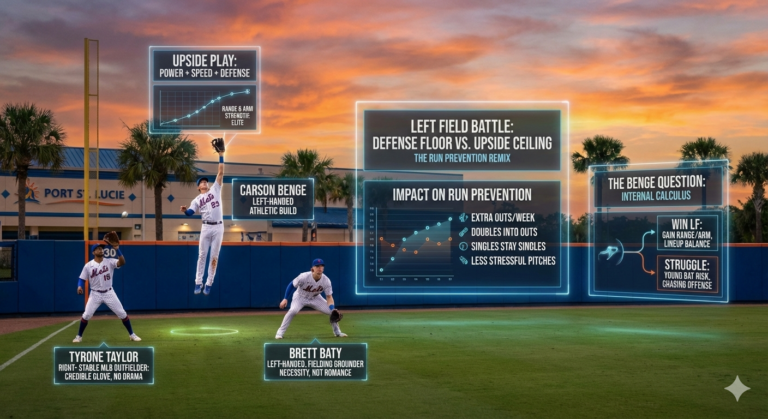
Left field is where Stearns’ run-prevention agenda gets tested in public.
Juan Soto is your right fielder. Luis Robert Jr. is in center. The open question is the corner that decides whether the outfield defense is a strength or just “better than last year,” which is not a real plan.
The contenders (the real list)
The Mets’ own depth chart pegs Tyrone Taylor and Brett Baty as left-field options.
Anthony DiComo’s spring primer makes the bigger point: top prospect Carson Benge is coming to camp to compete for the starting left-field job, even with minimal experience above Double-A. Mets officials love his blend of power, speed, and defense.
So it’s basically this:
- Carson Benge: upside play, real defense, real athleticism, real long-term piece.
- Tyrone Taylor: stable MLB outfielder, credible glove, the “no drama” option.
- Brett Baty: the “we’re doing this because the roster math demands it” option.
Why this battle decides October
Left field is not just left field. It is:
- How many extra outs you get per week
- How many doubles turn into outs
- How many singles stay singles
- How often your pitchers get forced into stressful pitches with runners already in scoring position
Stearns already told you the Mets are raising the defensive standard.
Left field is the easiest place to execute that promise immediately without changing the infield again.
The Benge case: upside that fits the new Mets identity
Benge is the type of player Stearns wants on the field: athletic, runs well, defends, impacts the game without needing three homers a week. DiComo spelled it out: Mets officials love the power-speed-defense blend and see him as a long-term cog, with Opening Day still a question.
Here’s the real internal calculus:
- If Benge wins LF, the Mets gain range and arm while keeping the lineup from going too lefty-heavy.
- If Benge struggles, the Mets risk a young bat getting buried early, then chasing offense later.
Spring training is not about the stat line. It’s about whether his at-bats look like major-league at-bats. Competitive takes. Handling velocity up. Adjusting to spin.
The Taylor case: boring, professional, and sometimes boring is the point
Every roster needs a guy who doesn’t create problems.
Taylor can catch the baseball. He can play competent outfield defense. He does not force you into “creative” substitutions in the sixth inning. That stability matters more than people admit.
If the Mets think the infield defense and bullpen are already volatile because of new roles, Taylor in left becomes the stabilizer.
The Baty-in-left case: necessity, not romance
Putting Baty in left field is the baseball equivalent of rearranging furniture during a plumbing leak.
It can work. It can also become a daily tax on the entire pitching staff.
Baty’s value is the bat and his development path. Asking him to learn a new position while also being a key offensive piece is a risk. Sometimes teams do it anyway because the roster forces it.
This is where the DH fight connects, and it matters.
Roster Fight 2: DH, the Polanco Ripple Effect, and Why the Mets Need a Plan Not a Rotation

The DH spot is where good teams cheat.
They use it to protect bodies, optimize matchups, and keep bats in the lineup without sacrificing defense. Bad teams use it like a storage unit for whatever player they cannot place anywhere else.
The 2026 Mets cannot be the second type.
Polanco changes everything
Jorge Polanco is not coming to New York as a pure DH. The Mets are giving him first base reps, but his recent deployment in Seattle tells you the truth: in 2025, the Mariners started him 87 times at DH.
So the Mets have a first baseman who has DH mileage, and that matters for workload planning. It also impacts who gets DH at-bats on days Polanco plays first, or needs a half-day.
MLB reporting around the Mets’ winter indicates Polanco is expected to be used mainly at first base and designated hitter.
Translation: DH is not a fixed position. It’s going to be a rotating mechanism.
The Mets’ DH puzzle pieces
The MLB depth chart lists Mark Vientos and Jorge Polanco as DH options, with Ronny Mauricio and Jared Young also in the mix.
This is the underlying fight:
- Vientos needs at-bats, needs a role, needs a lane.
- Baty needs at-bats too, plus defensive reps, plus whatever the Mets decide about his fielding home.
- Polanco will need DH days to keep his body right while learning first base.
- Mauricio is the classic “too talented to ignore” roster challenge, especially if he can cover multiple spots.
- The bench needs at least one player who can credibly play the outfield and not be a defensive drop-off.
Now combine that with the team’s stated goal: get better defensively and prevent runs.
So the DH cannot just be “whoever hits today.” It needs structure.
The cleanest version: DH as a matchup weapon
The ideal, ruthless, cold-blooded Mets approach looks like this:
- Polanco DH vs tougher lefties or when his legs need it
- Vientos DH when you want right-handed thump
- Baty DH when you want a left-handed bat and you’re prioritizing defense elsewhere
- Rotational rest for regulars, especially the kind of maintenance days that keep hamstrings and backs from turning into two-month problems
The 2026 offseason additions and projection work done publicly suggests the Mets improved defensively overall, with a spotlight on how the new roster could upgrade multiple positions, and how left field defense in particular should be better depending on whether Benge or Taylor is out there.
That defense-first framing is the lane for Baty’s usage. If Baty’s glove is acceptable at third or in left, he plays more. If not, DH becomes the pressure valve.
The real fight inside the DH fight: who forces the Mets to make a decision?
Vientos is the guy who can force the issue.
If he hits in spring, hits with authority, and shows he can handle velocity, the Mets will find a way to get him 450-plus plate appearances. If he looks like a streaky bat again, the Mets will treat him like depth.
This is why the Grapefruit League at-bats matter more than the results. You’re looking for:
- swing decisions (chase rate trends)
- contact quality (line drives, not just pulled fly balls)
- ability to handle breaking stuff with two strikes
Vientos is also tied to the Nicaragua exhibition wrinkle. The Mets’ spring primer notes a pair of exhibition games vs WBC teams, and that Vientos is set to play for Nicaragua.
That is not nothing. It impacts timing, reps, and workload.
Bench construction, the hidden part of the DH plan
You can’t build a smart DH plan with a dumb bench.
If Benge wins LF, you free up flexibility. If Taylor wins LF, you probably keep a different kind of bench bat. If Baty is in LF, the bench needs a true infielder. If Baty stays at third, the bench needs an outfielder who can start without damaging the defense.
This is where Mauricio becomes interesting. The Mets’ depth chart has him all over the place.
That versatility can be a roster cheat code, assuming the glove is playable.
The Mets’ offseason is a constant reminder: this is a roster built to win games in a different way than 2025. Stearns literally described it as a compilation of pieces, not a one-for-one replacement mentality.
DH is where that philosophy becomes real. Or becomes chaos.
Roster Fight 3: The Bullpen Without Díaz, the Leverage Hierarchy, and the Three Jobs That Actually Matter

If you want the clean version first: the Mets bullpen has upside. It also has volatility, which is another way of saying, “you’ll learn who you can trust by May.”
Anthony DiComo’s bullpen breakdown is direct. Díaz left for the Dodgers. The Mets responded with a plan: Devin Williams on a three-year deal to close, plus a mix of veterans and younger arms competing for the rest.
The locks, the likely locks, and the jobs up for grabs
DiComo lists four Opening Day locks: Devin Williams, Luke Weaver, Brooks Raley, Luis García.
Add A.J. Minter as a near-lock once healthy, with the caveat that he is finishing rehab from a torn left lat and may open on the IL. Mets officials expect him after the minimum stay.
So let’s do the math.
Most teams carry 8 relievers. Sometimes 7 early, sometimes 9 when they play games with options.
Assume 8.
- Locks: Williams, Weaver, Raley, García (4)
- Minter: likely (5), timing-dependent
- That leaves 3 bullpen seats in play. DiComo basically says that.
The main candidates for the final seats
DiComo notes Huascar Brazobán and Tobias Myers as favorites for two spots, with the caveat that the Mets could keep Myers stretched out as a starter instead.
Then the competition layer gets spicy:
- Craig Kimbrel is in camp fighting for his career.
- Younger, harder-throwing arms include Jonathan Pintaro, Dylan Ross, Ryan Lambert, Alex Carrillo.
- Several of these arms have options and could shuttle between Syracuse and New York.
This is the roster fight that decides October the most, and it’s not close.
Here’s why.
Leverage is not a feeling. It’s an inventory problem.

The Mets didn’t just lose Díaz. They lost a known answer in the ninth inning. Díaz was also a psychological weapon. Even when he wasn’t perfect, opponents had to think about it.
Now the Mets are building a leverage ladder.
- Williams closes.
- Weaver, Raley, García are the bridge.
- Minter adds another lefty leverage option if healthy.
- Everyone else has to prove they can handle either the sixth inning mess or the inherited runner nightmare.
ESPN’s offseason analysis even points out the bullpen was middle-of-the-pack by ERA in 2025, and that Williams and Weaver are intriguing, with Williams’ peripherals still looking strong even in an ugly ERA season.
That’s the point. The Mets need peripherals that hold up in leverage.
Strikeout ability. Walk control. Weak contact. Getting ahead early.
What the Mets should be hunting in this competition
Forget spring ERA. It lies.
The Mets should be hunting for three specific profiles:
- The inherited runner killer
A reliever who enters with men on and ends the inning. That guy is not always your best reliever. He’s your most valuable reliever in October. - The multi-inning stabilizer
Someone who can cover 4 to 6 outs when the starter is at 82 pitches in the fifth and the lineup turns over. If Myers stays stretched, he could be that, or he could be rotation depth. DiComo flagged that exact decision point. - The optionable weapon
Stearns has wanted this forever. DiComo even notes the Mets believe they can finally pump optionable bullpen talent to the majors consistently, something they have lacked in the past.
That last one is a big deal. It means the Mets want the bullpen to be a system, not a weekly emergency.
Kimbrel, the chaos factor
Kimbrel in camp is not a nostalgia act. It’s the Mets acknowledging that you can never have enough bullpen shots.
If he has anything left, he becomes a high-variance piece with a real payoff. If he doesn’t, you move on and let the kids fight.
DiComo framed it as Kimbrel fighting to keep his career alive, and that’s accurate.
The October connection
Every postseason series comes down to two things:
- Can you prevent runs without giving away free bases?
- Can you win leverage innings?
Stearns is trying to build a roster that does both. He said the Mets have to be better at keeping runs off the board, and defense plus pitching is the blueprint.
This bullpen competition is where that blueprint either becomes real, or becomes Mets baseball theater.
The Hidden Thread Connecting All 3 Battles: Run Prevention, Matchups, and Injury Risk
Left field is defense and range.
DH is workload and lineup optimization.
Bullpen is leverage and options.
All of them tie back to one organizational stance: the Mets are not building 2026 like 2025. They’re trying to build a roster that is more balanced, more defensive, and more capable of surviving the grind.
Stearns already told you the “piece replacement” mindset is not the way they see it. It’s the compilation of pieces.
This is why camp starts now.
If Peralta and McLean are throwing early at the complex, that’s not just cute content for social. It’s the ramp. If the Mets are already talking workloads with WBC involvement, that’s planning.
Teams that plan win the boring games in May. Those boring wins are what buy you the margin for error in September. That margin is what keeps you from panic trades. That’s what lets you enter October with a roster that still has working joints.
What I Think Happens, and What the Mets Should Want

This is the part where fans scream at the screen. Perfect.
Left field
The Mets should want Benge to win the job, but only if the at-bats look real. Defense plays. Speed plays. If he shows he can compete against big-league pitching, the upgrade in run prevention is immediate.
If not, Taylor starts in left and Benge gets his runway elsewhere, without forcing a development crisis in Week 2.
DH
DH should be structured, not improvised.
Polanco is going to need DH days. The Mets already know he has recent DH-heavy usage in his profile.
Vientos should get a real shot to claim the “right-handed thump” lane.
This gets cleaner fast if the Mets make a single early decision and stop pretending DH is a vibe.
Bullpen
Williams closes. Weaver, Raley, García are the bridge. The rest should be selected with one priority: who can get outs with runners on, and who can be trusted when the heart of the order is up.
If the Mets solve those final three seats correctly, October looks a lot less like a prayer circle.
Why This Matters for Mets Fans
This is not spring fluff.
These battles decide whether the Mets are built to win tight games, or built to win only when the offense goes nuclear. They decide whether the Mets can protect their rotation by not asking starters to be superheroes. They decide whether late leads feel like wins, not like a suspense series on HBO.
Stearns has already acknowledged the standard. Pitching and defense have to be better.
Spring training is where the Mets prove they meant it.
Resources
- MLB.com (Anthony DiComo), “Mets Spring Training: Everything you need to know” (Feb. 4, 2026).
- MLB.com (Anthony DiComo), “The retooled Mets bullpen: No Díaz, but lots of upside” (Feb. 2, 2026).
- MLB.com (David Adler), “Well aware of the noise, Stearns lays out the plan for rest of Mets’ offseason” (Jan. 13, 2026).
- MLB.com, “Jorge Polanco contract with Mets: $40 million, two years” (Dec. 16, 2025).
- MLB.com, Mets roster depth chart (accessed Feb. 4, 2026).
- ESPN, “After offseason additions, are 2026 Mets better than 2025 team?” (Jan. 23, 2026).
- Amazin’ Avenue, “Mets’ spring training workout dates announced” (Jan. 14, 2026).
Join the conversation at RandomMetsFans.com
Subscribe to the newsletter
Let’s build the smartest Mets community on the internet