The New York Mets shocked MLB by acquiring All-Star outfielder Luis Robert Jr. from Chicago, sending infielder Luisangel Acuña and pitching prospect Truman Pauley to the White Sox. This blockbuster move (announced Jan 20, 2026) is designed to upgrade New York’s outfield defense and speed. Below we provide comprehensive 2026 projections and context for all three players, assess Mets roster impact and payroll implications, and evaluate what the trade signals for each team’s future.
2026 Projections (Key Stats)
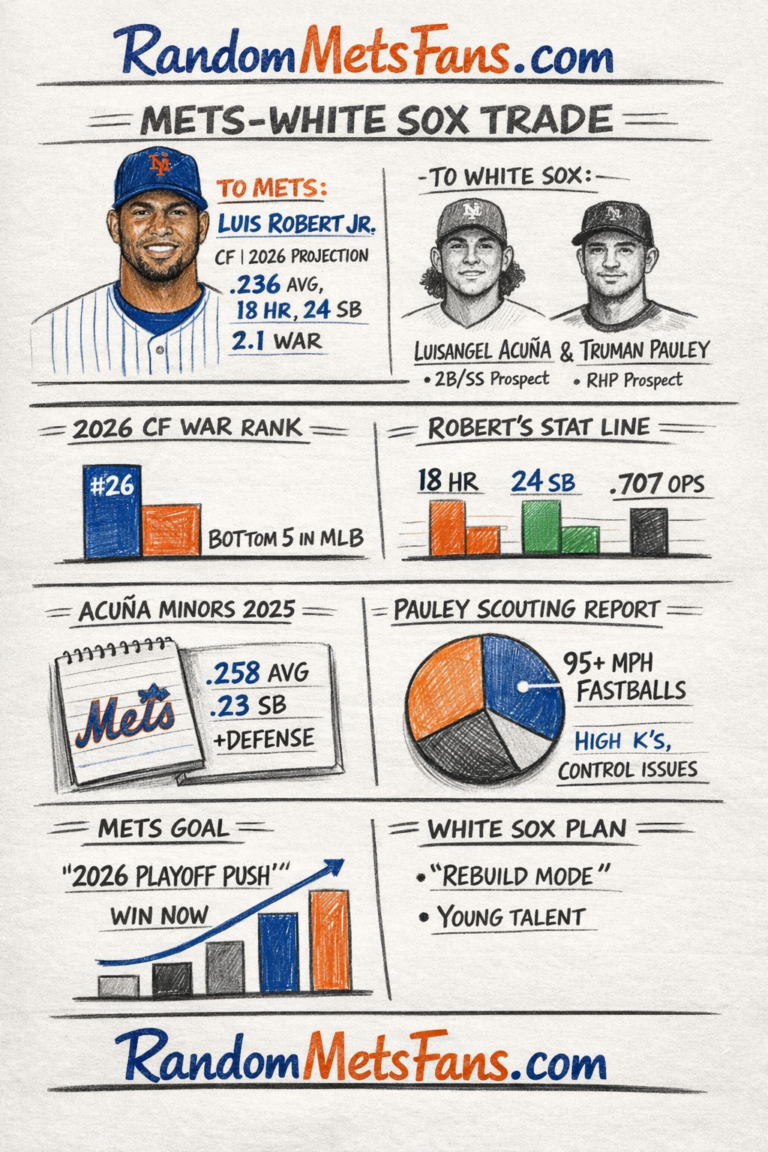
Below summarizes 2026 pre-season projections for Robert, Acuña and Pauley (war is FanGraphs/ZiPS). Robert’s stats come from ZiPS; Acuña’s and Pauley’s projections are approximated from available projection systems and scouting. (Note: Pauley, a recent draftee, is projected at the minor-league level and would not have MLB counting stats in 2026.)
Sources: Luis Robert’s 2026 ZiPS projection (CF, 18 HR, 24 SB) from FanGraphs. Acuña’s projections (roughly .245/.305/.350 with ~3 HR, 10 SB) are based on composite forecasts for 2025 and assume similar or slightly expanded playing time. Pauley, a 2025 draft pick, has no MLB projection – his 0.0 WAR reflects expectation of continued development in the minors.
Luis Robert Jr.: Performance, Injuries, Contract, and Fit
Luis Robert’s peak was in 2023, when he smashed 38 HR, drove in 80 runs and stole 20 bases (slashing .264/.315/.542) en route to an All-Star nod. Since then his bat cooled: over 2024–25 he hit just .223 with a .660 OPS (28 HR in 210 games). The chief concern is health, Robert has twice suffered left hamstring strains and missed significant time, including the final month of 2025. Nevertheless, he still totaled a career-high 33 steals in 2025, giving him 102 career steals and 102 HR through 577 games. Robert remains a strong defensive center fielder (a 2020 Gold Glove winner) and pairs his plus-arm with elite speed.
Contract-wise, Chicago had already exercised Robert’s $20M club option for 2026 and holds a $20M option (with $2M buyout) for 2027. In this deal the Mets assume those obligations, taking on his full $20M 2026 salary and the $2M buyout. In effect, New York is betting Robert can rebound now that he’s out of the White Sox spotlight. Given the Mets’ marked need in center (see below), Robert’s Gold Glove defense and baserunning give them an immediate upgrade.
“He can play in the corner outfield spots, but he specializes in center field – the position of need for the Mets,” notes Newsweek on the trade.
Robert’s fit is bolstered by New York’s revamped lineup. Having just signed Bo Bichette at shortstop and moved on from Brandon Nimmo and Jeff McNeil, the Mets clearly aimed to add a premium defender and run-producer to push for 2026 contention. As one analysis observed, New York wanted to “improve their fielding” and fortify the outfield after offseason departures. If healthy, Robert provides a high-ceiling element to the Mets’ playoff window.
Luisangel Acuña: Prospects and Performance
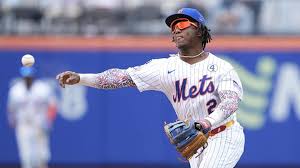
Luisangel Acuña, 23, is an athletic infielder (capable of 2B/SS and occasional outfield) with elite speed. The Mets acquired him in mid-2023 for Max Scherzer; he promptly hit .308 in 14 MLB games (3 HR) that year. In Triple-A Syracuse in 2024 he played 131 games, batting .258/.299/.355 with 7 HR, 50 RBI and 23 steals. He got off to a hot start in 2025 (earning NL Rookie of the Month for April with a .698 OPS and 7 steals) but struggled to hit for power and was sent back to Syracuse by June.
Across his brief MLB tenure (2024–25), Acuña has hit .248/.299/.341 in 109 games, showing contact ability but little power and a modest .299 SLG. He offers excellent defense: scouting reports note he was +3 Outs Above Average (OAA) at shortstop in 2024 and +1 OAA at second base in 2025. He also has plus speed – a 40+ stolen-base upside, as analysts have observed. However, Acuña’s 2025 minor-league statline (6% BB rate, 18.5% K rate) indicates his hitting is still developing. He’s regarded as a line-drive hitter with a high-contact approach and game-winning speed, but without clear power.
In sum, Acuña is a former Top-100 prospect who projects to be a versatile bench/infield piece with plus defense and baserunning. MLB.com notes he “appeared on Top 100 lists as recently as 2024,” but adds that he “hasn’t done much to back those rankings up” yet. Chicago will hope more regular playing time helps his bat develop.
Truman Pauley: Scouting and Outlook
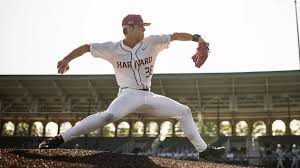
Truman Pauley (22) was a 12th-round pick in 2025 out of Harvard. In college he showed swing-and-miss but electric stuff. Across 2024–25 he pitched 114 IP (ERA ~5.0) with 132 strikeouts and 89 walks, but scouts note his raw tools: a mid-90s sinker with elite vertical movement (22.5″ average induced vertical break) and a “filthy” gyro-slider. He struggles with command (career walk rate near 7.4 BB/9 in college), giving him a future as a high-upside power reliever or, if control improves, a mid-rotation starter. One analysis called Pauley’s command “below-average” but lauded the arm talent: “He induces a ton of swings-and-misses with his front-door slider and sinking fastball,” likely projecting as a power bullpen arm.
Pauley is unproven in pro ball; 2026 will likely be his first minor-league season. Given his profile, projections would suggest a mid-to-high A (or Rookie/A) level usage with moderate strikeouts. (ZiPS/Steamer do not have a 2026 MLB line for Pauley, so he carries 0.0 WAR above.) In Chicago’s rebuild, he is a lottery ticket: the Sox have added a 95+ mph reliever with maybe 60-grade strikeout stuff, hoping to refine his control over time.
Impact on Mets’ 2026 Window and Roster
This trade makes an aggressive statement that the Mets view 2026 as a playoff opportunity. By acquiring a former All-Star in his physical prime, New York is bolstering its lineup despite already-high payroll. The club explicitly targeted center field — a position where projections had flagged them as weak. In fact, early analytics ranked Mets’ 2026 CF WAR projection 26th in MLB (LF 27th), calling the outfield “problematic.” The Metsmerized blog notes Fangraphs analysis concluding the Mets needed “help in the outfield with, say, a Luis Robert Jr.” to round out the roster.
With Robert in center, the Mets gain a legitimate defender. The outfield mix (with Juan Soto in right) will be deeper and more athletic. Robert’s speed also adds a run-producing element – his 24 steals in 2026 proj. would be a big increase over Tyrone Taylor’s output. The trade also opens playing time for multi-positional depth (Luis Garcia, Brett Baty in left or DH). In short, the Mets likely improved both offensively and defensively on the corners of the outfield.
On the mound, the Mets didn’t give up any proven big-league arms, so their rotation and bullpen remain intact. This suggests New York is doubling down on the contention window from 2026 onward. However, taking on Robert’s hefty salary ($20M) pushes the Mets further into luxury-tax territory. Sox On 35th reports that Chicago will pay none of Robert’s 2026 salary; Steve Cohen’s Mets are effectively committing another $20M and a buyout on 2027 in exchange for a few years of Robert. This likely bumps their 2026 payroll well above $320M and increases long-term obligations. Financially it underscores that the Mets are prioritizing immediate upgrades over payroll flexibility.
In the short term, analysts note this move “fills a key need in the outfield and improves [the Mets’] defense as a whole”. The price (Acuña+Pauley + salary) is steep but affordable for the Mets. It puts more pressure on the rotation to perform, since their offense and defense just got a jolt while pitching remains largely unchanged. If Robert returns to 2023 form, New York’s 2026 playoff odds improve significantly; if he falters or misses time, the cost is high. The upgrade is clear, but the trade tightens the win-now timeline for the Mets’ window.
Mets Front Office and Outlook

Acquiring Robert suggests the Mets front office is all-in on competing in 2026. This follows their aggressive signings (Juan Soto, Bichette) and recent trades. It implies GM David Stearns believes the team is a star short on the championship track, especially defensively. New York’s spending has been scrutinized (“second-highest CBT payroll behind the Dodgers”), and this move confirms they will not relent. As one local column noted, projections had the Mets among the top-6 teams by WAR despite a turbulent offseason; adding Robert is consistent with “overblown” offseason criticism and the belief they just need a few more pieces.
The trade also signals confidence in the core of young Mets: Acuña and Pauley were expendable, meaning the front office prefers Robert’s proven five-tool skill set over further unproven prospects. In long-term outlook, it shows a classic win-now posture: trading controllable youth for a veteran with only two years remaining on his contract. For fans and the media, it underscores Stearns’ willingness to spend and gamble on bounce-back talent.
White Sox Perspective: Rebuild and Return Package
From Chicago’s standpoint, the trade ends years of uncertainty around Robert and shifts focus fully to rebuilding. They shed $20M in salary commitment for 2026, gaining payroll flexibility. Acuña (23) and Pauley (22) add intrigue to the farm system. Acuña immediately becomes one of the White Sox’s top infield prospects (he was ranked #8 in the Mets’ system before). He brings plus speed and defensive versatility. The Sox could allow him to play regularly as a potential leadoff hitter, accelerating his development. If his hit tool comes around, Chicago gains a potential every-day middle infielder with base-stealing upside. If not, he remains a useful utility/bench piece.
Pauley joins a system in dire need of pitching. His profile (high-velocity, high-spin) fits the modern emphasis on power arms. Even if he needs time, the Sox can afford to stash him and hope his command improves, possibly grooming him as a future reliever. In a few years, if both players pan out, Chicago gets sizable value for essentially a pending free agent. At worst, the Sox recoup two high-upside lottery tickets.
In other words, Chicago appears to favor long-term upside over short-term output. The return package doesn’t replace Robert’s production now, but it aligns with a reset strategy. In a rebuild, swapping salary for controllable youth is prudent. The Sox analysts will view it as patience with development: Acuña’s sub-.300 OBP to date means he’s still raw, and Pauley is years away. However, each has high ceilings. Sox fans might grumble over losing a star, but front office and beat writers are likely relieved to have clear direction.
Media and Analyst Reactions
Reactions in the press highlight both sides of the deal. ESPN’s Jeff Passan (reporting the trade) noted Robert’s slump and premium speed (“33 stolen bases” in 2025) and identified Acuña as a rookie contributor (16 steals in 2025) and Pauley as a recent draft pick. MLB.com’s Mark Feinsand emphasized Robert’s All-Star credentials and Gold Glove defense, while confirming the salary details and options.
New York media mostly cheer the upgrade: Newsweek calls it a “blockbuster” fulfilling a “key need” in the outfield. Mets bloggers note how projections flagged CF as a glaring weakness, and one explicitly said the Mets’ projections “cry out” for adding Robert Jr.. Local beat writers (e.g. SNY) pointed out that New York traded for a less-expensive alternative to Cody Bellinger (the club’s other reported target). The consensus is that the Mets have significantly upgraded their defense and speed without sacrificing proven arms.
Chicago commentators frame it as finally moving on from Robert’s big salary. Sox On 35th notes the White Sox regained Acuña and Pauley, “two of the promising young players,” even if Acuña has yet to fulfill his hype. MLB Trade Rumors highlighted that Chicago gets players who can develop at multiple positions. Most analysts view this as a reasonable deal: New York got their CF, Chicago shed payroll and added youth. Fans reaction on social media was mixed: Mets fans expressed excitement for the clear upgrade, while White Sox fans understood the logic of shedding salary for prospects.
In summary, the Mets-White Sox trade is a high-leverage move that signals New York’s all-in competitive posture and Chicago’s commitment to rebuilding. Projections show Robert providing a solid all-around contribution if healthy. Acuña and Pauley enter Chicago as lottery tickets for a franchise retooling. The trade tightens the Mets’ 2026 window – both by improving the roster and by increasing financial commitment – while giving the White Sox two intriguing pieces to develop into future contributors.
Join the conversation at RandomMetsFans.com
Subscribe to the newsletter
Let’s build the smartest Mets community on the internet