If you want MacKenzie Gore, you’re not paying the price. You’re paying the “we’d rather eat glass than help you” price.
That’s the part Mets fans always skip. Everyone loves the clean little idea of “add a starter.” Just go get one. Plug him in. Rotate the Instagram graphic. Done. This one is different, not because Gore isn’t a fit, he’s a perfect fit, but because the seller is a division rival and the relationship comes with receipts.
This rumor is worth talking about for one reason, it exposes what the Mets are really doing this winter. They’re not shopping for vibes. They’re shopping for innings with upside, at a cost that doesn’t lock them into another long contract, and they’re trying to do it by trading from depth instead of paying retail on the open market.
That’s the whole story. Gore is just the flashlight.
Why the Mets called
The Mets called because Gore checks the boxes that matter when you’re trying to build a rotation without turning payroll into cement.
He’s young, already proven he can take the ball and has the kind of arm that can look like a mid-rotation stabilizer one month and a top-of-the-rotation problem the next. That kind of volatility is annoying when it’s on your team in April, then it’s priceless when it turns into dominance in September.
Control matters too. A controllable starter is a roster weapon, not a rental. The Mets can plan around it. The front office can build the bullpen around it. The manager can stop playing nightly roulette with the sixth inning.
It also lines up with what’s been reported about the Mets leaning toward the trade market for rotation help instead of locking into another big free-agent commitment. A trade like this is the cleanest way to buy upside without signing a long-term IOU.
Why the Nationals say “astronomical”
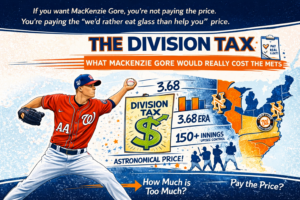
Washington can say “astronomical” with a straight face, and they should.
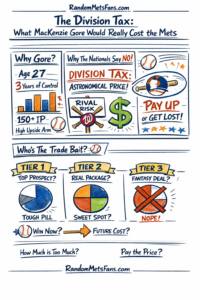
This is a division rival tax, which means the Mets are not just paying for Gore’s talent. They’re paying for the privilege of not watching Gore beat them twelve times over the next few years while the Nationals rebuild.
That’s the part fans underestimate. Trading within the division is personal, even when everyone pretends it’s business. Every GM knows how the headline reads. Every owner knows what their fans will scream into the void if the deal works out for the rival. Every front office knows the clip will be replayed in highlights for years if the player dominates in your own ballpark.
The Nationals also have leverage because they can wait. A pitcher with multiple years of control is not a “move him now or lose him” asset. They can hold, listen, and let the market drag the price upward as other teams get desperate.
This is why you should treat “Mets interested” as the appetizer, not the meal. The real question is not whether the Mets would like Gore. The real question is whether the Mets are willing to pay the kind of price that makes the Nationals look smart even if Gore becomes a star in Queens.
What the Mets can offer without nuking the future
This is where the story becomes real, and where most coverage gets lazy.
The Mets have depth in the minors and they have pieces on the 40-man that create a roster squeeze. That combination is a gift and a problem at the same time. A trade like this can solve both, but only if the Mets are willing to move a real piece, not a box of spare parts.
The Nationals are not taking “quantity” for Gore. They’re taking impact, ideally impact that arrives quickly.
Here’s what the Mets can actually put on the table, in tiers, without turning the farm into a crater.
Tier 1: The “this is why Washington answers the phone” tier
This is the tier Washington wants. It usually starts with one premium prospect the Mets really do not want to lose, then it gets padded with a near-ready arm and a secondary piece.
Reports already suggest there are prospects the Mets consider off-limits. That’s normal. Every team says it. A division rival hears it and raises the price anyway.
If Washington demands one of the names the Mets won’t trade, the conversation ends fast. That’s the adult answer. Fans never love it, but it’s the difference between building a sustainable contender and doing a panic swap that looks great for a week.
Tier 2: The “close enough to make it interesting” tier

This is the tier where a deal could live.
It looks like one near-ready pitching prospect who could help soon, paired with another legit piece, then topped off with something that fits Washington’s timeline. This is also the tier where you see the Mets lean into what they have in volume, arms with real ceilings and bats that are blocked up top.
This is where names like Brandon Sproat and Jonah Tong start showing up in the conversation, since they represent the kind of value that makes a rebuilding club listen. It also matches the type of packages that have been floated by people covering the rumor from the Nationals side, which is a tell. Washington wants pitching prospects, not bench clutter.
Tier 3: The “fantasy trade” tier
This is the tier fans build on Twitter, then act shocked when it does not happen.
It’s two mid-level prospects, a reliever you’re tired of, and a guy the Mets are about to DFA anyway. That package does not get Gore, not from Washington, not from anyone with multiple years of control, not in a market where other clubs can offer actual premium talent.
The Nationals can take a better offer from a non-division team and still sleep at night. That reality alone kills the fantasy package.
The hidden cost nobody wants to talk about
The Mets also have to manage the 40-man ripple effects.
A big trade does not just bring Gore in. It forces the Mets to choose who loses oxygen. Someone gets pushed off the roster. Someone loses a path to playing time. Someone becomes a trade chip the next morning.
This is why the “most logical receipt” might not be a top prospect at all. It might be a big-league or near-big-league bat who is valuable to another team, and redundant to the Mets once you zoom out.
The infield picture is the clearest example of how this could play out. Crowded positions create pressure. Pressure creates trades. Trades create pitching.
Fans tend to treat those hitters like separate characters in separate storylines. The front office treats them like inventory.
That’s not cold. That’s how you win.
What the Mets should do, if this is real
The Mets should stay in the conversation, then draw a hard line before the deal turns into a “division rival tax” robbery. The right approach is simple.

Keep the premium off-limits tier intact unless Washington’s ask is somehow reasonable, which it probably won’t be. Build an offer around near-ready pitching, add a strong secondary piece, then stop. No late-night desperation. No public pleading. No bidding against themselves.
Washington wants a deal that makes them look smart even if Gore becomes great in Queens. That is the standard. The Mets have to decide whether meeting that standard costs too much of their future.
There’s also a bigger truth here. The Mets do not need Gore specifically. They need the Gore profile, young-ish, controllable, capable of throwing meaningful innings without a long-term contract hanging off the payroll. If Washington insists on an “astronomical” return, fine. Walk. Take the same package to the next seller.
That’s not weakness. That’s discipline.
Why this matters for Mets fans
This is the fork in the road for the 2026 Mets. One path is the easy fan path, sign a name, feel better, deal with the consequences later.
The other path is the Stearns path, trade from depth, keep the long-term books clean, build a rotation that can hold up, and accept that roster conversion means someone you like becomes the cost of doing business.
Gore is not just a pitcher rumor. He’s a stress test of how serious the Mets are about building a contender that lasts.
If the Mets actually want to win in October, this is what it looks like in January.
Resources
- Report linking the Mets to MacKenzie Gore and noting the Nationals’ “astronomically high” ask (Sports Illustrated, Mets On SI).
- Nationals-side discussion of the rumor and example prospect packages, including mention of a division-rival premium (Federal Baseball).
- Notes on the same report circulated through Yahoo’s aggregation.
- Reporting that the Mets prefer the trade market over free agency for rotation upgrades (MLB Trade Rumors).
- Mets 2026 roster context via RosterResource, useful for understanding 40-man pressure and roster math (FanGraphs).
Join the conversation at RandomMetsFans.com
Subscribe to the newsletter
Let’s build the smartest Mets community on the internet