

There are easier conversations in life than this one.
Explaining your Mets fandom to a therapist, or worse, your spouse, is like trying to describe why you keep touching a hot stove even though you’ve owned the stove since 1986 and it’s never once not burned you.
But at some point, someone in your life will ask the question: “Why do you do this to yourself?”
This guide is for that moment.
Step 1: Admit It’s a Condition
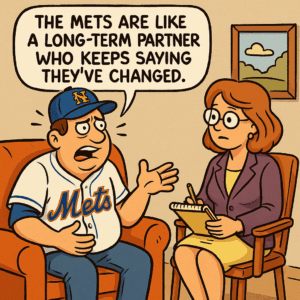
The first rule of recovery is admitting you have a problem.
You’re not a casual sports fan, you’re a member of an emotional support group disguised as a baseball team.
When your therapist says, “Tell me about your relationship with the Mets,” you’ll pause. You’ll laugh. Then you’ll realize she’s not joking.
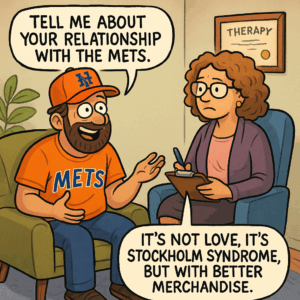
Explain it like this: “It’s not love, it’s Stockholm Syndrome, but with better merchandise.”
You’ve been conditioned to expect disappointment. You don’t celebrate wins; you flinch at them, because experience has taught you joy is just the setup for another bullpen meltdown.
Step 2: Use the Trauma Timeline
You’ll need to provide context. Therapists love timelines. Walk them through it slowly, like a crime scene reconstruction.
- 1969: The miracle year. Everything worked once. It’s why we can’t leave.
- 1986: The peak. The party. The standard we’ll never live up to.
- 2007-08: The collapse years. The ones that live in your bones.
- 2015: The false dawn, hope got its renewal notice.
- 2025: The prestige TV reboot that should’ve been canceled halfway through.
By the end, your therapist will probably write “chronic optimism disorder” on the chart.
Your spouse, meanwhile, will be Googling annulment options during commercial breaks.
Step 3: Explain the Language of Pain
Mets fans communicate in sighs, eye rolls, and dark humor. It’s not sarcasm, it’s survival.
We don’t say “maybe next year” with hope. We say it like a prayer you whisper before a plane crash.
If your spouse doesn’t understand, translate:
- “Typical Mets” = “I love them, but I also hate myself.”
- “Ya gotta believe” = “Please lie to me.”
- “This feels different” = “I’ve learned nothing.”
Step 4: Compare It to Marriage
It helps to put the relationship in familiar terms.
Tell your therapist:
“The Mets are like a long-term partner who keeps saying they’ve changed. They promise better communication, a new bullpen, fewer mistakes, and then they blow a 3-run lead to the Marlins.”
To your spouse, frame it like this:
“It’s basically the same as our relationship, except the Mets get more of my attention and provide less intimacy.”
If you’re lucky, they’ll laugh. If not, prepare for separate counseling sessions.
Step 5: Don’t Overshare During Roleplay
Your therapist might ask you to “imagine the Mets as a person.” Don’t fall for it.
That’s how you end up saying things like, “He’s unreliable, emotionally unavailable, spends recklessly, and ghosts me every October.”
Which, yes, is accurate, but it also leads to uncomfortable follow-ups like,
“So why do you stay?”
You’ll want to say, “because they’re family.” You’ll end up saying, “because I hate myself just enough to think they might change.”
Step 6: Embrace the Humor Defense Mechanism
When you’ve been a Mets fan long enough, humor isn’t a choice, it’s armor.
It’s how you survive the moments between hope and heartbreak.
Therapists call it “deflection.” Mets fans call it Tuesday.
Your spouse will roll their eyes when you crack jokes after another loss, but that’s not avoidance, it’s maintenance. You’re regulating your nervous system with sarcasm. Cheaper than medication, and it works about as well.
Step 7: Acknowledge the Cycle
Your therapist will eventually identify the pattern.
“So every year, you rebuild trust, get emotionally invested, experience betrayal, then promise yourself you’re done, and come back anyway?”
Exactly.
You’ll nod, proud and ashamed all at once, because the truth is, being a Mets fan isn’t about baseball. It’s about faith without evidence. It’s about learning to live with chaos, disappointment, and the occasional miracle that keeps you hooked.
That’s not fandom. That’s our Mets religion.
Step 8: Prepare for the “Boundaries” Talk
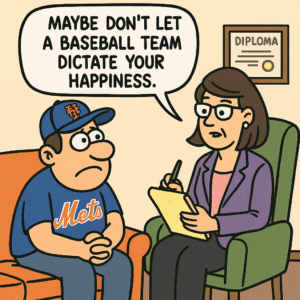
Therapists love boundaries.
They’ll say things like, “Maybe don’t let a baseball team dictate your happiness.” Real cute Doc, real cute.
You’ll smile politely and think, Sure, and maybe oxygen shouldn’t dictate my breathing.
Deep down, you know there is no “off switch.” The Mets live rent-free in your prefrontal cortex. You can change jobs, cities, even relationships, but you can’t unsubscribe from this nonsense.
Step 9: Explain the Offseason Withdrawal
If your spouse thinks you’ll calm down in winter, they don’t understand the sickness.
The offseason is worse.
It’s the baseball version of staring into the void and convincing yourself the void’s working on a better bullpen.
Therapist: “How are you feeling now that the season’s over?”
You: “Hopeful and terrified. They might sign someone. They might not. It’s Schrodinger’s Roster.”
Spouse: “Can we go apple picking?”
You: “Not until we address the fifth starter situation.”
Step 10: Normalize Relapse
You will swear off the Mets. You’ll say, That’s it. I’m done.
Then spring training arrives, the sun hits just right, and some rookie you’ve never heard of hits a home run off a journeyman reliever from the Orioles.
Suddenly, your brain rewires itself.
“Maybe this year really is different.”
It’s not. It never is, but it’s that lie that keeps you going.
Step 11: How to End the Session Gracefully
When your therapist asks, “So what would healing look like?” just say:
“A competent bullpen and a parade down Roosevelt Avenue.”
When your spouse asks, “What would make you happy?” say:
“A wildcard berth and someone else doing the dishes in October.”
They’ll both laugh, but you won’t, because deep down, you mean it.
Step 12: Acceptance (Sort Of)
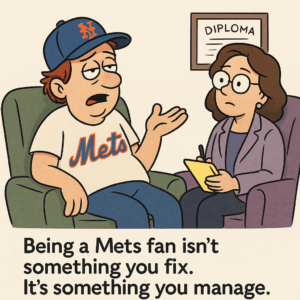
Being a Mets fan isn’t something you fix. It’s something you manage.
You’ll never be cured, you’ll just learn to live with the noise, the 7 train screech, the bullpen implosions, the annual hope.
You’ll start recognizing the progress in small moments: You only threw one remote this season.
You waited until June to lose faith.
You stopped tweeting at Steve Cohen after midnight. To me, that’s growth.
Closing Thought
Explaining Mets fandom to a therapist or spouse is like trying to explain gravity to someone who’s never fallen. You can describe the science, but they’ll never feel the drop.
So don’t overthink it. Just say this:
“It’s painful, irrational, and it ruins my week at least twice a month… but I wouldn’t trade it for anything.”
Mets fandom isn’t just suffering, it’s shared suffering. It’s community through chaos. It’s proof that even in failure, there’s belonging.
If that isn’t love, or a diagnosable mental condition, I don’t know what is.
Sources: Personal fan experience, Mets archival records, and six decades of collective Queens-based emotional endurance.
Mets Fans Will Love These Too:
 2026: How To Be A Kick Ass New York Mets Fan
 The Citi Field Blueprint: The Kind of Team That Wins Here
 Mets Top 25 Prospects for 2026, Post-Trade Reset (Yes, It’s a Different System Now)
 The Mets Bullpen Build Is Sneaky Good, Which Is Exactly Why Nobody Trusts It Yet
 The Mets Team From My Childhood That Would Ruin Baseball