The Mets’ bullpen is quietly building from within. With big bats like Pete Alonso gone (five-year deal with Baltimore) and Edwin Díaz traded, New York’s offense will look “a lot different in 2026”. That makes late-inning pitching even more crucial: a shutdown bullpen “compresses games,” flipping 4–3 losses into wins. Instead of focusing on blown games or saves, the Mets are banking on skills and metrics. If the relievers can prevent walks, force swings, and limit hard contact, the team can steal 5–4 games and start strong, even without its former power.
Key Bullpen Metrics Over Traditional Stats
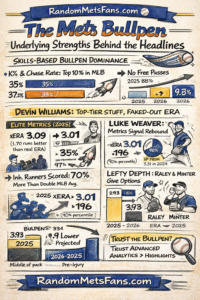
Bullpen evaluation leans on repeatable skills, not counting stats like saves. Key metrics include:
- High Strikeout and K–BB Rates: A high K% (strikeout rate) means a pitcher can “put hitters away,” while K–BB% (strikeouts minus walks) measures dominance. High strikeout pitchers avoid traffic. (Williams struck out 34.7% of batters in 2025, 97th percentile.)
- Walk Rate (BB%): Few “free passes” is vital. A low team bullpen BB% is an early-warning metric; free baserunners kill rallies.
- Chase and Whiff Rates: Good bullpens induce swings on bad pitches. Williams’s chase rate was 35% (97th percentile) and whiff rate 37.7% (99th), meaning he got batters to swing at pitches out of the zone and miss an elite amount.
- Quality-of-Contact Metrics: Stats like expected batting average (xBA) and hard-hit% show how hard opponents hit the ball. Even with an inflated ERA, Williams held opponents to a .195 expected average (95th percentile). Similarly, limiting barrels and hard hits prevents long innings.
- Advanced Run Estimators: xERA, FIP and DRA strip out luck and defense. These “under the hood” metrics forecast repeatable performance. For example, despite Williams’s 4.79 ERA, his Statcast xERA was 3.09, FIP 2.68 and DRA 3.01 – far below 4.79, implying bad luck and sequencing inflated his ERA.
Devin Williams: Elite Skills Behind a “Bad” ERA
Surface stats can deceive. Take closer Devin Williams: he posted a 4.79 ERA in 2025, but a deeper dive shows he still pitched like an ace. Statcast’s expected ERA for Williams was 3.09 – nearly two full runs lower than his actual ERA. His FIP (2.68) and DRA (3.01) similarly suggest a sub-3.00-run performance. In fact, among all pitchers facing at least 250 batters, Williams’s 1.70-run gap between ERA and xERA was one of the largest in MLB.
Williams backed that up with elite strikeout and contact skills. He struck out 34.7% of hitters (97th percentile) and finished 2025 in the 90th percentile or higher in expected batting average (.195, 95th percentile), chase rate (35%, 97th), and whiff rate (37.7%, 99th). In short, batters almost never square him up. The underlying data – strikeout rate, chase rate, low xBA – all remained at Cy Young-caliber levels, even as outcomes lagged. Williams also had a season-high **35.7% hard-hit rate (85th percentile, so opponents didn’t miss-guess his stuff often.
Where did the damage come? Largely not his fault. An astonishing 70% of inherited runners scored after Williams loaded the bases – more than double the MLB average. If even half of those runs had been prevented, his ERA would have been in the high-3s. In summary, Williams’s skills stayed elite in 2025 despite the 4.79 ERA. The metrics say he’s the same high-leverage finisher he was in Milwaukee – the ERA distortion was mostly bad luck and unfortunate sequencing.
Luke Weaver: Promising Peripherals, Awkward Results
Right-hander Luke Weaver endured a rough 2025 ERA, but his peripherals hint at a rebound. Early in the season, Weaver was dominant (1.05 ERA over 25 apps) before a hamstring injury sidelined him. Post-injury his ERA ballooned to 5.31, but his underlying stats were still excellent. In 2025 Weaver had an xERA of 3.01, lower than his 3.31 from 2024. He allowed an expected batting average of .196 and an expected wOBA of .272 – both improvements over 2024. His chase rate ticked up to 32.8%, and his signature changeup produced a +5 run value (versus +3 in 2024).
Put simply, Weaver’s pitch mix remained strong (fastball-changeup combo) and hitters generally squinted more against him. The jump in his peripheral stats despite health hiccups suggests the high ERA was deceptive. If Weaver can stay healthy and trim a few walks or homers, those underlying skills project him as a late-inning weapon. His 2025 profile – low xERA, strong strikeout and chase numbers – looks more like a burgeoning reliever than a “washed-up arm.”
Lefty Depth: Raley and Minter
The Mets also ensured multi-layered depth rather than relying on one closer. Both southpaws Brooks Raley and A.J. Minter are in the mix for 2026. New York re-signed Raley to a one-year deal (with a club option) after he recovered from Tommy John surgery. Raley was 2.80 ERA in 2023 for the Mets and threw 3.42 ERA ball over his career since 2020, so the team bets on a late-season payoff. Minter, who signed a two-year deal in January 2025, opted into 2026 after missing most of 2025 with an injury. He had been outstanding as a lefty setup man, posting a 1.64 ERA with 7 holds in 13 games before his lat strain.
With Raley and Minter available (when healthy), New York can match left-right matchups instead of overworking one arm. That means fewer “just try to hope for a strikeout” situations. In short, the Mets aren’t riding a single closer – they have a layered bridge. High-leverage jobs could fall to Raley, Minter, or Weaver interchangeably, depending on matchups. This approach is more robust than a one-man closer strategy, and it fits a team expecting fewer runs.
Why It Matters for 2026
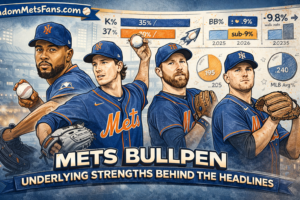
Losing Alonso (career Mets HR leader) and Díaz overhauled New York’s roster. The offense will feature less raw power and will take time to gel. In that context, an excellent bullpen can keep the Mets in every game. Instead of needing 11–8 slugfests, the Mets must win 5–4 games. That requires no free passes (walks), lots of strikeouts with runners on base, and avoiding big swings even when mistakes happen.
In concrete terms: if the bullpen can consistently hold opponents to one run over the 7th–9th innings, New York turns narrow deficits into victories. Mike Petriello (MLB) and others note that the 2026 Mets have a bullpen that “could be much improved if Weaver and Williams return to form,” which could offset a lighter lineup. Last year the Mets’ pen was middle-of-the-pack (3.93 ERA). Improving that to, say, a top-10 unit would significantly boost the team’s chances in a tight NL East race.
What to Watch Early On
Forget early save totals; watch the process metrics:
- Team bullpen walk rate: A rising BB% is a red flag (free baserunners kill innings). A low BB% means the pen isn’t handing out freebies.
- Williams’s chase%/whiff%: If his chase rate stays near 35% and whiff near 38%, he’s still unhittable. A drop here would signal his stuff isn’t fooling hitters as much.
- Weaver’s changeup usage and outcomes: That pitch was his bread-and-butter. If hitters start swinging and missing at Weaver’s changeup (as they did last year, producing a +5 run value), it means he’s back to form.
- High-leverage K%: In close games (late innings, tie or one-run), the bullpen should rack up Ks. The early-season percentage of strikeouts in high-leverage situations is a barometer. Violent swinging (high K%) signals pressure on opponents, whereas low K% means balls in play and more runs.
If these indicators remain strong in April, the bullpen is doing its job – games get shorter and opponents start pressing in the 7th inning. The Mets fans can feel confident the staff is helping win 4–3 and 5–4 ballgames.
Bullpen skills will win more games than doomsday takes. The data suggest New York’s relievers have the raw ability for late-inning dominance. If the outcomes catch up (runs allowed come down), the Mets will earn March praise for being winners, not January scorn for being broken. In short: do you trust this bullpen more than the lineup right now? Only time will tell, but the analytics say the pen is poised to deliver.
Join the conversation at RandomMetsFans.com
Subscribe to the newsletter
Let’s build the smartest Mets community on the internet