After tossing his first live batting practice as a Met in Port St. Lucie, Freddy Peralta was all smiles – literally. The 29-year-old right-hander, acquired this offseason to lead New York’s rotation, exudes an infectious energy on the mound. And he has plenty of reason to grin. The Mets have quietly assembled a run-prevention machine around him, and their new ace knows that a strong defense can be a pitcher’s best friend. Peralta has already raved about the Mets’ revamped infield, one essentially “filled with shortstops” at every position, because it means those borderline grounders and liners are far more likely to turn into outs. Team president David Stearns has similarly touted the advantage of having “four shortstops in the infield”, reflecting the club’s new emphasis on pitching, gloves, and athleticism over all else.
An Infield of Shortstops: A Pitcher’s Dream

What exactly does “an infield full of shortstops” look like? In the Mets’ case, it means all four starting infielders are natural shortstops by trade, Francisco Lindor at shortstop (a Gold Glove-caliber mainstay), Marcus Semien at second base, Bo Bichette sliding over to third, and Jorge Polanco learning first base. This collection of athletic infielders is a gift for a pitch-to-contact guy’s peace of mind. “That’s a pretty distinct advantage,” Stearns noted of deploying four experienced shortstops around the horn. Peralta clearly agrees, knowing that a lot of those tough-to-reach baseballs will be caught instead of sneaking through.
From a risk-management perspective, Peralta can pitch aggressively in the zone without fearing every ball in play. Even if he isn’t a classic groundball specialist, roughly one-third of his balls in play are on the ground, and having elite range at all four infield spots means many of those should be turned into outs. For instance, former first baseman Pete Alonso, whom Polanco replaces, ranked dead last among MLB first basemen in Defensive Runs Saved last year. Polanco, by contrast, brings a middle infielder’s agility and hands to first base. And while he’s never played first in games before, it’s not as crazy as it sounds – plenty of excellent first basemen began their careers at other positions. Likewise, Bichette is a shortstop with good range and a strong arm moving to a less demanding spot at third. Even if there are growing pains, the athleticism and instincts of these players should make the left side of the infield much more reliable than it was in 2025. As one analysis noted, both Bichette and Polanco are actually projected to handle their new positions capably, even “somewhat good,” based on their range and arm metrics. In other words, the Mets are betting that better athletes in new spots will still outperform the familiar but defensively limited faces they replaced.
Building a Run-Prevention Machine
This past offseason, Stearns set out to remake the roster with run prevention in mind, and he wasn’t subtle about it. The Mets parted with several fan favorites who didn’t fit the new defense-first vision. Longtime regulars Brandon Nimmo and Jeff McNeil were traded, and franchise slugger Pete Alonso (along with closer Edwin Díaz) departed in free agency. It was a bold makeover that initially shocked fans, but the defensive metrics help explain it. Nimmo and Alonso had been negative defenders by Statcast’s Outs Above Average (OAA) in 2025 (Alonso ranked in just the 2nd percentile). McNeil was solid at second but stretched in the outfield. Simply put, the previous unit was not a run-preventing defense, and it contributed to a second-half collapse in 2025.
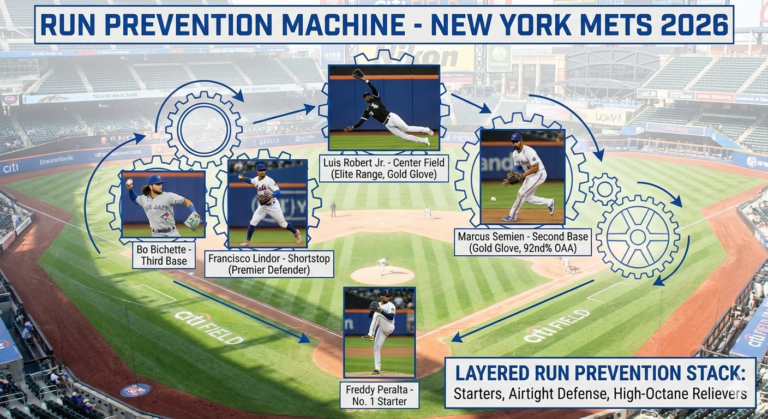
To correct course, the Mets imported a wave of players with strong gloves and athletic profiles. Semien, acquired in the Nimmo deal, just won a Gold Glove at second base and ranked in the 92nd percentile for OAA at that position, immediately shoring up a long-time weakness at the keystone. In center field, New York traded for Luis Robert Jr., an elite defender with 93rd-percentile outfield range (and a past Gold Glove on his shelf). He replaces Nimmo in center, turning what was a mildly below-average spot into a likely strength. If anything, the Mets now have an embarrassment of riches in outfield defense, Tyrone Taylor, another plus glove acquired as a depth piece, could end up in left field, providing an upgrade there as well. Meanwhile, the left side of the infield gets the aforementioned Bichette (a rangy 25-year-old shortstop moving to third) alongside Lindor (still one of the game’s premier defensive shortstops when he’s right). On paper, that’s potential defensive upgrades at four or five positions compared to last Opening Day. It’s no wonder Stearns invoked his Milwaukee roots: the blueprint looks like something the Brewers would design, run prevention at all costs. The logic is simple: fewer holes in the field + deeper pitching = fewer runs allowed.
Crucially, the Mets didn’t ignore pitching talent while assembling this run-prevention puzzle, far from it. Peralta was the centerpiece, arriving via trade as a proven No. 1 starter in his prime. But he’s not the only new arm in town. The front office also fortified the bullpen and back end of the staff. All-Star closer Devin Williams came aboard to replace Díaz, giving the Mets a swing-and-miss weapon in the ninth. (Williams’ 4.79 ERA last year was a fluke; advanced metrics valued him much higher, and he’s consistently been one of baseball’s top relief arms.) The Mets added swingman Luke Weaver and reliever Luis García for depth. The result is a layered run-prevention “stack”: starters who miss bats, an airtight defense behind them, and high-octane relievers to seal the deal in the late innings. If the Mets grab an early lead, this roster is built to make it hold up.
Peralta’s Ace Arsenal and Approach

All the defensive upgrades aside, Freddy Peralta’s own evolution is a huge part of the equation. In 2025 with Milwaukee, he threw a career-high 176⅔ innings and posted a career-best 2.70 ERA, establishing himself as a bona fide ace. Over the past three seasons, Peralta has been roughly a top-20 pitcher in MLB by most measures, ranking 7th in opponent batting average (.208) and 11th in strikeout rate (28.9%) among starters in that span. His strikeout-minus-walk percentage (K–BB%) sat around 20%, which is elite territory, and he’s consistently difficult to square up. In fact, last year he ranked near the top of the league in limiting hard contact (among the leaders in lowest hard-hit rate and exit velocity) while still piling up whiffs. This is a pitcher with the stuff to dominate on his own – but now, with a stronger defense, he can pitch even more freely.
Peralta’s pitch mix has evolved significantly as he’s grown from a flamethrower into a polished frontline starter. He still features a lively four-seam fastball as his primary weapon (averaging about 94–95 mph with excellent carry and a +9 run value last year). But in recent seasons he added and refined his secondary pitches to keep hitters off balance. Notably, Peralta dramatically overhauled his slider in 2025, reducing its usage (under 10% of his pitches) but adding 2+ mph of velocity and extra spin, which caused its whiff rate to skyrocket to 53%. In essence, he turned the slider into a put-away pitch that he could deploy sparingly for maximal effect. Meanwhile, he leaned more on a much-improved changeup as his #2 offering, throwing it about 21% of the time. That changeup dives away from lefty hitters with 16+ inches of fade, and it generated a 34.4% chase rate and 35% whiff rate, a deadly combination. Rounding out the arsenal is a big-breaking curveball to change eye levels. The upshot is that Peralta can attack hitters in a variety of ways: elevate the fastball for swings and misses, pull the string with the fading change, or flip the breaking balls to keep hitters guessing. It’s the repertoire of a pitcher who doesn’t need to rely on luck or his defense, he led the NL in strikeouts in 2025 with 204 Ks, yet he wisely pitches to contact when the situation calls for it. “I like the competitiveness we’re gonna face here,” Peralta said of coming to New York, embracing the challenge. With his swing-and-miss stuff backed by a gold-plated defense, that competitive fire can burn even brighter.
Of course, even an ace benefits from risk mitigation. Peralta does issue the occasional walk (about 8–9% walk rate) and flies tend to hang in the air in his outings (his ground-ball rate has hovered in the 35–40% range, a bit below league average). In the past, those factors could lead to “risk pockets” an untimely walk or a bloop hit setting up a big inning. But the Mets’ blueprint is designed to cover those pockets. A speedy outfield led by Robert Jr. will track down many of those fly balls. An infield of four shortstops will turn would-be seeing-eye singles into routine 6-3 putouts. And if Peralta ever does find himself in a jam, he can be confident in making a good pitch and letting the gloves behind him do the work. This peace of mind can also help Peralta be more efficient; he might pitch to contact earlier in counts knowing the defense will convert outs, keeping his pitch count lower. It’s a virtuous cycle: trust your stuff, trust your defense, go right at hitters.
Leading the Staff with Energy and Smiles

Beyond the numbers and on-paper upgrades, Freddy Peralta brings intangible qualities that make him the ideal tone-setter for this new-look Mets team. By all accounts, he was a beloved clubhouse leader in Milwaukee, the kind of teammate who could loosen up a room and bring players together. (As one anecdote revealed, after Brewers day games, “everyone… knew where they were going… Freddy Peralta’s house” for a team get-together.) He carries an “infectious smile” and positive vibe everywhere he goes, a trait Mets fans already know well from Francisco Lindor. New York’s front office clearly valued this aspect of Peralta; Stearns, who first acquired Freddy as a raw prospect years ago, praised his quality leadership and targeted him not just for his arm but for his clubhouse impact. Now that he’s here, Peralta has embraced the leadership mantle. He described his style as simply “be himself” every day, bring optimism and help others, believing that if he does that, “everything goes better.” It’s a perfect fit for a team trying to gel a lot of new faces into one unit.
Early signs are encouraging: Peralta has already connected with many of his new teammates (a barrage of welcome texts and FaceTime calls came from Lindor, Juan Soto, Francisco Alvarez, and others as soon as he was traded). The word “family” keeps popping up in his remarks, and it doesn’t sound like a cliché, he genuinely invests in team chemistry. That matters, because the Mets underwent so much change that establishing a winning culture is as important as compiling defensive runs saved. A year ago, the clubhouse mix wasn’t ideal and the team’s performance suffered down the stretch. Peralta’s arrival is helping turn the page. He is not overwhelmed by the New York spotlight, in fact, he has welcomed it with open arms, and his enthusiasm is already rubbing off on those around him. As one Mets pitcher, Tobias Myers, noted in camp, Peralta “brings the best out of” the pitchers around him by example. He works hard, competes hard, and has fun doing it, which sets a tone younger players can follow.
In short, Freddy Peralta embodies exactly what the Mets want this season to be about. On the mound, he’s a dynamic, evolving ace with the weapons to dominate and the wisdom to utilize a great defense behind him. In the dugout, he’s a leader by example, upbeat, hard-working, and unselfish, who can help knit together a roster full of new teammates all pulling toward one goal. The Mets re-made their roster for run prevention, and now their run-prevention machine is nearly built. All the parts are there: a stellar defensive infield and outfield, a deeper pitching staff, and a refreshed clubhouse chemistry to glue it together. At the center of it stands Peralta, flashing that megawatt smile as he fires another strike. If all goes according to plan, a lot of baseballs will be caught, a lot of zeros will go up on the scoreboard, and Freddy Peralta’s energy will be contagious for a Mets team looking to turn run prevention into lots of wins.
Sources: Freddy Peralta introductory press conference and coverage; Mets offseason analysis on defensive upgrades; Peralta pitch arsenal data (FanGraphs, Statcast); David Stearns quotes on “four shortstops” and run prevention philosophy; Sports Illustrated and SNY reports on Peralta’s clubhouse impact; Metsmerized and MLB.com analysis of roster moves and projections.
Join the conversation at RandomMetsFans.com
Subscribe to the newsletter
Let’s build the smartest Mets community on the internet