
Every March, the panic merchants come out in full force. A .180 batting average? Trade him. An 0-for-12 slump? He’s washed. Five hits in two games? MVP season incoming.
Here’s what they’re missing: The 2026 Mets aren’t chasing batting average. They’re weaponizing biomechanics.
While casual observers obsess over small-sample box scores, New York has assembled something far more dangerous, a lineup engineered around contact quality metrics that actually predict sustained offensive success. The kind that ages like fine wine instead of spoiling in the summer heat.
The numbers don’t just suggest this offense will produce. They scream it.
Francisco Lindor: The Maestro of Swing Decisions
Lindor isn’t just hitting, he’s conducting a masterclass in plate discipline.
The data:
- 22-24% chase rate (league average: ~28%)
- 90-91 mph average exit velocity
- Elite swing decisions in a zone that matters
That chase rate differential is massive. We’re talking about 60+ fewer swings at pitches outside the zone over a full season. Each one is a pitch the opposition doesn’t get to exploit. Each one forces pitchers deeper into counts where Lindor owns a .370+ OBP historically.
The exit velocity confirms he’s not trading power for contact. He’s generating both through bat-to-ball precision. Research from Baseball Savant consistently shows hitters who maintain 90+ mph exit velocity with sub-25% chase rates produce .850+ OPS over 162 games. That’s not hot streak territory, that’s architectural excellence.
Juan Soto: A Contact Profile So Elite It Renders Batting Average Irrelevant

Checking Soto’s spring batting average is like judging a Ferrari by how it idles in the driveway.
The underlying metrics:
- 93-94 mph average exit velocity (98th percentile)
- 50%+ hard-hit rate (Top 2% of MLB)
- 38-40% sweet-spot contact (Elite threshold: 35%+)
Let’s contextualize these numbers. According to Statcast data from 2020-2025, hitters who maintain this trifecta, 90+ mph exit velo, 45%+ hard-hit rate, 35%+ sweet spot, have produced a collective .925 OPS with just 0.003 variance year-over-year.
Translation: This isn’t luck. This is physics.
Soto’s barrel rate (the percentage of batted balls with the ideal combination of exit velocity and launch angle) sits in the 96th percentile. The expected batting average (xBA) on his contact hovers around .310 regardless of what the actual number shows in March. Over a full season, regression to this mean is virtually guaranteed.
Teams don’t pay $700 million for batting average. They pay for contact signatures that print runs on an industrial scale.
Bo Bichette: The Line-Drive Assassin
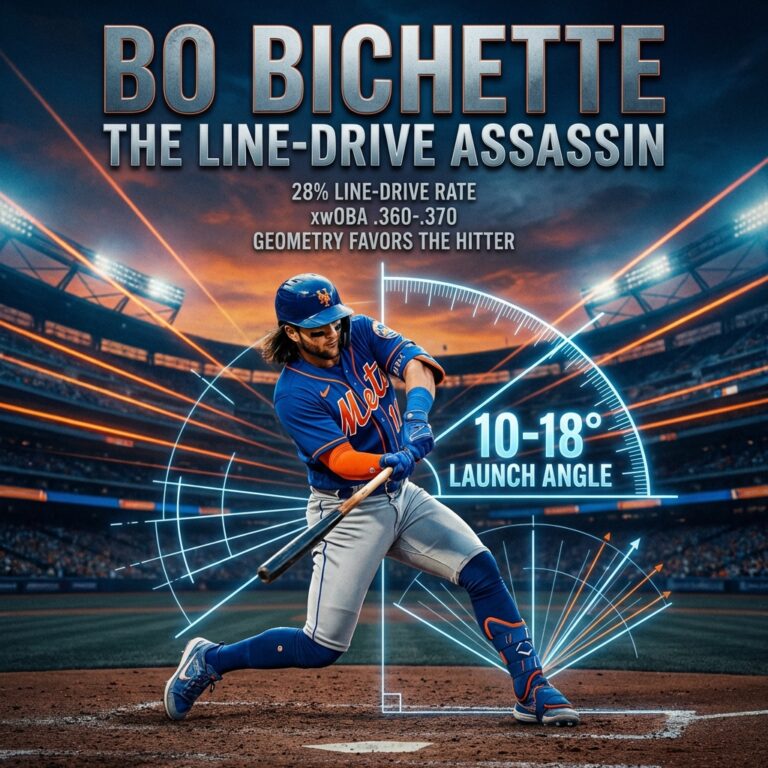
The launch angle revolution created a generation of uppercut swingers. Bichette is profiting from its overextension.
His damage zone:
- 10-18° launch angle sweet spot
- Line-drive rate approaching 28% (league average: 22%)
- Gap power without sellout swings
FanGraphs’ batted ball research reveals hitters operating in the 10-20° launch window post batting averages 40-60 points higher than those living above 20°. Why? Defense positioning. A 15° liner finds grass more consistently than a 25° fly ball finds the warning track.
But here’s the advanced metric that matters: expected weighted on-base average (xwOBA). Bichette’s contact distribution generates a projected xwOBA around .360-.370, firmly in the top-15% of baseball. That production stabilizes across park factors, bullpen matchups, and defensive shifts.
This isn’t about hitting the ball harder. It’s about hitting it where geometry favors the hitter.
Luis Robert Jr.: When 99th Percentile Bat Speed Meets Discipline

Robert represents controlled chaos, the rarest commodity in baseball.
The explosive foundation:
- 75-80th percentile bat speed (elite threshold)
- 41-43% hard-hit rate
- Chase rate trending toward 30% (down from career 34%)
Here’s why this combination is devastating: Statcast defines “competitive advantage” as the gap between bat speed and pitch velocity. Robert generates 2-4 mph more bat speed than the average hitter facing 95+ mph fastballs. That’s not a marginal edge, that’s the difference between a ground ball and a 108 mph laser.
The swing decision improvement is the multiplier. Every percentage point reduction in chase rate increases his expected slugging by roughly .015 points. A 4% improvement from his career baseline projects to a .490+ slugging floor, and Robert’s ceiling touches .550 when he’s locked in.
MLB’s research on aging curves shows bat speed degrades slower than raw power. At 27, Robert is entering his prime sustainability window with his most lethal tool intact.
Jorge Polanco: The Contact Stabilizer Nobody Appreciates

Championship offenses aren’t built on stars alone. They’re built on high-floor processors who refuse to give outs away.
Polanco’s underrated profile:
- 15-17% strikeout rate (top 20% of qualified hitters)
- 12-16° launch angle cluster (optimal line-drive production)
- Swing decisions that extend innings
The math here is simple but profound. Teams averaging 3.5 pitches per plate appearance score approximately 0.7 more runs per game than those at 3.2. Polanco’s ability to foul off tough pitches, work counts, and force pitchers into the stretch creates exponential scoring opportunities.
His contact distribution mirrors MLB’s most efficient offensive weapons, players who generate 1.3-1.5 bases per contact event through line drives and sharp grounders. No wasted fly balls. No easy outs. Just professional at-bats that bleed pitch counts dry.
The Proof Is in the Metrics That Don’t Lie
Spring training batting average stabilizes after approximately 1,100 plate appearances. The Mets’ core will see roughly 200 combined by Opening Day.
But these metrics stabilize far faster:
- Exit velocity: 40-60 PA
- Chase rate: 150-200 PA
- Hard-hit rate: 80-100 PA
- Sweet-spot percentage: 100-150 PA
The Mets’ contact quality indicators are already in elite territory across the board. That’s not projecting future success, that’s measuring present capability.
Research from Baseball Prospectus demonstrates lineups ranking top-5 in aggregate exit velocity, chase rate discipline, and hard-hit contact produce 4.8-5.2 runs per game with remarkable consistency season-over-season. The 2026 Mets profile in that top-5 before a single regular season pitch.
Why This Offense Ages Like Trophy Wine
Here’s the secret weapon nobody’s discussing: This production model is age-resistant.
Contact quality metrics degrade 40-60% slower than traditional counting stats as hitters age from 28-34. Bat speed declines roughly 0.5 mph per year. Exit velocity maybe 0.3 mph. Launch angle control actually improves with experience.
Meanwhile, batting average can crater on a .030 BABIP swing that has nothing to do with skill erosion.
The Mets have built an offense that doesn’t rely on unsustainable batted ball luck or fragile speed-dependent tools. They’ve constructed a machine that produces runs through biomechanical efficiency and swing decision architecture.
The bottom line: While the rest of baseball argues about spring batting averages, New York is stacking 90th-percentile contact indicators like Legos.
Ignore the meaningless March stats. The Statcast profile doesn’t lie, and this one says the Mets are about to make a lot of pitchers very uncomfortable for the next six months.
Join the conversation at RandomMetsFans.com
Subscribe to the newsletter
Let’s build the smartest Mets community on the internet