Mets fans love prospects in two modes: future superstar or future trade chip. Jacob Reimer is annoying in the best possible way, he refuses to fit neatly in either box.
The bat is real. The development story is even better. The position is the argument starter.
Reimer looks like the type of hitter the Mets have been trying to manufacture for years: right-handed, selective, damage-focused, comfortable living in counts, not terrified of velocity, and now finally lifting the baseball with intent. He also comes with a very Mets prospect twist. Third base is not guaranteed, first base is plausible, left field is on the table, and the entire value proposition lives or dies on how much power shows up against Major League pitching.
This is a deep dive on who Reimer is, what the data says, what the people around him have said out loud, what the swing changes actually mean, and how this can matter in 2026 when the Mets will need cheap, controllable production at the corners.
The Snapshot
Name: Jacob Reimer
Bats/Throws: Right/Right
Primary path: 3B now, corner bat long-term (3B/1B/LF mix)
Age: 22 season in 2026
Draft: 4th round (2022), over-slot signing
2025 levels: High-A Brooklyn, then Double-A Binghamton
If you want the one-line summary: Reimer is a plate-discipline hitter who learned how to do damage without selling his soul.
The 2025 Breakout Was Not Fluky

Reimer’s 2025 stat line reads like someone finally matching approach with intent:
- High-A (Brooklyn): .284/.384/.502 in 61 games
- Double-A (Binghamton): .279/.374/.479 in 61 games
- Total (122 games): .282/.379/.491 with 17 HR, 32 doubles, 15 steals, 58 walks, 112 strikeouts
That is the profile of a hitter who can get on base, drive the ball, and stay athletic enough to not clog a lineup.
The more important part is what changed underneath it.
A big criticism earlier in his pro career was a ground-ball heavy batted-ball mix that kept the raw strength trapped in the dirt. In 2025, the batted-ball shape finally moved toward what corner bats need:
- Brooklyn: 39.3% GB, 33.5% FB, 27.2% LD
- Binghamton: 39.6% GB, 40.3% FB, 20.1% LD
- Combined: 39.4% GB, 36.7% FB, 23.9% LD
He also pulled the ball more than ever, posting a 51.0% pull rate.
That is the whole story. Lift plus pull is how right-handed hitters turn “nice doubles” into “put him in the middle of the order.”
There was a tradeoff: swing and miss ticked up.
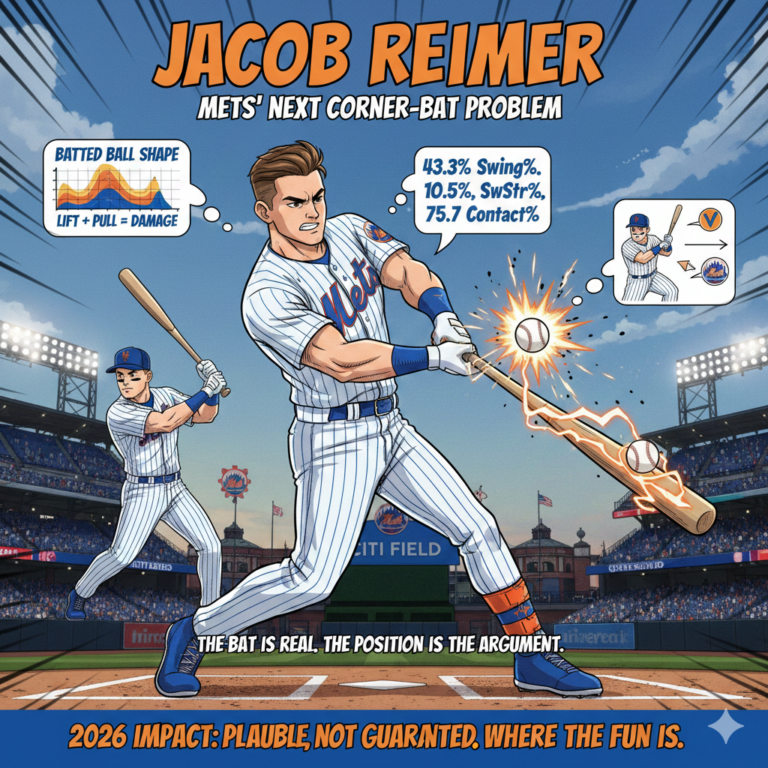
- Swing% rose to 43.3%
- SwStr% climbed to 10.5%
- Contact% dipped to 75.7%
Those numbers are not scary for a corner profile if the damage travels with them. This is the modern deal. More intent, more air, more pull-side authority, slightly more whiff.
The Injury Year Matters More Than People Admit

Reimer’s 2024 was a mess, not talent-wise, body-wise. A hamstring injury wiped out most of the season and turned his development timeline into a fog machine. He said it straight, and it is the most honest thing a hitter can admit:
“Once I was finally healthy, I didn’t feel healthy.”
He described playing with the constant thought that one hard run could re-tear it, then made the obvious point that should not need explaining:
“When you’re playing baseball, if you’re 50% in, you’re not gonna perform.”
That matters for two reasons.
First, 2025 was not just a breakout, it was a return to normal physical confidence.
Second, the mental side is already wired the right way. Reimer talks like a hitter who understands routines, process, and the difference between motivation and panic.
One more line from his 2024 season preview tells you how he carries himself:
“You got to keep your feet where they are that day.”
That is a professional sentence.
What Changed in the Swing, In Human Language
Reimer did work at Driveline, then leaned into the Mets’ hitting lab and development staff. His quotes are not vague. They are mechanical.
He said the offseason focus was:
“Just bat speed, posture, stuff like that.”
Then he described the shift that unlocked the pull-side damage:
“Find some freedom in my swing… that has upped my bat speed and let me turn quicker, and pull the ball a little better.”
This is the key. “Turn quicker” is code for better rotational sequence and earlier barrel entry into the zone. A right-handed hitter who cannot turn the barrel on time ends up spraying singles and rolling over pitches he should punish.
Reimer’s stance and move also fit the data story. He has an open setup, high hands, a leg lift, and a fairly direct path. The profile favors middle and up. That is the area where pull-side lift lives. The adjustment is not some random “swing harder” nonsense, it is posture and timing that lets the barrel meet the ball with leverage.
A hitting lab quote from Reimer is the modern version of “we have video now,” except he is talking about sequencing at the millisecond level:
“All the data from the swings you take will show everything from the tiny… millisecond of your sequence, to where you’re standing, to your posture…”
He also talked about comparing swings to Major Leaguers, name-checking Pete Alonso as an example, then building drills off those benchmarks.
This is why the 2025 batted-ball change is credible. The work matches the output.
Approach Profile: Patient With a Mean Streak
Reimer’s game is not “see ball, hit ball, hope.” He has always shown strike-zone awareness and comfort taking walks. The critique in earlier years was passivity, passing on pitches he could damage.

2025 shows a hitter who stayed selective while being more willing to attack.
Swing% rose, contact slipped, whiff rose, damage exploded.
That is the exact development curve you want from a corner bat prospect. You want a hitter who can recognize pitches, then choose violence on the right ones.
The danger zone is obvious too: if Major League velocity and sharp breaking balls push the whiff rate too far, the walks will not save him. This becomes a low-average, walk-heavy, power-dependent bat, which plays great when the power is 25-plus homers, and plays like a roster problem when it is 15.
Reimer’s entire ceiling is tied to where that power lands.
Pitch Type and Zone Fit, What Will Challenge Him
Public minor league pitch-type data is not as clean as MLB Statcast, so this part is inference off the scouting notes and his swing shape.
Reimer’s setup and “middle-up” swing plane usually comes with two MLB challenges:
- Fastballs above the belt that demand elite bat speed and early decision-making
- Breaking balls down and away that punish hitters who want to pull everything
He is already aware of the pull-side plan, which is good and dangerous at the same time. Pull plans work when the hitter has a two-strike approach that still covers the outer third.
The promising note from his scouting is that he reads spin well and tracks pitches, with enough plate coverage to make contact down in the zone when he chooses. The next step is proving that skill holds at Triple-A and in MLB camps.
A good 2026 outcome includes him punishing mistakes inside and not expanding the zone when pitchers refuse to give him something to yank.
Defense and Position, The Comment Section Starter
Here is the part Mets fans will fight about.
Reimer has played mostly third base as a pro, with some first base, and he got some left field looks in the Arizona Fall League. The arm is strong enough for third. The range and first step are the debate.
One scouting summary said he lacks the quick-twitch and lateral burst ideal for third, with occasional passivity on plays and some accuracy scatter depending on the rush of the throw. The concern is simple: more mass, less mobility, eventual move off the left side.
This is where “corner bat” matters. If he becomes a first baseman, the bat has to be louder. If he becomes a left fielder, the bat still has to be loud, plus he has to look playable enough out there to not turn games into adventures.
Reimer does have enough athleticism for the position conversation to stay open for now. He stole 15 bags in 2025. He is not a statue. He just might not be a long-term third baseman in a league where third base is increasingly filled with actual shortstops who grew into power.
Realistic projection: some third base early, then a split between 1B and corner outfield as he fills out.
The Tools in Modern Terms

Think of Reimer’s tools like this:
- Hit tool: Above average chance, driven by zone control and pitch recognition
- Power: The swing changes unlocked it, now it has to translate to MLB quality pitching
- Speed: Better than you assume for the body type, not a burner, not a clogger
- Arm: Good enough for third, plays fine anywhere on a corner
- Glove: The limiter, not fatal, just position-shifting
This is a profile that lives in a spectrum from “useful everyday bat” to “dangerous middle-order hitter,” with the defensive home deciding how loud the bat has to be.
2026 Projection, The Numbers and the Reality
Projection systems are not always kind to prospects, especially hitters with uncertain defensive homes and developing power.
FanGraphs’ public projections show a wide range of possible MLB value, including a pessimistic line that looks like a bench bat and a more optimistic one that looks like a real regular.
That spread is the point.
Reimer’s 2026 story depends on three outcomes:
1) The fast track outcome
He carries the 2025 batted-ball shape into Triple-A, keeps the walk rate healthy, and forces a midseason MLB look. The Mets use him as a right-handed corner option who can platoon or rotate across 3B, 1B, and LF.
2) The normal outcome
He spends most of 2026 in Triple-A refining contact quality and two-strike decisions, then becomes a 2027 roster feature.
3) The frustrating outcome
Whiff rate climbs, pitchers live down and away, power shows up in streaks, and he becomes a Quad-A masher until a swing adjustment or approach tweak sticks.
The good news: Reimer already talks like someone who adjusts with intent, not panic.
Citi Field Fit, The Quiet Advantage
Citi Field is not Coors. A right-handed hitter who lives on oppo fly balls will watch too many “nice swings” die in a left fielder’s glove.
Reimer’s 2025 evolution toward pull-side lift is exactly what plays in Queens. Line drives to the gaps become doubles. Pulled air becomes homers down the line and in the left field seats when the barrel is right.
A right-handed corner bat who can lift and pull is not optional in the current NL. It is roster oxygen.
The “Make People Argue” Comps
Comps are not predictions. Comps are arguments with shoes on.
Comp 1: Justin Turner (prime-ish shape, modern version)
This is the easiest stylistic comp for the comment section. Turner was not a top-10 tools guy. Turner was a plan guy who became a monster when the swing matched the intent. Reimer’s zone feel and “damage through lift” development path makes this comp feel logical enough to start a war.
Comp 2: J.D. Davis with better discipline and more athleticism
This one will annoy everyone, which is the point. Davis had real thump and could run into a season. His value swung wildly with contact quality. Reimer’s walk base and stolen-base athleticism gives him a chance to be a more complete version, with the same corner-bat pressure to hit.
Comp 3: Josh Donaldson-lite, without the defensive certainty
This is the spiciest comp, and it is intentionally controversial. Donaldson’s value came from loud pull-side damage and real third base defense. Reimer’s bat path evolution hints at the damage side, while the defense is the question mark. The comp works as a “shape” comp, not a ceiling promise.
Pick your favorite, then pretend the other two are criminal. Comments will write themselves.
What Coaches and Context Tell Us

Two things show up repeatedly in how people around the Mets talk about development right now.
First, there is a strong emphasis on preparation and playing hard. Cyclones manager Gilbert Gómez described his club as:
“Committed to playing the game hard and to be prepared.”
Second, Reimer himself has noticed an organizational cultural shift toward baseball-focused leadership that still speaks analytics. He put it plainly:
“You can tell the culture is different… baseball guys… in with the new wave… analytics side.”
This matters for Reimer specifically, since his recent development is a product of systems. Driveline work, swing lab work, staff continuity, and a clear plan toward pull-side damage.
Nothing here screams fluke. Everything screams “this was built.”
The Risk Profile, What Can Break This
A prospect like Reimer carries three real risks:
- Defensive home risk
A move off third raises the bat requirement. - Whiff creep risk
The 2025 jump in SwStr% is fine. A further jump against better pitching changes the profile fast. - Health recurrence risk
Hamstrings can be annoying. Confidence can lag behind the medical clearance. He already lived that.
The counter is also real: Reimer is already building the habits and the mental language of a hitter who can absorb failure, learn, and keep moving.
Why This Matters for Mets Fans in 2026
The Mets’ competitive window is not a single year. The roster is expensive. The farm matters most when it creates usable, controllable production that lets the front office spend money surgically, not desperately.
Reimer is exactly the type of player who can show up in 2026 and matter in a very Mets way:
- A right-handed bat who lengthens the lineup
- A corner option who makes injuries less catastrophic
- A cheap bat that offsets expensive pitching
- A prospect who stays in the org precisely because other chips got traded
He is also the type of player who can become a fan obsession in three weeks if he hits in Spring Training.
That is not a joke. That is Mets math.
The Bottom Line
Reimer’s 2025 breakout is backed by mechanical changes, batted-ball shape, and an organizational development story that he can describe in detail.
The bat is trending toward real Major League value. The position is the unresolved puzzle. The 2026 impact window is plausible, not guaranteed, and that is where the fun is.
Corner bat prospects either become lineup fixtures or they become “why did he not hit enough?” trivia questions.
Reimer is positioned to be the first one, provided the contact holds and the power keeps showing up against pitching that can actually locate.
Resources
- MiLB season preview with Reimer quotes on Driveline work, swing changes, culture, and coaching staff.
- Gotham Baseball feature with Reimer quotes on the hitting lab, buy-in, hamstring recovery, plus a Gilbert Gómez quote.
- Amazin’ Avenue prospect profile with full 2025 stat line, swing mechanics notes, batted-ball rates, Pull%, Swing%, SwStr%, Contact%, plus defense and positional risk.
- MLB Pipeline piece highlighting Reimer as a Top 100 candidate, with updated scouting context and developmental notes.
- MLB Pipeline “Top 10 by Position” list showing Reimer ranked among the top third base prospects for 2026.
- Baseball Savant player page for biographical details and level-by-level 2025 results.
- FanGraphs player page for consolidated minor league performance and publicly posted projection ranges.
- MLB.com recap of Brooklyn’s 2025 title run referencing Reimer among the affiliate’s key bats, plus direct quotes from manager Gilbert Gómez.
Join the conversation at RandomMetsFans.com
Subscribe to the newsletter
Let’s build the smartest Mets community on the internet