
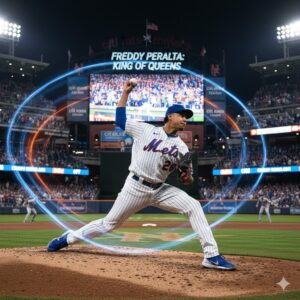
Freddy Peralta just walked into Queens with a profile that plays like a modern number one: elite swing-and-miss foundation, plus secondaries that grade as real weapons, plus a home park that can make his one loud risk look quieter. He led the National League in wins in 2025 (17) with a 2.70 ERA across 33 starts and 176.2 innings. The move is not a vibes trade, it is a run prevention bet grounded in strikeouts, fastball shape, and the way Citi Field suppresses scoring.
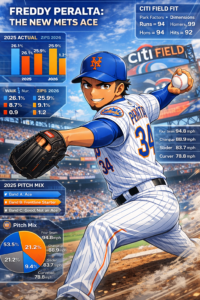
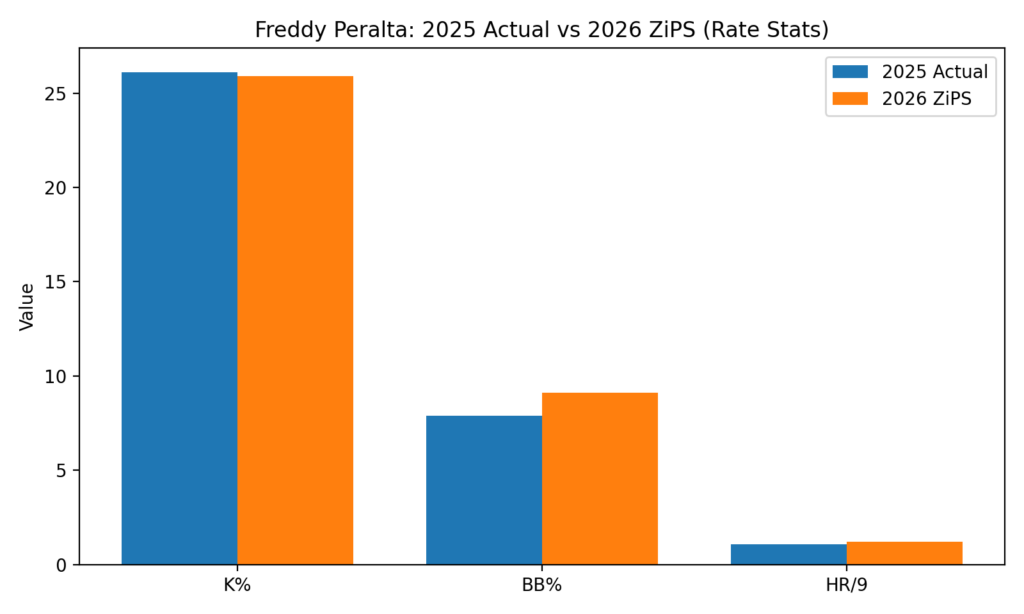
ZiPS forecasts regression in 2026, yet still pegs him as a frontline arm: 160.7 innings, 25.9% strikeout rate, 9.1% walk rate, 1.2 HR per 9, and 2.5 WAR. Translation: even the “pullback” version of Peralta is a real top-of-rotation piece.
What the Mets actually bought
The 2025 headline, then the underlying engine
The 2025 line is clean: 2.70 ERA, 1.08 WHIP, 204 strikeouts, 176.2 innings. That is not a fluky five-start heater, that is a full season workload at top-tier results.
The engine underneath that season shows why the Mets can reasonably project this to travel:
- Strikeouts stay sticky. Peralta struck out 26.1% of hitters in 2025 and sat at 25.9% in the ZiPS 2026 forecast. The “skill” remains, even when the projection system cools the outcomes.
- Whiffs and chase are not average. Statcast’s plate-discipline line for 2025 shows a 31.3% whiff rate and 31.4% chase rate, plus a strong 12.8% swinging-strike rate. Those are pitcher-driving numbers, not defense-driven numbers.
Career arc: the short version that matters
Peralta’s career is not a straight line, it is a set of iterations. Eight MLB seasons produced a 3.59 career ERA with 1,153 strikeouts across 931 innings. He has shown the ability to miss bats as both a starter and reliever, then scale back into starter volume without losing the core strikeout trait.
Two things defined the “why not just assume ace forever” counterpoint:
- Health has interrupted peaks. MLB’s transaction log documents multiple shoulder-related IL stints (2021 shoulder inflammation; 2022 lat strain plus later shoulder inflammation). Durability becomes part of the 2026 projection debate whether fans like it or not.
- The fastball has been the swing variable. Peralta can dominate with it when the location and ride play together. He can also get punished when it leaks into damage zones.
That second point is the entire story for Citi Field.
Pitch design: why the arsenal works
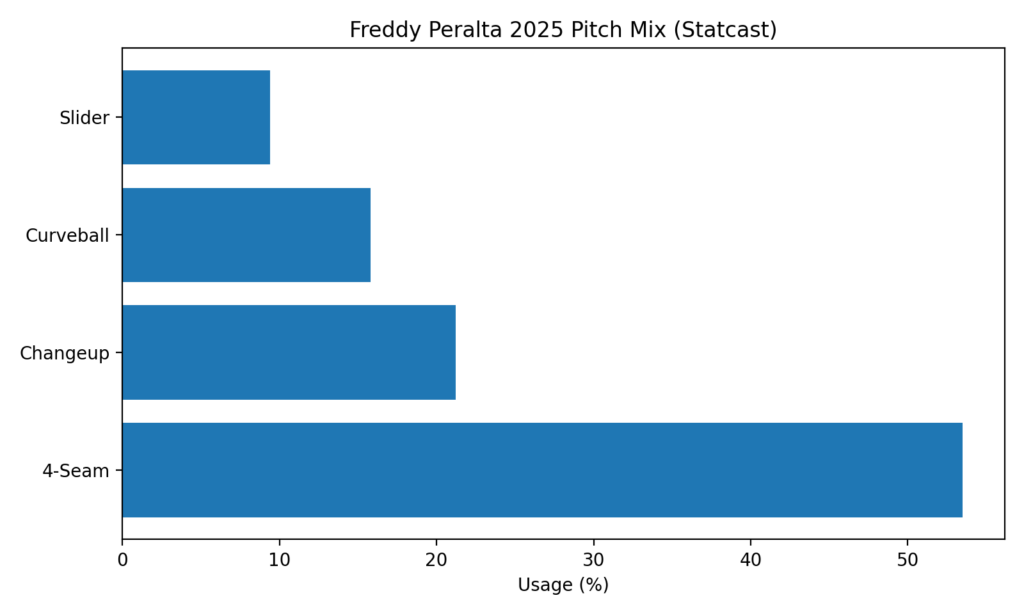
Statcast classifies Peralta as a four-pitch starter with a straightforward identity:
- Four-seam fastball: 53.5%
- Changeup: 21.2%
- Curveball: 15.8%
- Slider: 9.4%
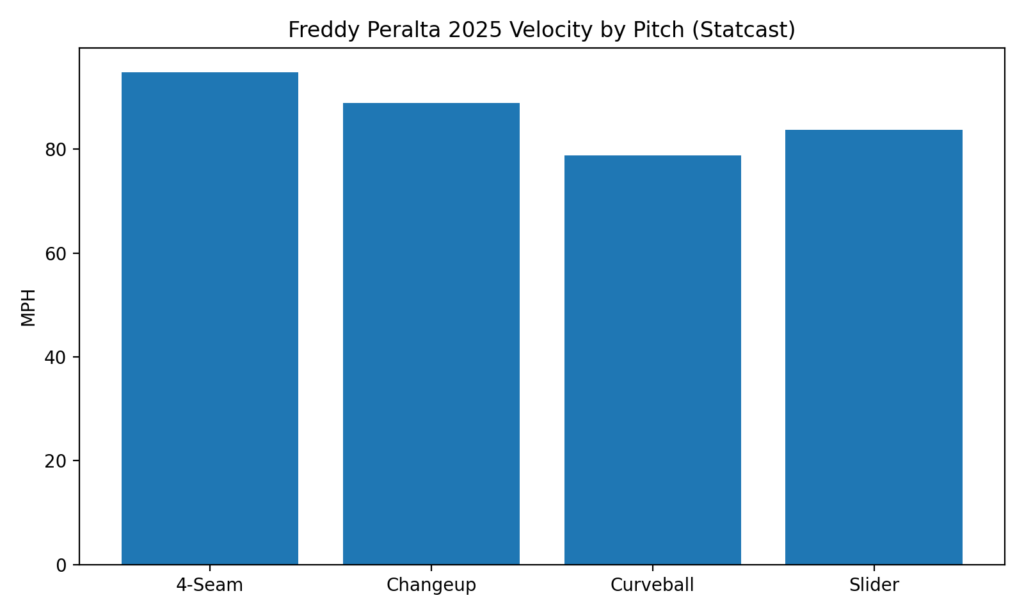
Velocity separation is strong:
- Four-seam: 94.8 mph
- Changeup: 88.9 mph
- Slider: 83.7 mph
- Curveball: 78.8 mph
That gap structure matters. His changeup lives in the classic “kill timing” window off a mid-90s four-seam. The curveball and slider give him two different breaking speeds, which helps him avoid becoming a two-pitch profile that good lineups solve by the third trip.
The sneaky tell: active spin and movement
Statcast’s pitch tables show high active spin on the four-seam (86%) and changeup (88%), plus meaningful total movement on both offerings. That combination supports a fastball that plays “above” its velocity and a changeup that does not just float into barrels.
Pitch value reality check
FanGraphs pitch values for 2025 show a key truth: his four-seam was a net negative in run value, while the slider, curve, and change were positives. That split explains both the ceiling and the pressure point. Peralta does not need the fastball to be elite to win, yet he does need it to avoid being a liability in the heart of the zone.
Citi Field fit: this is the park that can cover his biggest flaw
Citi Field remains a pitcher-friendly environment by recent park factor measurements. MLB’s own park factors list Citi Field at Runs 94, Homers 99, Hits 92 with 100 as league average. Big picture: scoring is suppressed.
Dimensions reinforce why:
- Left field: 335
- Center field: 408
- Right field: 330
This park fit matters for Peralta in one very specific way: the damage version of Peralta is usually “fastball mistake becomes a homer” rather than “death by singles.” Citi Field does not erase that risk, yet it reduces the punishment for a subset of deep fly balls that leave other parks.
How his pitches should play here, pitch by pitch
Four-seam fastball
The goal at Citi Field is not “throw it more,” the goal is “throw it with intent.” A high-ride four-seam paired with a changeup works best when the heater stays above bats or off the barrel plane. Citi Field helps when contact turns into deep fly outs instead of cheap homers, yet it only helps if the fastball misses the heart.
Changeup
This is the carry tool. The velocity gap off the four-seam is real, and Statcast’s active-spin and movement profile supports a change that should continue to miss barrels. Citi Field’s spacious gaps also reward pitchers who induce softer contact that stays in the yard.
Curveball and slider
He owns two breaking speeds that can be sequenced to avoid predictable timing. The curveball’s slower velocity band forces hitters to cover the bottom of the zone, then the slider can live as a chase pitch off the plate. That sequencing becomes more valuable in Citi Field because the Mets can play for strikeouts and controlled contact without needing a homer-suppressing miracle every night.
2026 projections, framed like a front office
ZiPS forecast for Peralta in 2026:
- IP: 160.7
- K%: 25.9
- BB%: 9.1
- HR/9: 1.2
- FIP: 3.97
- WAR: 2.5
That is a “good number one on a playoff team” line, even before factoring in Citi Field’s run environment.
Three outcome bands that actually make sense
Band A: Ace outcomes
Health holds. Walk rate stays closer to his 2025 level. The fastball becomes neutral instead of negative on run value. That version can live in the low-3s by ERA with real Cy Young chatter, especially with Citi Field shaving off a few mistake homers.
Band B: Frontline starter outcomes
This is the ZiPS line. Slight regression, still high strikeouts, some walks, some homers. The Mets get 160 to 175 innings of above-average run prevention and a legitimate stopper every fifth day.
Band C: Good pitcher, not an ace outcomes
Walk rate climbs. The fastball bleeds damage. Health creates missed time or fewer deep starts. That version is still useful, yet it turns the rotation math into “who is the real one” again.
Risk management: what has to be true for 2026 to pop
1) Keep the shoulder and lat from becoming the headline
The injury record is real. 2021 shoulder inflammation happened. 2022 featured a long IL run plus a later shoulder inflammation stint. The Mets do not need to baby him, yet they do need to manage stress and recovery intelligently.
Practical usage goals:
- Aggressive early monitoring of velocity and release consistency in spring
- Quick action on fatigue signs in April and May
- Planned breathers around high-intensity stretch runs, not reactive panic
2) Make the fastball “boring”
FanGraphs pitch values point to a 2025 story where secondaries carried more of the run-value load than the heater. That is fine if the fastball functions as a platform pitch rather than a liability pitch. The Mets should chase two outcomes: fewer heart-zone heaters, more fastballs that set up the changeup.
3) Citi Field is not a cheat code
The park suppresses runs and hits, yet it still allows homers close to league average by park factor. Citi Field helps on the margins. Citi Field does not fix bad fastball decisions.
What this means for the Mets rotation, in plain English
Peralta gives the Mets something they have lacked in recent “almost” seasons: a starter who can end losing streaks without needing perfect defense or three homers of support. The strikeout foundation travels. The pitch mix travels. Citi Field supports the profile. ZiPS sees regression and still calls him a 2.5 WAR arm. That is why this is an ace acquisition even when fans want a video game stat line every week.
Visuals to embed in the article
2025 Actual vs 2026 ZiPS (K%, BB%, HR/9)
2025 Pitch Mix Bar Chart
Velocity by Pitch
Join the conversation at RandomMetsFans.com
Subscribe to the newsletter
Let’s build the smartest Mets community on the internet