
Mets fans should probably stop printing prospect lists. The ink dries, then David Stearns flips the table.
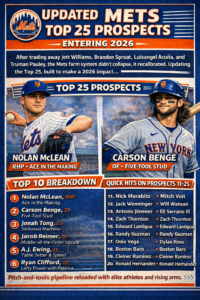
Originial Top 25 Mets Prospect article written earlier this month prior to trades made this week.
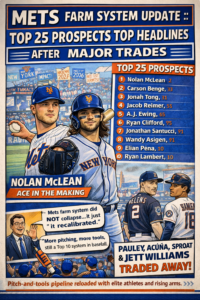
The Mets just shipped out four high-end names in a hurry: Jett Williams and Brandon Sproat in the Freddy Peralta deal, plus Luisangel Acuña and Truman Pauley in the Luis Robert Jr. trade. That’s not “tweaking.” That’s a roster strategy with a body count.
So here’s the updated reality: the system didn’t die, it rebalanced. The high-end “future everyday guys” got thinner, the upper-minors pitching stayed strong, and the org leaned even harder into tools, athleticism, and arms that miss bats.
Below is the updated Top 25, with a deep dive on the new Top 10 and sharp notes on 11–25.
Updated Top 25 Mets Prospects (Entering 2026)
Top 10 (Detailed Breakdown)
1) Nolan McLean, RHP (Age 24)

This is the new headliner. McLean is now the prospect you build around, not the one you “include if the other team insists.” His separator is the slider: a true weapon, not a “solid pitch.” MLB Pipeline describes it as a high-spin sweeper with 15–16 inches of horizontal break at 84–87 mph, and it plays like a cheat code when he’s ahead in the count. His big-league cameo only poured gas on the hype, and the Mets are treating him like an imminent rotation anchor, not depth.
Why he’s No. 1: bat-missing breaking ball, starter’s arsenal, and the org has him on the fast track.
Nolan McLean complete break down – where McLean goes next
2) Carson Benge, OF (Age 23)
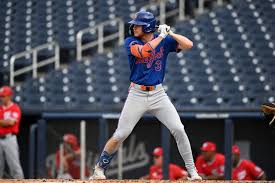
Benge is the rare prospect who checks the scouting boxes and the production boxes without needing excuses. Over 131 minor league games, he owns a .280/.389/.468 line with 17 HR and 25 SB, and the plate discipline is real. David Stearns didn’t even bother pretending this was a “someday” plan: “We have to find space for those players to play. Carson is among them.” That’s not fluff. That’s a front office telling you the depth chart is being shaped around him.
Andy Green also framed Benge’s late-season Triple-A slump the right way: “He’s human… his hot stretches were really good.” Development, not panic.
Why he’s No. 2: near-MLB ready bat, on-base foundation, enough athleticism to matter defensively, and the org is clearing runway for him.
3) Jonah Tong, RHP (Age 22)
Tong is the “stuff wins” guy, and the stuff is loud. MLB Pipeline credits his four-seam with 94–97 mph velocity and a 36.5% minor-league fastball whiff rate (MLB average cited at 21.4%), which is a gigantic gap. The curve comes in 74–76 mph with 65+ inches of vertical break, and the changeup took a real jump with 13–14 inches of arm-side movement and heavy drop.
Translation: hitters get two problems, then three, then they’re walking back to the dugout like they forgot something on the stove.
Why he’s Top 3: missing bats is the most bankable pitching trait in the minors, and Tong misses a lot of bats.
4) Jacob Reimer, 3B/1B (Age 21)
Reimer is the system’s best “bat first, but not bat only” corner guy. He sits at Double-A, he’s young for the level, and the profile fits what modern development wants: damage potential, approach growth, and enough defensive competency to keep options open. The prospect-trade binge just widened his lane to become the next homegrown “middle-of-order or bust” type.
Why he’s Top 5: scarcity. Legit corner bats are harder to grow than people admit.
5) A.J. Ewing, OF/2B (Age 21)

Ewing is the kind of athlete teams love because he solves problems. MLB Pipeline highlights his 60-grade speed and his ability to handle defense in both the infield and outfield, with center field becoming the focus. This is the system’s best “table setter with real value” profile now that Acuña and Jett are gone.
Why he’s Top 5: athletic versatility plus a legitimate defensive base gives him multiple paths to Queens.
6) Ryan Clifford, 1B/OF (Age 22)
Clifford brings one loud tool: power that plays. MLB Pipeline notes he hit 29 homers in 2025, ranking sixth in the minors, and he’s been one of the youngest players in the minors to reach major HR totals since 2023. It’s a classic lefty thump profile, and the Mets system needs that more now because they’ve traded away some of the high-up-the-middle upside.
Why he’s No. 6: if you can hit the ball over the wall consistently, you don’t need permission to matter.
7) Jonathan Santucci, LHP (Age 22–23 range)
Santucci’s value pops even harder after the trades because the system needs arms who can start, not just bullpen cannons. MLB Pipeline gave him an honorable mention among the system’s best tools, and he fits the mold: lefty velocity, bat-missing secondaries, and starter traits. He’s the kind of prospect who becomes “untouchable” the moment the Mets need a midseason rotation lift.
Why he’s Top 10: lefty starters with upside turn into currency fast.
8) Wandy Asigen, SS (Age 16)
This is the new shiny object, except it’s not hype-only. MLB Pipeline had him as the No. 2 international prospect, and the reporting notes evaluators pushed for him to be No. 1. He has already posted 110+ mph exit velocities, and his speed is not theoretical: 6.55 seconds in the 60-yard dash. The arm is described as average right now, but the actions and instincts give him a real chance to stick at short.
He’s years away, so nobody should be penciling him into a 2026 lineup. Still, if you’re ranking ceilings, he belongs in the conversation immediately.
Why he’s Top 10: elite amateur signal, real power indicators, real speed indicators, and age-relative upside.
9) Elian Peña, SS (Age 18)
Peña is the “patient optimism” pick. The DSL line matters because it shows both performance and approach: .292/.421/.528, plus he won DSL top prospect honors after being Player of the Month in August. He’s already in that category of teenage infielders where you stop nitpicking and start tracking growth trends.
Why he’s Top 10: switch-hitting shortstop profile with actual on-base production at a young age.
10) Ryan Lambert, RHP (Age early-20s)
Lambert’s ranking rises in a world where Sproat is gone. The organization itself is already framing him as a bullpen impact candidate for 2026. That’s a big clue. The Mets don’t talk like that about guys they view as “maybe someday.”
Why he’s Top 10: proximity and role clarity. He’s being developed for leverage, not limbo.
Prospects 11–25 (Quick Hits, No Fluff)

- Nick Morabito, OF
True burner. MLB Pipeline notes 108 steals over the past two seasons and consistent sprint speeds at 30 ft/sec+. That’s game-wrecking speed if the bat stays playable. - Mitch Voit, INF
Strong hit/power foundation, moves fast if the approach holds. Post-trade, he’s a “climb the ladder” candidate. - Jack Wenninger, RHP
Starter traits, strike-throwing development path. The kind of arm that becomes rotation depth or trade grease. - Will Watson, RHP
Miss-bats profile. If command stabilizes, he jumps. - Antonio Jimenez, SS
Still a relevant middle-infield talent, and MLB Pipeline explicitly includes him in the “same-system talent wave” conversation. - Eli Serrano III, OF
Tools and variance. If the contact rate improves, he takes off. - Zach Thornton, LHP
Lefty who can pitch. That’s never out of style. - Edward Lantigua, OF
Upside athlete. Needs louder performance to surge. - Randy Guzman, 3B
Corner profile with power potential. Development hinges on approach and defensive home. - Daiverson Gutierrez, C
Catching depth matters more than fans admit. If the bat progresses even a little, he sticks around a long time. - Onix Vega, INF
Useful middle-infield traits, can rise quickly with better impact contact. - Dylan Ross, RHP
MLB Pipeline literally tags his splitter as a plus weapon and gives pitch-shape detail (spin-killer profile). Relief prospects with a signature bat-misser move fast. - Boston Baro, INF
Speed, versatility, and a “fight for the roster” profile. Bat decides everything. - Cleiner Ramirez, OF
Signed with real buzz. The report notes he hit .419 (13-for-31) in the Caracas Prospect League and scouts like the bat speed and eye. - Ronald Hernandez, C
Development catcher with defensive value. A system needs these guys, even if nobody wants to talk about them.
What Changed, For Real
1) The “up-the-middle” pipeline took hits.
Jett and Acuña were the cleanest everyday up-the-middle bets. Those are gone. The system is now more dependent on Peña, Asigen, and Jimenez to produce the next wave there.
2) The system’s identity is now “pitch and tools.”
McLean and Tong are the backbone. Benge is the position-player headliner. After that, you’re looking at athletes and arms with specific standout traits.
3) The near-term 2026 help is clearer than before.
Stearns and the development staff are openly discussing roster space for Benge, and they’re naming McLean and bullpen arms as 2026 impact pieces. That’s not subtle.
Resources
- MLB Pipeline: Mets Top Prospects (2026 list view and top ranks shown).
- MLB Pipeline: Mets prospects with best tools (McLean slider details, Tong whiff rates/pitch movement, Clifford HR total, Morabito speed/steals).
- MLB (DiComo): Benge impact/2026 runway, quotes from Stearns and Andy Green, Benge’s career minor league slash and extra-base totals.
- MLB Pipeline (Borek): Wandy Asigen signing details (rank, bonus), EV and speed notes; Peña DSL slash and honors; mention of Jimenez/Peña placement.
- MLB: Mets trade for Luis Robert Jr. (includes Acuña and Pauley in return).
- MLB: Mets-Brewers Freddy Peralta trade (includes Jett Williams and Brandon Sproat going out).
Mets Fans Will Love These Too:
 The Mets’ 2026 Top 25 Prospect Recalibration: A Bold New Era Begins
 The Most Important Mets Players in 2026 Might Not Be Famous Yet
 Mets Daily January 24, 2026
 “Trade-First Rotation Plan” Means Someone You Like Is Getting Moved
 Mets Prospect Report : Jacob Reimer Is the Mets’ Next Corner-Bat Problem