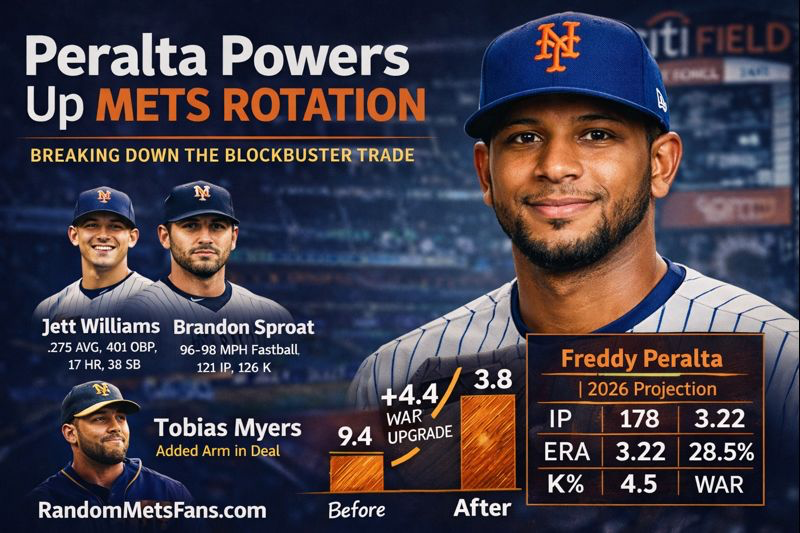
Another day, another big swing by the Mets’ front office. In what might be the most impactful move of their offseason surge, New York has acquired All-Star right-hander Freddy Peralta and swingman Tobias Myers from the Milwaukee Brewers in exchange for two top prospects, Jett Williams and Brandon Sproat. This trade is a calculated win-now maneuver for the Mets, who are clearly pushing their chips in for 2026. Let’s break it down analytically, what the Mets are getting, what they’re giving up, and what it means for 2026 and beyond.
🔥 The Headliner: Freddy Peralta Freddy Peralta delivers a pitch for Milwaukee.
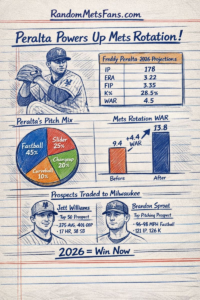
Freddy Peralta isn’t just a frontline starter — he’s a legitimate ace. The 29-year-old is coming off a career-best 2025 campaign in which he went 17–6 with a 2.70 ERA over 33 starts (176⅔ innings) and finished 5th in NL Cy Young voting. He fanned 204 batters (28.2% K-rate) against a 9% walk rate, while holding opponents to a measly .210 average. According to a FanGraphs/ZiPS composite projection, Peralta is expected to throw ~178 innings with a 3.2 ERA (around 3.35 FIP), a 28-29% strikeout rate, and roughly 4.5 WAR in 2026 – in other words, ace-level production. Acquiring him upgrades the Mets’ rotation overnight.
Pitch Arsenal: Peralta attacks hitters with a four-pitch mix that blends power and deception. His fastball sits 94–96 mph and plays up thanks to elite spin and a flat vertical approach angle, making it lethal up in the zone. He pairs it with a biting slider (used primarily against righties) and a fading changeup that neutralizes left-handed hitters. He’ll also mix in a slower curveball as an occasional show-me pitch. This arsenal generates a ton of whiffs, Peralta’s swinging-strike rate has hovered around 13% in recent years, placing him among MLB’s top bat-missers. And despite his fly-ball approach (which can lead to the occasional homer), he allows very few baserunners – hitters have managed only a .210/.288/.367 line against him over the last three seasons. Simply put, Peralta is a bat-missing machine with the metrics to back it up.
Durability? Check. Peralta has shed the “injury-prone” label by making 30+ starts in three straight seasons. In fact, he hasn’t required a single IL stint since 2022. Since 2023, he’s tied for 5th in MLB with 95 starts and ranks 15th in innings pitched (516). The strikeout totals are elite as well, only Dylan Cease and Zack Wheeler have tallied more Ks in that span, meaning Peralta is 3rd in all of baseball in strikeouts over the last three years. Consistency and availability have become hallmarks of his game. This guy’s not just flash — he’s proven he can carry the load of an ace.
🧠 The Stearns Connection: There’s an extra layer here: Mets president David Stearns knows Peralta intimately from his days in Milwaukee. Stearns was the Brewers GM who originally inked Peralta to a long-term extension back in 2020, a five-year, $15.5 million deal with two club options that has become one of baseball’s most team-friendly contracts. That foresight by Stearns locked in Peralta at well below market value, and now he’s reaping the rewards again. The Mets will owe Peralta just $8 million in 2026, the final year of that extension, an absolute bargain for a pitcher of his caliber. They potentially control a No. 1 starter for one more year at a sub-market rate. No wonder Stearns moved fast, he knew exactly what he was getting, both on the mound and on the payroll.
🎯 Tobias Myers: The Underrated Add-On
While Peralta justifiably grabs the headlines, Tobias Myers, 27, is a quietly useful addition to the Mets’ staff. Don’t write him off as a mere throw-in. Myers is a flexible swingman who can slot into the back of the rotation or serve as a long reliever – the kind of depth piece championship teams need when injuries inevitably strike.
Myers had a 3.55 ERA in 50⅔ MLB innings for Milwaukee last year (with similarly strong numbers in Triple-A). In 2024, as a rookie, he was even better – a 3.00 ERA over 138 innings, making 25 starts. This is a pitcher who has proven he can get big-league hitters out. He doesn’t light up the radar gun (his fastball averages ~93–94 mph), but he commands the zone well (career 6–7% walk rate) and generates a lot of soft contact. His arsenal is solid if unspectacular: a four-seam fastball, a cutter/slider combo, and a splitter-like changeup he introduced in 2025 that batters whiffed on nearly 40% of the time. That splitter gave lefties fits (.108 average against it) and helped cover what had been a platoon weakness. In short, Myers is a savvy pitcher – he gets downhill angle, mixes pitches, and competes.
For 2026, projections peg Myers for around 60 innings with an ERA in the low-4.00s (roughly league-average), which is perfectly fine for a swingman/SP6 role. Expect him to compete for the fifth starter spot in spring. At worst, he’ll be the first man up when the Mets need a spot start or some length out of the bullpen. Contending teams can never have too much pitching, and Myers provides inexpensive quality depth.
🧬 What the Mets Gave Up: Jett Williams and Brandon Sproat
Every big trade requires giving up talent, and the Mets paid a hefty but reasonable price here. Heading to Milwaukee are two of New York’s most prized prospects:
🧢 Jett Williams — The Sparkplug
Age: 22
Position: SS/2B/CF (Versatile Infielder/Outfielder)
MiLB 2025 Stats: ~.275/.400/.460, 17 HR, 38 SB (153 wRC+ in AA/AAA combined)
The Mets’ No. 1 prospect (and a consensus top-50 prospect in MLB) is a 5’6″ ball of talent and energy. Don’t be fooled by his smaller stature, Jett Williams can flat-out play. In 2025 he rocketed through Double-A and Triple-A, slashing around .270/.400/.460 with double-digit homers and steals. His elite plate discipline (he walked 16% of the time in the minors) and contact skills make him an ideal future leadoff hitter. Williams has a keen eye, he doesn’t expand the zone much, which led to a .401 OBP at Double-A and an overall .363 OBP across the two levels. He’s the type of hitter who can work counts, frustrate pitchers, and then burn them with surprising pop for his size.
Scouts also rave about his athleticism and speed. Williams swiped 34 bases in the minors last year (38 if you include the Arizona Fall League), and his footspeed is matched by excellent instincts. Defensively, he’s a Swiss Army knife, originally a shortstop, he has also seen time at second base and center field, and could probably handle any up-the-middle spot capably. That versatility, combined with his offensive profile, gives him multiple pathways to the majors. Think of a right-handed Brandon Nimmo with more speed and positional flexibility. In fact, David Stearns himself described Williams as a “gamer” with “incredible tools… one of the fastest players in the minor leagues”, and projected him as a top-of-the-lineup sparkplug for Milwaukee in the near future.
For the Brewers, Williams could be a franchise cornerstone in the making. He’ll likely start 2026 in Triple-A polishing up, but it wouldn’t be a surprise to see him in Milwaukee by mid-season. His blend of on-base skills, speed, and defensive versatility gives him a high floor with an exciting ceiling (some see 20 HR / 40 SB potential down the road). Losing him hurts the Mets’ farm, but you have to give up talent to get talent – and the Mets decided that trading an OBP/speed phenom was worth it to land an ace.
💪 Brandon Sproat — Power Arm with Upside
Age: 25
Position: RHP Starter
MiLB 2025 Stats: 121 IP (AAA), 4.24 ERA, 22.1% K, 10.4% BB
Brandon Sproat was the Mets’ top pitching prospect (a former 2nd-round pick out of Florida) and slots in as a top-10 prospect in Milwaukee’s system immediately. He’s a big 6’3” right-hander with a big arm. Sproat made his MLB debut last September, logging four starts for the Mets, and spent most of 2025 at Triple-A Syracuse. The results in AAA were uneven (4.24 ERA, with bouts of wildness), but scouts are tantalized by his raw stuff. He features a high-90s fastball that reportedly touched 100 mph, usually sitting in the 95–98 range in AAA. It’s a “riding” four-seamer with life, and he’s complemented it with a hard slider, plus a curveball and changeup that flash solid. In total, he’s got a five- or six-pitch mix and isn’t afraid to use all of it.
The key question with Sproat is command. He can overpower hitters, but at times he overthrows and loses the strike zone (his walk rate was around 10% in the minors last year). If the Brewers’ pitching development (one of the best in MLB) can help him harness his control, Sproat has mid-rotation upside – think a potential #3 starter who piles up strikeouts. He’s shown he can miss bats (career ~11 K/9 in minors) and has the arsenal depth to face lineups multiple times. If the command doesn’t come around, Sproat’s Plan B is moving to the bullpen, where his high-octane fastball/slider combo could play up in shorter stints (he could certainly hit 100+ mph in relief). Some evaluators have suggested he could be a late-inning weapon if starting doesn’t pan out.
Milwaukee will likely give Sproat a shot to compete for a rotation spot either out of camp or later in 2026. At 25, he’s more or less MLB-ready, needing just a bit more polish. It’s worth noting the Brewers have had success molding pitchers like this, and they coveted Sproat enough to insist he be part of the return. For the Mets, parting with a young power arm is tough, but again, that’s the cost of doing business for a win-now ace. Sproat’s future could range from solid mid-rotation starter to high-leverage reliever, depending on how that command progresses.
⚖️ Trade Summary: Who Wins?
This deal has the classic structure of an ace-for-prospects blockbuster, with a twist of an extra MLB arm changing hands. Here’s the breakdown:
| Team | Gains | Value/Direction |
|---|---|---|
| Mets | Freddy Peralta (All-Star SP1), Tobias Myers(SP5/Swingman) | Immediate upgrade to rotation ace; adds pitching depth for a postseason run. Win-now mode. |
| Brewers | Jett Williams (Top-50 prospect, SS/CF), Brandon Sproat (Top pitching prospect) | Infuses two young, high-upside talents into system; both near MLB-ready. Build for future while still aiming to compete. |
From the Mets’ perspective, this is clearly a win-now move. They’ve transformed their rotation by adding Peralta, and in doing so signaled that 2026 is not a step-back or transition year – it’s a year to contend. New York can now roll out a projected 2026 rotation of, say, Freddy Peralta, Kodai Senga, Nolan McLean , David Peterson, and a competition for the fifth spot between Myers, and others (plus young arms like Jonah Tong waiting in the wings). That staff suddenly looks playoff-caliber on paper. Before this trade, the Mets’ rotation was talented but volatile; with Peralta at the top, it now has a legitimate ace to anchor it.

For the Brewers, the trade is painful in the short term – dealing away your homegrown #1 starter is never easy – but it fits their recent pattern and long-term strategy. Milwaukee was unlikely to afford an extension for Peralta (who hits free agency after 2026), and their modus operandi has been to flip impending free agents for prospect packages rather than let them walk. This is now the third straight offseason they’ve traded a star in his walk year (following Corbin Burnes and Devin Williams previously). In Williams and Sproat, the Brewers acquire two MLB Pipeline Top-5 prospects from the Mets’ system (Williams was #3 and Sproat #5 per Pipeline), both of whom could contribute as soon as this season. Milwaukee’s competitive window stays open, they won 97 games in 2025 and still have a strong core, and now they’ve reloaded with young talent to sustain success beyond 2026. In a couple of years, we might look back and see this as a win for both sides: the Mets get their ace, and the Brewers get cheaper years of two potential impact players.
By the numbers, the Mets’ pitching WAR projection leaps significantly. Before the trade, New York’s rotation was projected around ~9.4 WAR; inserting Peralta’s ~4.5 WAR elevates that to roughly ~13.8 WAR – a huge boost that vaults the Mets’ staff into the NL’s top tier. The marginal wins gained here could be the difference in a tight NL East race or securing a Wild Card. In a league where every win matters, paying the prospect price for an ace in his prime makes a lot of sense for a team in the Mets’ position.
🗣️ What the Analysts Are Saying
The baseball media had plenty of reactions to this blockbuster:
“Peralta might be the best starter moved this offseason. The Mets didn’t flinch.” – Jeff Passan, ESPN
“Williams is going to be a damn good player, but you have to give talent to get an ace.” – Joel Sherman, NY Post
“Peralta’s deal is so team-friendly, you can justify this even if Williams becomes a star.” – Will Sammon, The Athletic
On social media, Mets fans are ecstatic, celebrating the arrival of a new ace and the front office’s aggressive approach. There’s a sense that after a disappointing 2025, the team is finally back in “win now” mode, and Peralta’s addition has reinvigorated hopes for 2026. Brewers fans, meanwhile, have mixed feelings. Many are understandably frustrated to see a popular, homegrown star shipped out (especially coming off a near-World Series run last year). But there’s also an acknowledgment that the return is significant, Williams and Sproat bring real excitement for the future. It’s a bittersweet moment in Milwaukee: the present takes a hit, but the future gets a little brighter. As one Brewers fan quipped, “It hurts now, but two or three years from now we might be glad we made this move.”
💰 Contract Impact
One major subplot of this trade is the financial angle, which actually favors the Mets:
- Freddy Peralta: Owed $8 million in 2026, the final season of that ultra-team-friendly extension Stearns gave him in Milwaukee. There are no further options after 2026 – he’ll be a free agent next winter, but $8M for an ace in 2026 is an incredible value (for context, mid-tier starters are signing for double or triple that annual amount). New York will likely explore an extension, but even if they only have Peralta for one year, the cost is modest. His luxury-tax hit is around $8.8M, barely a blip for a team with a projected $350M+ payroll.
- Tobias Myers: Will make around the league minimum in 2026 and isn’t arbitration-eligible until 2028. He’s under team control through 2030, so the Mets have a cost-controlled arm for several years. Essentially, they swapped six years of Myers for six years of Sproat (who is similarly cost-controlled) in the deal.
- Jett Williams & Brandon Sproat: Both are pre-arbitration prospects, making peanuts for now. Milwaukee will get their prime years at bargain rates if they develop as hoped. Williams won’t even be arb-eligible until ~2029. The Brewers, of course, also shed Peralta’s $8M 2026 salary, but that wasn’t a significant factor (he was affordable even for a small-market club).
Big picture: This trade barely moves the needle on the Mets’ payroll. Peralta’s $8M fits easily under the Cohen budget that’s already north of $320M in commitments (the Mets’ CBT payroll is projected around $360M after this move). In fact, adding Peralta on such a bargain contract arguably makes the payroll more efficient, they’re getting ace production for mid-rotation dollars. There’s no financial strain here, which is likely part of why the Mets felt comfortable trading prospects instead of trying to buy an ace in free agency.
🧵 Final Take

This trade is a bold bet by the Mets, a calculated, analytics-driven, and aggressive wager that Freddy Peralta is the real deal. They’re betting that Peralta will continue to be a swing-and-miss horse at the front of the rotation, that he’ll be the guy taking the ball in Game 1 of a playoff series at Citi Field. They’re signaling that 2026 is not a year to retrench or rebuild, but a year to go all-in for a championship run.
For the Brewers, it’s a pragmatic (if painful) move: a conscious decision to sell high on Peralta before his contract runs out, replenishing the talent pipeline in the process. Milwaukee fans might hate losing an ace now, but Jett Williams could be a lineup sparkplug for years to come, and Brandon Sproat could be anchoring their rotation by 2027. In a sense, the Brewers are threading the needle, trying to remain competitive (they still have a strong team for 2026) and stockpiling young talent to extend their window.
Time will tell who “wins” this trade. If Peralta leads the Mets deep into October in 2026, nobody in Queens will lament the prospects that got away. If Williams blossoms into a star in Milwaukee, Brewers fans will forever link him to the deal. But right now, one thing is clear: the Mets are playing for keeps. They identified a frontline starter and they paid the price to get him. Freddy Peralta just put a flamethrower at the front of New York’s rotation, and the Mets’ ambitions in 2026 just got a whole lot hotter.
Sources: New York Mets & Milwaukee Brewers official announcements; MLB Trade Rumors and MLB.com analysis; ESPN News Services.
Join the conversation at RandomMetsFans.com
Subscribe to the newsletter
Let’s build the smartest Mets community on the internet
Mets Fans Will Love These Too:
 Mets’ Strategy: Trading for Young Pitchers Like MacKenzie Gore
 “Trade-First Rotation Plan” Means Someone You Like Is Getting Moved
 The Citi Field Blueprint: The Kind of Team That Wins Here
 The Tucker Gut Punch Was the Point: The Mets Can’t Win This Game by Playing It
 Mets Prospect Report : Jacob Reimer Is the Mets’ Next Corner-Bat Problem