Jett Williams Is the Prospect Who’s Going to Make Half the Fanbase Say “Trade Him” Right Before He Turns Into a Problem
Every Mets rebuild argument eventually turns into a loud, lazy chant about “getting younger,” then the second a real young player shows up with an approach that does not look like batting practice, the same crowd starts sweating the first cold streak like it’s a moral failure, which is exactly why Jett Williams is the most important kind of prospect to have in this organization right now. He is not the clean, obvious, six-foot-four thunderstick that makes casual fans feel safe, he is the smaller, faster, smarter type who wins by making pitchers throw extra pitches, by taking bases you thought were not there, and by turning the strike zone into a negotiation that the pitcher keeps losing in public.
The snapshot that matters, production plus the “how”
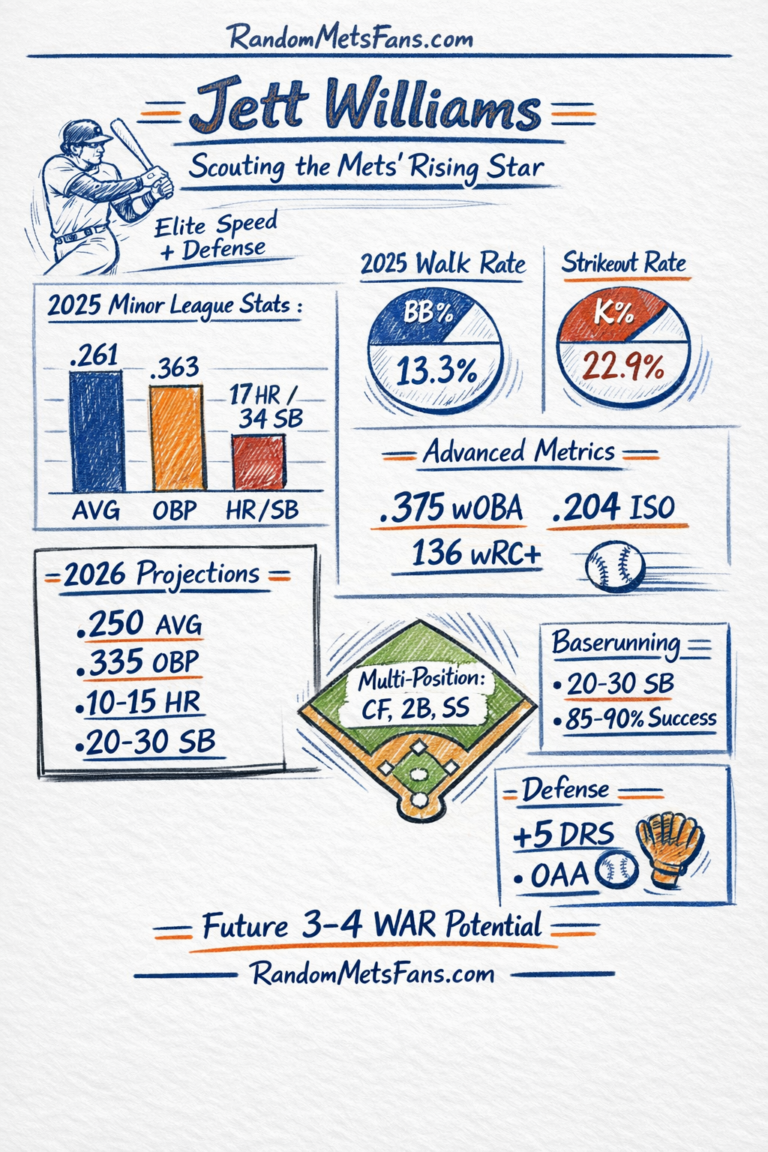
Williams’ 2025 season gave you the complete outline of why the Mets treat him like a near-term big leaguer, since he stacked 130 games across Double-A and Triple-A with 17 homers, 34 steals, a .261 average, a .363 on-base percentage, and a .828 OPS, which is the kind of blended line that screams “impact” even before the advanced numbers start doing the heavy lifting. He scored 91 runs while driving in 52, he took extra bases without needing perfect contact, and he kept the on-base engine running even as the ladder got steeper.
The advanced profile is the part that turns this into something more than a box-score crush, since FanGraphs credits him in 2025 with a 13.3% walk rate against a 22.9% strikeout rate, a .204 ISO, a .375 wOBA, and a 136 wRC+ across his full minor league slate, which is a pretty blunt statement that he produced well above league context while still playing a style that tends to age well. Plate discipline like that gives you a floor, power like that gives you a ceiling, and speed like that gives you a second path to value on nights when the bat is not perfect.
Double-A showed the “real” version, Triple-A showed the stress test
The most honest way to read Williams’ 2025 is to separate the performance by level and then ask what changes were signal versus noise. Double-A Binghamton was the loud version, since he produced a 156 wRC+ with a .281 average, a .390 OBP, a .477 slugging percentage, a .396 wOBA, and a 14.7% walk rate, plus 32 steals against seven times caught, which is the kind of well-rounded line that forces a front office to start planning around him instead of merely ranking him.
Triple-A Syracuse was the reality check, since the numbers tightened up and the margins got smaller, which is exactly what should happen when the pitching gets more surgical and the book on you gets thicker. In 34 games at that level, he posted an 81 wRC+ with a .209 average and a .285 OBP, while still popping seven homers, which tells a very specific story where the power traveled and the on-base skill got stressed, largely in a small sample that included a brutal BABIP dip to .223. The walk rate at Triple-A slid to 9.3% while the strikeout rate sat around the same neighborhood at 23.2%, which reads less like “he forgot how to hit” and more like “he faced older arms who challenged him differently, and he did not get the same bounces while he figured it out.”
A small sample is still a small sample, yet the shape is useful, since Williams stayed dangerous even while scuffling, which is an underrated trait for a young hitter. Plenty of prospects slump and become passive, or start expanding the zone to chase a highlight, whereas Williams still ran into seven home runs in that short Triple-A window, which is a signal that the bat speed and the impact are not delicate.
The foundation is older than 2025, it started with the on-base obsession
Williams has been screaming “top-of-the-order pain in the neck” since the moment he entered full-season ball, and the best proof is still the 2023 season where he lived on base and ran wild. Baseball Savant’s prospect write-up notes a .425 OBP, a .876 OPS, eight triples, 81 runs, 45 steals, and 104 walks in 2023, with those walks finishing second among all minor leaguers, which is not a cute trivia stat, it is a personality trait that shows up in every stop. Pitchers do not hand you 104 walks by accident, and umpires do not give you free bases out of sympathy, so that kind of number tends to show you who a player is before the slash line even finishes developing.
The 2024 season is the missing chapter that explains why 2025 felt like a relaunch, since he played only 33 minor league games that year, bouncing between levels in short bursts, which is the kind of year that interrupts rhythm, steals reps, and forces a prospect to spend more time getting healthy than getting better. The transaction history shows a long injured list stretch in 2024 that derailed the normal development cadence, which matters when people try to treat every cold streak as a permanent verdict rather than part of a longer arc.
Power, speed, and the kind of approach that plays in October

Williams’ power is not theoretical anymore, since 17 homers in 2025 paired with a .204 ISO across the full minor league sample gives you real impact, not just gap-to-gap optimism. That power also shows a “modern” shape, since the ISO at Triple-A actually popped higher than Double-A in the small sample, which suggests the impact plays even when the average and OBP wobble, and that is a useful trait for a player who is going to see nasty sequencing at the highest level.
The speed is not decorative, since the stolen base totals have been consistent and meaningful, and his 2025 line shows 34 steals with nine caught, plus a Double-A segment of 32 steals with seven caught, which is valuable pressure in an era where small edges matter again. Speed also ages into versatility, since it gives the Mets options in how they deploy him, how they build lineups around him, and how they manufacture runs when the offense gets tight against elite pitching.
The real separator, though, is still the strike-zone behavior, since a player who can carry a double-digit walk rate while adding power and steals is basically forcing pitchers to choose how they want to lose. Pitchers who nibble give him base runners and chaos, pitchers who challenge him give him mistakes he can lift, and pitchers who try to get cute with spin eventually have to land it in the zone or fall behind, which is where his swing decisions become an advantage rather than a style choice.
Defensive value and the Mets’ chessboard problem

Williams is listed as a multi-position defender, and the Mets have used him across the dirt and into the outfield mix, which is not just about athleticism, it is about creating enough pathways to the lineup that the bat does not get blocked by roster politics. The Mets’ own prospect listings now show him at Triple-A with a 2026 timeline, which is the kind of organizational placement that typically precedes a real look when the first injury hits or when the lineup needs a different shape.
This is the part where the debate gets spicy, since fans want a single clean position and a single clean ETA, while real teams want optionality. Williams’ best value at the major league level might come from being movable, sliding between middle infield, the outfield, and the top of the order depending on what the roster needs that week, and that flexibility is exactly how good organizations squeeze extra wins out of a 26-man roster without spending another $100 million.
What has to happen next, and what the Mets should actually be watching
Williams does not need to “prove he can hit,” since the track record already says he can, and the 2025 Double-A line makes the case that he can dominate a level with both patience and impact. The next development step is about solving the Triple-A attack plan, tightening swing decisions against older arms who can land secondary pitches for strikes, and bringing the walk rate back toward his normal territory, since that is the engine that makes everything else feel inevitable.
The encouraging part is that his 2025 Triple-A slump did not erase the power, and the BABIP crater in that small sample suggests a chunk of it was variance rather than a total inability to square the ball. A player who keeps hitting the ball hard enough to run into homers while the rest looks ugly often ends up being fine once timing, approach, and batted-ball luck normalize, and the Mets have every reason to bet on that outcome given how stable his on-base identity has been for multiple seasons.
Jett Williams is the kind of prospect who forces a decision, since his skill set is loud in the ways that matter and annoying in the ways opponents hate, and that combination tends to play in meaningful games when the pitching gets elite and the margins get tight. The Mets can keep buying solutions, or they can let a homegrown on-base menace run the show near the top of the lineup, and that second option is the one that looks a lot smarter when October turns into a grind.