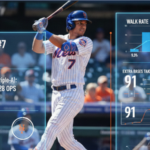
The Edward Cabrera smoke isn’t the story. The story is the Mets finally admitting they’ve been hoarding infielders like they’re collectibles, not assets.
The only way this rumor becomes real is if David Stearns does the thing every front office says they’ll do, and almost none actually do when feelings get involved: trade the blocked bat for the controllable arm. If you’re looking for the cleanest “blocked bat” on this roster right now, start with Mark Vientos.
Why Cabrera is even on the table
Cabrera is the kind of pitcher teams trade for when they want upside without paying ace money.
Here’s the snapshot:
- 2025: 3.53 ERA, 137.2 IP, 150 K
- Underlying line MLB evaluators actually care about: 3.83 FIP, 97.0 mph average fastball, 25.8% K-rate, 8.3% walk rate (career best)
- Control window: under team control through 2028
- Cost: projected $3.7M in 2026 arbitration
That last part matters. A young starter with real stuff, three more years of control, and a low arb number is the exact kind of pitcher you can build around without turning your payroll into a horror movie.
Why this is secretly a Mets infield decision
The Mets have spent the offseason reshaping the roster like a guy rearranging furniture because he doesn’t want to deal with the leak in the ceiling.
They traded for Marcus Semien. They signed Jorge Polanco to a two-year deal. Francisco Lindor isn’t moving. That’s already three infield anchors before you even get to the younger guys.
Now zoom out:
- Ronny Mauricio still exists and needs a lane.
- Luisangel Acuña is in the “needs MLB reps soon” bucket.
- Brett Baty is still in the mix.
- And Vientos is sitting there as the most obvious “power bat with no clean defensive home.”
So if you’re Miami, and you’re listening on Cabrera, you’re not asking for vibes, You’re asking for something controllable that helps your lineup.
tHat’s where Vientos walks into the conversation whether Mets fans like it or not.
The honest Mark Vientos profile (numbers, not opinions)

Vientos in 2025 was the definition of “I like the player, but I get the problem.”
The surface line:
- 121 games
- .233/.289/.413
- 17 HR, 61 RBI
- .702 OPS
Now the part that makes teams still want him:
- He hits the ball hard. 91.4 mph average exit velocity
- He hits it hard a lot. 50.5% hard-hit rate
- He hits it in ways that turn into real damage. 11.5% barrel rate
- His expected production was better than what he got credit for: xwOBA .317 vs wOBA .303 (translation: some bad outcomes on well-hit balls)
So why would the Mets move him? the other side of the profile is a roster headache:
- Plate discipline isn’t a carrying tool: 6.5% walk rate, 24.8% strikeout rate
- defensively, it’s not subtle. At 3B in 2025, Vientos graded -6 Outs Above Average.
That’s not “needs reps.” That’s “this guy is really a bat-first corner/DH who you can hide sometimes, not build a defense around.”
the Mets just spent the offseason telling you they want more stability. Defense, leverage relief, fewer free outs. Vientos doesn’t fit that direction unless he’s mashing like a middle-of-the-order monster.
Why Miami would want Vientos in the first place
If you’re the Marlins, the pitch is simple:
You’re trading a pitcher who is:
- talented
- controllable
- valuable
So you need to get back at least one MLB-ready piece who can grow with your timeline.
Vientos gives them:
- a controllable power bat
- a corner profile that can live at 1B/DH
- immediate lineup help without paying market price
if Miami believes their coaching can tweak approach or pitch selection against him (or just accept him as a 20–30 HR bat), he becomes a clean “plug-and-play” return.
What the Mets gain (the part fans pretend doesn’t matter until July)
The Mets rotation hasn’t gotten the same attention as the bullpen and position group. That’s not an opinion, it’s literally how the winter has gone.
Adding Cabrera does three things immediately:
- Raises the ceiling: you’re getting a 97 mph starter who just put up a breakout season.
- Controls the cost: $3.7M-ish in arb is a bargain for a mid-rotation starter with upside.
- Buys you time: controlled through 2028 means you’re not forced into another panic buy next winter.
This is how contenders operate. They trade from surplus into scarcity. The Mets have surplus in young infield bats to help starting pitching which is scarce.
The “Vientos is the excuse” angle, stated plainly
Edward Cabrera is attractive, sure. The bigger story is this: the Mets have been avoiding the adult decision on Vientos. Is he a core piece you build around… or is he a valuable asset you flip before the roster squeezes his value?
With Semien and Polanco in the picture, the Mets can’t keep doing the “everyone gets a chance” thing without the whole roster turning into a traffic jam.
This rumor is Stearns acknowledging the surplus is real, and once you say that out loud, somebody’s going.
The risk (because Cabrera isn’t a free lunch)
Cabrera comes with legitimate concerns:
- 2025 was his first time clearing 100 innings in the majors
- Shoulder issues limited him in 2023 and 2024
- He hit the IL twice in 2025, including a right elbow sprain in September
So yes, you’re buying upside, but you’re also buying medical history. That’s the deal.
The reason you do it anyway is because upside + control + cost like this almost never hits the market without a “but…”
Why this matters for Mets fans
This is the fork in the road.
Option A: keep the blocked bats, shuffle roles, hope everyone stays happy, and pray the rotation holds.
Option B: cash in one of the “pretty good” bats for a controllable starter who can actually change the season.
If the Mets are serious about 2026 being a real push, they don’t need more “interesting” position players. They need innings and strikeouts they can count on.
Cabrera is that bet and Vientos is the chip that makes it possible.
Join the conversation at RandomMetsFans.com
Subscribe to the newsletter
Let’s build the smartest Mets community on the internet