Mets fans spent the offseason obsessing over Pete Alonso’s future and lamenting Edwin Díaz’s departure. But here’s the thing: the 2026 Mets will live or die by one ugly number, 796. That’s how many innings New York got from its starting pitchers in 2025. It ranked 27th in MLB. For comparison, the year before they got 892.2 innings from starters (5th in MLB). In one season, the Mets’ rotation went from workhorse to worse than almost everybody, and it showed in the standings.
Why 796 Innings Matters
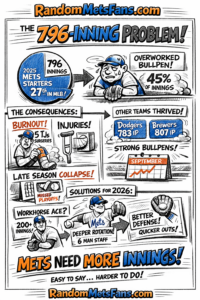
When starters don’t eat innings, your bullpen starves or rather, it gets overstuffed. Fewer starter innings means more work for relievers, more often, in tougher spots. The Mets learned this the hard way. Their bullpen had to cover roughly 45% of the team’s innings in 2025, one of the highest workloads in baseball. Early on, the relievers were lights-out (Mets’ bullpen ERA was a solid 3.93 for the year, mid-pack overall). By summer the fatigue set in. They ran out of gas, and the cracks became craters:
- Overexposure: Manager Carlos Mendoza was forced to use the same arms night after night. Former Met Adam Ottavino blasted Mendoza for having “no idea what he’s doing when it comes to bullpen guys … or even how to care about them at all”. It was harsh, but you get the frustration. At one point, the starters were going five, three, two, even one inning in consecutive games. What’s a manager supposed to do when every game becomes a relay race at the 4th inning?
- Leverage Inflation: Short outings meant relievers entering in higher-leverage situations earlier. The bullpen’s best arms had to handle the 5th, 6th, and 7th regularly, not just the 8th or 9th. That constant stress takes a toll. By late summer, the Mets’ relief corps was fried. Even with a decent season ERA, their performance plummeted in the second half (the pen was brilliant through May, then struggled from June on). Essentially, the credit card bill came due on all those early innings.
- Injury Risk: Perhaps the most violent cost, arms blew out. Four Mets relievers (Reed Garrett, Danny Young, Max Kranick, and Dedniel Núñez) required season-ending surgeries as the pen was worked to death. By year’s end, a whopping five Mets pitchers, including starter Tylor Megill, had undergone Tommy John surgery in 2025. That’s not a coincidence. Fatigue makes injuries more likely, and the Mets’ medical report was basically a list of overused bullpen arms.
- September Burnout: Come the home stretch, the tank was empty. In September, the Mets bullpen was a shell of itself, velocity down, command gone. Games that might have been winnable slipped away because the relievers simply had nothing left. New York finished 83-79 and missed the playoffs by a hair, after leading the division early in the year. The early-season overuse directly fed into late-season collapse.
Not All Low-Inning Rotations Are Equal
Now, 796 innings from starters is bad, but you might ask: Didn’t the Dodgers and Brewers also have short rotations? Yes, and they still thrived. Milwaukee’s starters threw only 807.1 innings (26th in MLB) and the Dodgers just 783.1 (28th), yet both made the NLCS. How? In short, they managed the downstream effects better. The Dodgers embraced the bullpen game as a strategy, they had depth and spread the workload across many arms. Milwaukee’s bullpen was deep and dominant, so they survived the strain. In other words, those teams defused the time bomb that a 780-800 inning rotation sets off. The Mets didn’t.
Consider a few extremes from 2025:
The lesson is that skimping on starter innings is a risky way to live. If you’re going to do it, you need extraordinary bullpen contingency plans. The Dodgers had one. The Mets… not so much. Mets relievers were “definitely overworked and misused thanks to the rotation’s inability to perform and go deep”. No amount of late-inning magic from Díaz (who was great before leaving) could save a bullpen that was running on fumes by Labor Day.
Solving the Inning Deficit

So, how do the Mets fix this 796-inning problem in 2026? Get more innings from the rotation. Duh, right? But it’s easier said than done. As it stands, New York’s projected rotation is full of question marks. Three rookies (Nolan McLean, Jonah Tong, Brandon Sproat) might crack the starting five, and all will be on innings limits. You can’t ask a 22-year-old to suddenly throw 180+ innings; that’s how elbows explode. The returning starters (Kodai Senga, Sean Manaea, etc.) will need to go deeper into games to pick up the slack. Senga was brilliant before he got hurt (1.47 ERA), but the Mets babied him in 2024 and he still got hurt in 2025. They might have to push him a bit further per outing, and hope his body holds up.
Really, the straightforward solution is to acquire a workhorse. New York has been linked to names like Framber Valdez, exactly the kind of arm who can shoulder 200 innings. Another rumor: trade for Tarik Skubal. Skubal logged 195.1 innings with a 2.21 ERA in 2025, emerging as one of baseball’s most reliable young aces. As former Met Ron Darling noted, the Mets lacked “a dependable pitcher who could pitch deep into games” to ease the bullpen’s burden. Valdez or Skubal would give them that missing piece, a guy who goes 7 innings every fifth day and saves the pen a few hundred pitches a month.
Even beyond an ace, the Mets need to rethink their approach. David Stearns is rebuilding the bullpen this winter, and he’s aiming for more swing-and-miss to compensate for tired arms. But the best bullpen fix is not needing to use it so much. In 2024, the Mets actually managed to pace their starters early (just ~5 IP per start in April) then ramp them up late. In 2025, injuries wrecked that plan and there was no safety net. For 2026, they might employ a modified six-man rotation or strategically use spot starters to give extra rest. The goal isn’t to coddle the starters, it’s to enable them to go longer into games when they do pitch. An extra day off here and there could mean an extra inning or two in each start.
And let’s not forget: the defense and lineup play a role. Quicker innings come from good defense (fewer errors, fewer extra pitches) and from run support (a 5-1 lead lets a pitcher relax and pound the zone). Stearns has hinted that improving team defense is part of protecting the pitchers. It all connects back to that one boring stat. Starter innings aren’t sexy, but they’re the foundation everything else rests on.
The Bottom Line
You can argue about Alonso’s contract or replacing Díaz in the ninth, but none of it will matter if the Mets can’t fix their starter inning shortage. 796 innings won’t cut it, not without the bullpen spontaneously growing four extra arms. Sure, there’s an element of violence to asking pitchers to do more (injuries happen, we know). But the status quo is itself a slow bleed. The Mets tried the heavy-bullpen strategy and it blew up in their faces. As we look to 2026, one number will tell the story by summer: how many innings are the Mets starters logging per week? If it’s consistently five-and-change per game, that’s progress. If it’s four and out, we’re headed for a repeat of the meltdown.
In the end, 796 is the grenade ESPN left on the table, and the Mets have to defuse it. Add an innings-eater, push the guys you have a bit further, and protect them so they can give you length. Do that, and maybe come next October we’ll be talking about a playoff run. Fail, and all the Polar Bear home runs in the world won’t save 2026 from the same fate as 2025. The stat may be boring, but it’s brutally clear: if the Mets want to contend, they need a lot more boring, valuable innings from their starters. Everything else is noise.
Sources: Starter and bullpen statistics from 2024–2025 via ESPN and StatMuse; injury and management quotes from and EssentiallySports; comparative team innings data via StatMuse; analysis inspired by Mets insiders and team reports.
Join the conversation at RandomMetsFans.com
Subscribe to the newsletter
Let’s build the smartest Mets community on the internet