

Being a Mets fan is not just a hobby, it’s a way of life. As one long-suffering fan put it, “being a Mets fan isn’t just a hobby. It’s a lifestyle, a spiritual journey, a personality trait, and a slow-burn emotional endurance test that builds character”. Expect side effects like irrational optimism, emotional whiplash, and familiarity with the phrase “we’ll get ’em next year” (spoiler: next year never comes). The good news is you can be a kick-ass Mets fan without losing your mind, without turning every loss into a personal crisis, and without spending your life arguing on Twitter. This evergreen playbook covers the mindset, knowledge, habits, and humor that will keep you loud, proud, and (mostly) sane, even when the baseball gods are roasting you for sport.
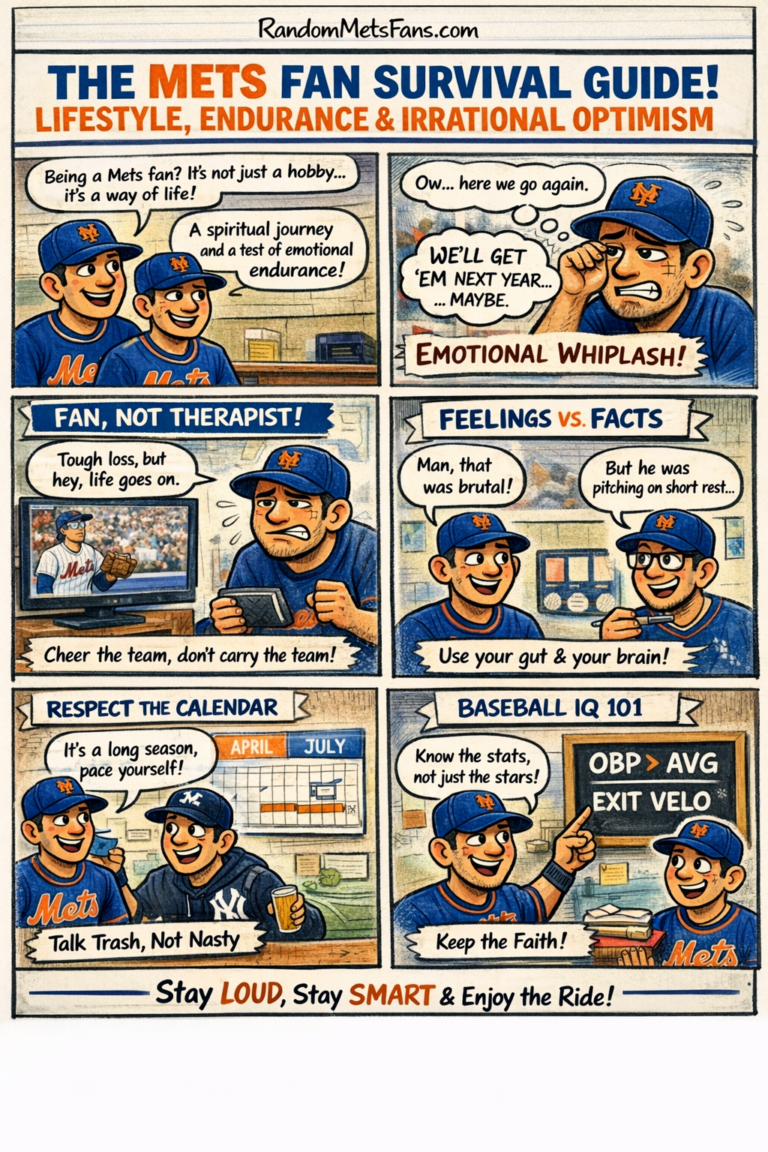
- Fan, not therapist: Remember, your job is to cheer for the team, ,not carry the team on your shoulders. You’re the fan, not the coach or GM. You get to enjoy the ride, vent a little, throw shade in jest, and then move on with your life. A true fan can feel the sting of a loss and still pay their bills the next day. Watch as sports psychologists find that watching games can boost your well-being, but don’t let every blown save ruin your day.
- Two-speed fandom (feelings vs. facts): Great fans have a gut and a brain. You can feel the pain, “That was brutal” and simultaneously understand the reality: “Well, he was pitching on 65 pitches in the 9th.” You celebrate every walk-off like it’s dessert, but you also know which player stats really matter. Panic sells, but knowledge saves you from believing every rumor.
- Respect the calendar: Baseball is a marathon. Don’t crown or bury the Mets in April. The season has phases. Early April is all noise (and hopefully hot dogs). By June, trends start forming. July (trade deadline) usually shows if the team is serious or just partying. August and September are when depth and injuries truly bite. And by October, it’s win or go home, no more excuses. React to games with context (fans who meltdown in April often look silly by July).
Sharpen Your Baseball IQ and Sanity
You don’t need a PhD in sabermetrics to be credible, just enough baseball smarts to sound dangerous (like calling in to WFAN with a flip phone would).
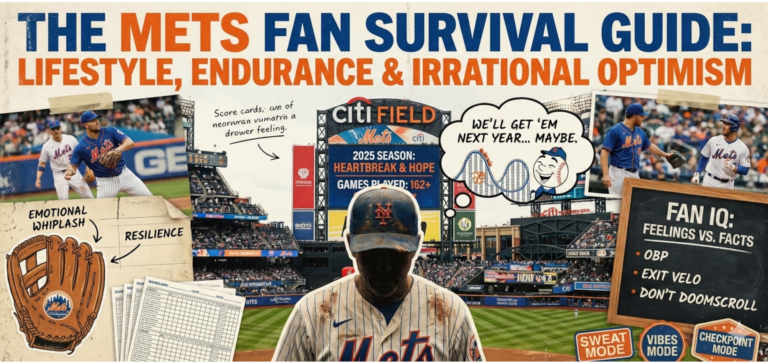
- Learn enough baseball to sound dangerous. Know the roster beyond the headlines, the role-players, the platoon subs, the bullpen arms named ‘Luis’ not just the stars. Understand basic stats. For hitters, batting average is old-school; focus on on-base percentage and power (slugging). Fangraphs reminds us OBP is a much better indicator of offensive value than batting average, since it counts walks and hit-by-pitches. For example, a .270 batter who never walks is often worse than a .240 guy who gets on base at .350. For pitchers, wins are an even more outdated stat. Wins depend on run support and bullpen, not just the pitcher’s skill. In fact, one analysis shows a starter might only influence ~3 of the 10 “slices” of a game, yet gets credit for all of them with a win. Instead, watch strikeout and walk rates, plus how often hitters square them up. The official statcast definition of “exit velocity” tells us that limiting hard contact (low exit velo against) is a sign of a good pitcher. In short: stop judging guys by vintage stats. Think OBP+SLG for hitters (or OPS/OPS+), and for pitchers look at strikeout%, walk%, and “hard-hit rate” (hard contact given up).
- Don’t let the internet algorithm run your emotions. Social media is a furnace of outrage. If your Mets feed is filled with doom-scrolling and hot takes, you’re handing over your sanity to strangers. Mute the rage-bait accounts. Treat rumors and trade chatter like tabloid gossip: half leverage, half nonsense. Always try to watch a game or highlight before declaring “this team is garbage.” Remember: being loud online is easy; being right is harder. Consume highlights, actual games, and just periodically glance at social media. A chuckle at memes is fine, but don’t let doom posters hijack your feelings. Studies even show that watching sports (in real life or on TV) can improve your mood and sense of well-being, so use social media as a dessert, not the main course, in your fandom diet.
- Love the prospects… responsibly. Prospect season is fun, everyone dreams a bit when you see a high draft pick. But healthy skepticism is key. Remember: development isn’t linear. Minor leaguers look great in Spring Training highlights because A) it’s cherry-picked footage and B) young players often suffer big leaps and valleys. When a prospect strikes out on three pitches in his debut, it’s not the apocalypse, it’s just baseball. Teams don’t “play the kids for charity” if someone’s up, the club believes he can help. So celebrate lower-level standouts, but don’t treat 22-year-old Single-A players like saviors. Otherwise you’ll end up screaming “Trade Alonso for this kid!” by midsummer. (Spoiler: no team trades their best all-star for an unknown.)
Game-Day Rituals and Routines
Baseball is a ritual-driven sport. Create habits that make each series and each win feel like a story, not a slog.
- Pick your mode. Not every game needs “at bat, nerve-wracking” intensity. Know your game-day mode:
- Sweat Mode. Phone down, every pitch viewed like a scar in the Matrix, heart in your throat, full fan mode. (Use sparingly: reserve this for playoff clinchers, Subway Series deciders, or the last game of the season if it matters.)
- Vibes Mode. Background playing, you’re grilling hot dogs, beers in hand, hanging with friends or family. You’ll curse the TV on big plays, but overall it’s party time. (This is perfect for Monday night games after work or silly March/April games.)
- Checkpoint Mode. Casual check-ins every few innings. You see the score updates and highlights periodically, but you live your life in between. (Great for Tuesday-thursday games or if you’re doing homework or chores.)
The trick is choosing a mode based on your own mood and schedule. Don’t force Sweat Mode every single day or you’ll scream at your TV like a pensioner who’s owed money. And if the Mets start early-afternoon on a workday, don’t feel guilty pausing; life is longer than any game.
- Build fun rituals. Every fanbase has tics, and Mets fans have to lean into theirs like survival skills. Find 1-2 goofy rituals that make games special:
- Pick one lucky jersey or hat (and then never wash it, you wild child). The study of fan psychology notes that these superstitions, from clothes to pregame meals, give us a sense of control over unpredictable games. Yes, you know rationally your underwear doesn’t really affect the score, but believing it helps manage the tension.
- Have one “Mets meal” that you only eat for game days (doesn’t matter what, as long as it’s sacred).
- Text one friend after every absurd moment (“Did you see that??”).
- Do a post-game “reset” (a walk around the block, a shower, a power ballad on the stereo) to clear your head after a loss.
Rituals serve a psychological purpose: sports fans use them to feel involved in a situation they can’t control. They turn 162 games into a series of mini-adventures instead of one endless grind.
- Show up, even when it’s a drag. The ultimate badge of fandom is consistency. Great fans don’t just cheer when the team’s loaded with stars and the skies are sunny. They’ll watch 7pm rainouts on TV, they’ll keep a beach chair on a freezing April night, they’ll yell at the radio in traffic if they miss the live stream. Even after ugly losses, tune in to see how the game ends. If you live near Citi Field, go to a Tuesday night game in June just because. On road trips? Travel to see your boys if you can. If not, buy merch, watch highlights, bring in new fans, and teach your kids (“Yes, this team will break your heart, and here’s how to laugh about it”). Loyal fanbases are more than just a meme online, they’re communities, and showing up (even tangentially) keeps the community alive.
Trash Talk with Class & Set Standards
Being a Mets fan should be fun. Roasting rivals and celebrating other teams’ absurdities is part of the game. Just keep it clever, not cruel.

- Talk trash, but keep it classy. It’s a multiverse of sports Twitter, have fun with it! Clap back at Yankees fans, laugh at Phillies fails, meme on Toronto losses. Use wit and sarcasm. For example: “Root for the Mets: where the playoffs are pipedreams and the only consistent statistic is heartache.” But keep it ad hominem–free: never insult players’ families or other innocents just living life. A good Mets joke is witty, not a troll invitation. Our target is the team’s performance, not feeding trolls.
- Demand accountability – but avoid toxic cynicism. We all want a championship. It’s fine (and normal) to criticize bad moves: “This bullpen construction is ridiculous” or “Why is our cleanup hitter batting .220?” Those are valid complaints. But don’t spiral into “This franchise is cursed, burn it all down!” territory. One is holding the team to standards, the other is just misery. The difference is voice tone: “This was a garbage contract” versus “I hate everyone in Queens.” The former is fan accountability; the latter is a cry for help. Keep standards high, sure, but pair them with faith that the team can improve. Otherwise you’re just venting, which is okay in moderation, but don’t make your life all about complaining. Enjoy the team even when you have a wish list for them.
- Remember: It’s bigger than one season. Great fans are rooted in history. The Mets have decades of stories ’69 magic, that 1986 win (and the flip), Piazza’s tears after 9/11 (still iconic), the ‘15 playoff run, the deGrom era. Those memories make every new game feel weighty. Be the fan who remembers other years as context, not just this one. Yes, 2025 had its heartbreaks (the Mets were 0–70 when trailing after the 8th inning, the only team to do that all year!), but we also made history (Juan Soto went 30–30 in homers and steals, Alonso broke a franchise home run record). When fans get obsessed with one year, they forget the resilience built over time. Carry the knowledge of 20 seasons with you, and you’ll never lose perspective. Your fandom is about being part of a generational saga, it transcends wins and losses.
Join the conversation at RandomMetsFans.com
Subscribe to the newsletter
Let’s build the smartest Mets community on the internet
Mets Fans Will Love These Too:
 Mets Fan Therapy : 12-Step Program
 The Citi Field Blueprint: The Kind of Team That Wins Here
 Mets Top 25 Prospects for 2026, Post-Trade Reset (Yes, It’s a Different System Now)
 The Mets Bullpen Build Is Sneaky Good, Which Is Exactly Why Nobody Trusts It Yet
 The Mets Team From My Childhood That Would Ruin Baseball